
Your phone system usually becomes a boardroom topic only when it starts getting in the way. Calls drop between sites. Remote staff use mobiles because the desk system can’t follow them. An office move turns into a telecoms project. Then someone mentions the landline switch-off and the discussion changes from “should we modernise?” to “how quickly can we do this properly?”
That’s where many UK SMEs are now. The move to hosted phone systems isn’t just about replacing handsets. It’s about deciding how your business wants calls, teams, customer service, resilience, and compliance to work over the next few years. For engineering firms, legal practices, financial services teams, and growing multi-site businesses, the right answer usually isn’t the cheapest package. It’s the one that fits your risk profile, your connectivity, and the way your staff work.
If you are looking at this for your own business, our managed telephone systems page covers what’s included, costs and how the migration works for North West businesses.
Table of Contents
- The End of the Landline and What Comes Next
- Understanding Hosted Phone Systems
- Strategic Benefits for Ambitious Businesses
- Navigating Security and Compliance Requirements
- Planning a Smooth Migration
- How to Choose the Right Managed Provider
The End of the Landline and What Comes Next
At 7:45 on a Monday morning, a supplier calls to confirm a delivery slot, the warehouse line rings out, and the only person who knows the old divert settings is on annual leave. That is how many SMEs discover their phone system is not just old. It is operationally fragile.
This pressure is increasing because the UK is retiring the legacy PSTN network. Openreach has published its move away from analogue services, and Ofcom has set out the wider shift to IP-based communications. For directors, the point is simple. Keeping an ageing landline setup is no longer a low-risk way to avoid change. It creates exposure around availability, supportability, and, in regulated businesses, auditability.
That matters more in firms with real-world constraints. A professional services office can often tolerate a short voice outage better than a manufacturer, care provider, transport operator, or multi-site distributor. If calls support production, service escalation, lone worker safety, gated access, or customer complaint handling, telephony is part of business continuity.
Hosted phone systems are the direction of travel because they remove the dependence on one cupboard, one PBX, or one site. The decision for a UK SME is not whether cloud voice exists. It is whether the service can be set up to match your connectivity, security obligations, and operational risk.
Practical rule: If calls stop when one office loses power, one broadband circuit drops, or one engineer is unavailable, the phone system is already a business risk.
That is why the landline switch-off should be treated as a review of resilience, not just a telecoms replacement. We advise clients to start by identifying what still depends on analogue lines. Common examples include lift alarms, fax replacements in clinical workflows, payment terminals, door entry systems, warehouse lines, and plant-room devices. Those dependencies often decide whether you can migrate quickly or need a staged plan.
Security also needs more attention than many providers admit. Voice traffic now depends on your data network, user identities, admin access, and internet edge. For an accountancy firm, legal practice, healthcare provider, or engineering business handling sensitive contracts, that means checking call recording controls, retention policies, MFA for admins, role-based access, and where data is stored. A cloud phone system can improve control, but only if it is designed properly and supported by a managed partner who will test failover and monitor call quality, not just sell licences.
If you are still mapping the broader change, this guide to understanding the PSTN switch-off is a useful starting point.
The immediate business shift
A hosted model changes the planning conversation:
- Users and locations matter more than extensions and line cards.
- Resilience depends on circuit design, mobile fallback, and call routing rules.
- Admin work shifts from engineer visits to portal control and provider support.
- Compliance becomes part of the design brief, especially for recording, retention, and access control.
- Remote, office, and site-based staff can sit inside the same call handling structure.
For most SMEs, that is the key change. The move is not about replacing a handset. It is about putting voice on a platform that can keep up with the business, stand up to outages, and meet the standards your sector expects.
Understanding Hosted Phone Systems
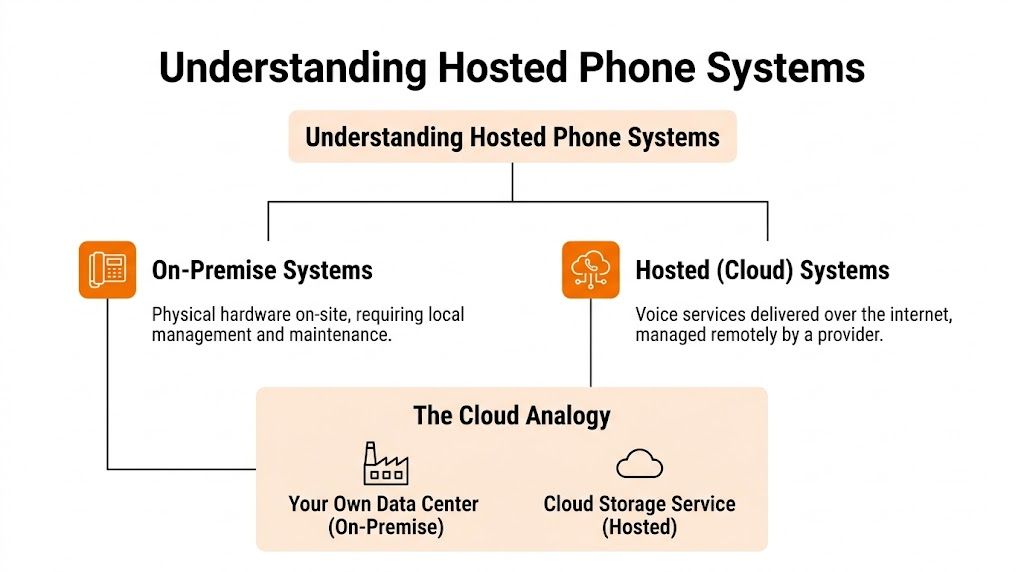
A hosted phone system is easiest to understand if you compare it with the shift from an on-site server to Microsoft 365. You used to buy, house, patch, and maintain the kit yourself. Now the service lives in a secure data centre, and you access it over the internet.
The same principle applies to voice.
Where the system lives
With an on-premise PBX, the call control lives in your building. You own or lease the hardware. You’re responsible for maintenance, updates, and often the awkward moments when parts fail or support is tied to an ageing platform.
With hosted phone systems, the call control lives off-site in the provider’s platform. Your business uses internet-connected endpoints such as IP handsets, desktop softphones, mobile apps, or conference devices. Admin changes happen through a portal rather than a site visit.
That distinction matters because many firms confuse hosted business telephony with basic consumer VoIP. They aren’t the same thing. A business-grade hosted platform includes central management, call routing, hunt groups, voicemail, reporting, and resilience options. Consumer tools usually don’t.
Some businesses also need a middle path. If you have a legacy PBX you’re not ready to retire immediately, SIP trunking can bridge the gap by letting existing telephony connect through IP services rather than traditional lines.
How calls actually move
Under the surface, voice is converted into digital packets and carried over your network connection. VoIP is the method. SIP is the signalling language that helps devices and services set up and manage calls.
You don’t need to become a telecoms engineer to make a good buying decision, but you do need to understand one operational truth. Call quality depends on the environment around the platform:
- Your broadband matters
- Your internal network matters
- Your Wi-Fi design matters
- Your provider’s engineering matters
If one of those is weak, the user blames “the phone system” even when the issue sits elsewhere.
Hosted voice works best when it’s treated like a core business service, not just another app sharing whatever bandwidth happens to be spare.
A simple comparison makes the distinction clearer:
| Model | Where control sits | Best fit | Main trade-off |
|---|---|---|---|
| On-premise PBX | In your office | Sites with strong in-house telecoms requirements | Hardware ownership and maintenance |
| Hosted phone system | In provider data centres | SMEs that want flexibility and easier scaling | Depends heavily on connectivity and provider quality |
| Hybrid with SIP | Split between site and cloud | Firms migrating in stages | More moving parts during transition |
For most SMEs, hosted is less about fancy features and more about reducing friction.
Strategic Benefits for Ambitious Businesses
A growing business usually feels the strain of an ageing phone system before it appears on a board agenda. A new site opens, a service team splits across office and field, or a compliance-heavy department needs tighter control over recordings and call handling. The old setup still works, but every change takes too long, costs too much, or relies on workarounds.

That is where hosted telephony starts to make commercial sense. The headline saving matters, but the stronger case for ambitious SMEs is operational control. You can add capacity without ordering another box for the comms room, give teams a consistent call experience across locations, and adapt faster when the business changes shape.
Why finance teams usually like hosted telephony
An on-premise refresh often brings a familiar list of costs. Hardware, licences, installation, support, and the risk of paying again when requirements shift 18 months later. Hosted services usually move more of that into a predictable monthly cost, which makes planning easier for firms trying to grow without tying cash up in telecoms hardware.
The primary benefit is the lower cost of change.
- Adding users usually becomes a service request, not a hardware project.
- Short-term teams or contractors can be brought in without redesigning the whole setup.
- Office moves and site changes are easier to absorb.
- System updates and platform improvements sit with the provider rather than becoming another internal project.
That matters for directors watching both margin and pace. If every change to telephony needs capital approval, engineer time, and site visits, the phone system slows the business down.
Operational gains that matter day to day
For engineering, logistics, and manufacturing firms, hosted telephony often improves coordination across mixed environments. Front office staff, workshops, warehouses, mobile engineers, and supervisors can work within one call structure instead of stitching together desk phones, personal mobiles, and informal forwarding rules. That reduces missed calls and gives customers a clearer path to the right person.
In regulated sectors, the value is often more disciplined than flashy. Legal, financial, and professional services firms can set up call flows that match departments, apply recording policies by team, and maintain a professional client experience even when staff are spread across offices and remote locations. The technology supports governance as well as convenience.
A good platform should also fit the systems people already rely on:
- Microsoft 365 environments where staff spend the day in Outlook, Teams, and mobile apps
- CRM workflows where inbound calls need customer context
- Shared service teams that need queueing, overflow rules, and visibility across multiple sites
- Business continuity plans where calls must keep flowing during a site outage or local incident
That integration point is often underestimated. In practice, the gain is less about adding features and more about cutting friction between departments.
After the platform basics, it helps to see the user experience in action:
There is also a control benefit that matters in regulated and industrial settings. When staff use approved business apps and managed devices, the company reduces dependence on personal mobiles, unmanaged call forwarding, and workarounds that are hard to audit. That makes supervision easier and lowers the chance that client conversations or operational calls drift outside company policy.
A well-designed hosted setup makes the business easier to reach, easier to manage, and easier to govern.
Hosted systems still involve trade-offs. Businesses with analogue lines for alarms, lift phones, gate entry, paging, or specialist plant may need a phased design. Firms in rural areas or on industrial estates with unstable connectivity may also need resilient circuits, failover options, or a hybrid approach rather than a full cutover on day one. For ambitious SMEs, the strategic value comes from matching the service to how the business operates, then using a managed partner to keep performance, resilience, and compliance aligned as the company grows.
Navigating Security and Compliance Requirements
A hosted phone system can create problems as easily as it solves them if security is treated as a procurement checkbox.
That risk is higher in firms that record calls, discuss sensitive client matters, or operate on industrial sites where connectivity is uneven and staff rely on mobile and softphone access. In those environments, directors need more than a feature list. They need to know where voice data sits, how access is controlled, what happens during an outage, and whether the service can stand up to audit.

For UK SMEs, the starting point is straightforward. Check whether the provider can explain its approach to GDPR, data handling, incident management, and service resilience in plain English, then back that up with documents such as certification scope, data processing terms, and support procedures. A provider that answers with broad claims about being “secure” usually has not done the hard work.
What regulated businesses should verify
For legal, financial, healthcare, professional services, and some manufacturing businesses, due diligence needs to go beyond the sales demo.
Start with these questions:
- Where is call data stored? That includes recordings, voicemail, transcripts, call logs, and analytics. If any of it is processed or stored outside the UK, your compliance lead needs to review the implications.
- Who can access it? Ask how admin roles are separated. Reception, supervisors, compliance staff, and IT administrators should not all inherit the same rights.
- What evidence supports the provider’s claims? Ask for certification details, audit scope, and the controls that apply to the telephony service itself, not just the wider business.
- How is data retained and deleted? Call recording becomes a liability if files are kept indefinitely because nobody set a policy.
- What happens during an incident? You need a clear route for breach notification, service issues, and support escalation.
Those checks matter because telephony now sits inside the same risk scope as email, identity, endpoints, and cloud apps. If the system stores recordings, exposes admin portals over the internet, or integrates with Microsoft 365 and mobile devices, it belongs in your security governance.
That point gets missed often in SMEs.
Security controls that need real attention
The strongest telephony environments usually get the basics right first. Multi-factor authentication for admin access should be in place. User permissions should match job roles. Logging should be detailed enough to investigate changes, failed logins, and unusual access to recordings or call data.
Then examine the controls around the platform:
| Control area | Why it matters | What to ask |
|---|---|---|
| Access control | Reduces misuse, error, and unnecessary data exposure | Can permissions be split by function and reviewed regularly? |
| Encryption | Protects signalling, recordings, and stored account data | What is encrypted in transit and at rest? |
| Logging | Supports investigations and audit reviews | Which events are logged, and how long are logs retained? |
| Supplier process | Lowers operational and security risk | How are patches, vulnerabilities, and incidents handled? |
For industrial and multi-site businesses, connectivity belongs in the same conversation as security. A warehouse office with unstable broadband, an engineering site on an industrial estate, or a rural branch with patchy mobile coverage can turn a cloud phone rollout into an availability issue if nobody tests the underlying links properly. Before committing to a provider, it helps to review your options for business broadband and leased lines so resilience and voice quality are designed in from the start.
A managed partner earns its keep here. Good providers do more than supply licences. They help define retention rules, lock down admin access, align telephony with Cyber Essentials controls, and build fallback options for sites where one circuit is never enough.
Call recording is a good example of the trade-off. It can support training, dispute resolution, and regulatory evidence. It can also create unnecessary exposure if every call is recorded by default, stored too long, and made visible to too many people.
The right hosted platform can support regulated work well. The difference is in the design, the governance, and the quality of the partner managing it.
Planning a Smooth Migration
A migration usually goes wrong long before the first user logs in. The warning signs show up earlier. An untested branch circuit, a forgotten alarm line, a port order submitted too late, or a call flow rebuilt from guesswork.
For UK SMEs in regulated and industrial sectors, that matters more than the handset choice. If a care provider misses inbound calls during a port, or a manufacturer loses service desk availability because warehouse Wi-Fi drops under load, the problem is operational first and commercial straight after.
Start with the network path
Hosted telephony works well when the network is stable, correctly configured, and sized for real usage. Voice traffic is sensitive to delay, jitter, and packet loss. A connection that feels acceptable for email and web browsing can still produce clipped audio, one-way speech, or calls that drop at busy times.
Start with a practical review of each site:
-
Test live performance during working hours
Check latency, jitter, packet loss, and upload consistency when the business is busy, not at 7am before anyone is online. -
Review competing traffic
Voice shares capacity with Microsoft 365 sync, CCTV backhaul, guest Wi-Fi, video meetings, backups, and cloud ERP traffic unless you separate or prioritise it. -
Map how each team will use the system
Reception desks on Ethernet, office staff on softphones, supervisors using mobile apps, and engineers picking up calls over site Wi-Fi create different support and coverage requirements. -
Set the fallback position before go-live
Decide what happens if the primary circuit fails. That may mean automatic call forwarding, a secondary circuit, 4G or 5G backup, or temporary routing to mobiles.
Site conditions vary more than many directors expect. A head office on leased connectivity and a depot on a contended broadband line should not be treated as the same environment. This guide to business broadband and leased lines for business connectivity planning is a useful starting point if you need to weigh cost against resilience.
One rule is worth keeping in mind. Design the network path first, then the phone system that depends on it.
Build the migration around business process
Once the connectivity picture is clear, the rest of the project becomes far easier to control.
A sound migration plan usually includes:
- A full number audit. Confirm every DDI, main number, non-geographic number, and analogue line. Include lift lines, fax replacements, alarms, payment terminals, and any device still tied to PSTN or ISDN services.
- Call flow mapping. Document how calls reach sales, service, on-call teams, and reception. Include overflow rules, voicemail, holiday routing, and out-of-hours handling.
- A pilot group with real pressure points. Test with reception, service desk staff, managers, and anyone handling high call volumes. They find routing and usability issues quickly.
- Role-based device decisions. Desk phones still suit some users. Softphones and headsets suit others. Shared areas, noisy workshops, and front desks often need a different approach again.
- User training by job function. A director needs call transfer, mobile twinning, and voicemail setup. A receptionist needs queue handling, presence visibility, and speed under pressure.
Porting deserves early attention. Numbers can take time to move, and delays often come from incomplete records or mismatched account details rather than the hosted platform itself. In regulated firms, we advise keeping a clear cutover plan, named owners, and a tested fallback for every customer-facing number.
A phased rollout is often the safer choice where there are multiple sites, legacy lines, or compliance constraints around recording and retention. A single cutover can work well, but only if the estate is simple and the dependencies are already known.
Blowfish Technology offers hosted VoIP and managed telephone systems as part of a wider connectivity and security service. That joined-up model helps when migration planning includes circuits, device rollout, user setup, and support, not just telephony licensing.
How to Choose the Right Managed Provider
Monday, 8:15am. Your warehouse team cannot call out, customer service is queueing calls on mobiles, and your operations manager wants to know whether the fault sits with the phone platform, the broadband circuit, or an access rule that changed over the weekend. In that moment, licence costs matter a lot less than whether your provider can isolate the issue fast, speak plainly, and own the fix.
The strongest hosted telephony proposals often look similar on paper. The significant difference appears after go live, especially in firms with compliance requirements, multiple sites, poor rural connectivity, or noisy industrial spaces where device choice and network stability affect call quality every day.

What to compare beyond price
A low monthly figure can hide expensive gaps. Look for a provider that can support the service as an operational system, not just sell handsets and licences.
Use these checks when comparing options:
- Support access. Can you reach an engineer quickly, or do all issues disappear into a ticket queue first?
- Sector experience. Have they worked with manufacturers, healthcare providers, professional services firms, or other regulated SMEs that need audit trails, controlled access, and predictable change processes?
- Connectivity capability. Can they assess LAN, Wi-Fi, broadband, and failover options, or are they treating telephony as if it sits apart from the network?
- Security and compliance understanding. Can they explain call recording controls, retention options, admin permissions, MFA, and UK data handling clearly?
- Service development. Can they help with policy changes, call flow reviews, Microsoft 365 integration, and resilience planning as the business changes?
What good support looks like in practice
Ask for operational evidence, not sales language. A serious provider should be comfortable sharing how support works, what gets measured, how escalations are handled, and who owns third-party issues when a voice fault turns out to be a circuit, firewall, or SIP configuration problem.
For regulated and industrial businesses, we would ask these questions early:
| Question | Why it matters |
|---|---|
| Who answers support calls and what happens after hours? | Shows whether urgent faults reach people who can act |
| How do you separate telephony faults from network faults? | Reduces finger-pointing during outages |
| How are admin rights, MFA, and user changes controlled? | Matters for security and auditability |
| Where are recordings and logs stored, and how is retention managed? | Important for compliance and evidence handling |
| What resilience options do you recommend for each site? | Tests whether they understand business continuity, not just licensing |
A managed provider should also explain the work they do between incidents. That includes onboarding, service reviews, security checks, number management, user changes, and periodic call flow adjustments. This guide on what a managed service provider does gives a useful picture of that broader operating model.
Blowfish Technology delivers hosted VoIP and managed telephone systems alongside managed IT, connectivity, and security services. That joined-up approach matters when the risk sits across several layers, which is common in UK SMEs with branch sites, factory floors, compliance obligations, or limited in-house IT capacity.
Choose the provider that can keep the service usable, secure, and supportable under pressure. That is what protects the business when the first real problem hits.
Ready to take the next step? Explore our hosted VoIP and managed telephone systems service, or speak to the Blowfish Technology team about your specific setup.

The Blowfish Technology team. Managed IT, cloud services, software development and connectivity for North West businesses since 1999.