
UK fixed voice service revenues fell to £1.09 billion in Q1 2025, down 13.3% year on year, while over two-thirds of UK landlines have already been upgraded to VoIP according to Expert Market's summary of Ofcom data. That changes the conversation around business phone systems uk. This isn't about whether digital telephony is coming. It's about whether your business moves on your terms or gets pushed into a rushed migration later.
For SMEs in manufacturing, legal, and financial services, reliable communication is about more than avoiding missed calls. Phone systems sit inside quoting, client care, matter management, compliance, payment workflows, shift coordination and emergency escalation. A poor decision creates operational friction. A well-planned one gives you cleaner call handling, stronger resilience, better reporting and fewer surprises as the 2027 switch-off gets closer.
Most owners don't need a telecoms lecture. They need a practical route from old lines to a system that works with broadband, Microsoft 365, mobile devices, security controls and the way their staff work.
Table of Contents
- The End of the Line for Traditional UK Phone Systems
- Understanding Your Modern Telephony Options
- Essential Features That Drive Business Growth
- Security and Compliance in the VoIP Era
- Evaluating Costs and Calculating Your Return on Investment
- Your Step-by-Step Migration and Implementation Plan
- Simplifying Your Transition with a Managed Provider
The End of the Line for Traditional UK Phone Systems
Millions of UK lines have already been moved off the old network, and the remaining businesses face a narrowing window to deal with the rest. For SMEs in legal, financial and manufacturing environments, that matters because phone lines are often tied to more than calls. They sit behind alarms, lift phones, payment devices, fax replacements, door entry systems and recorded-line workflows that carry compliance risk if they fail.
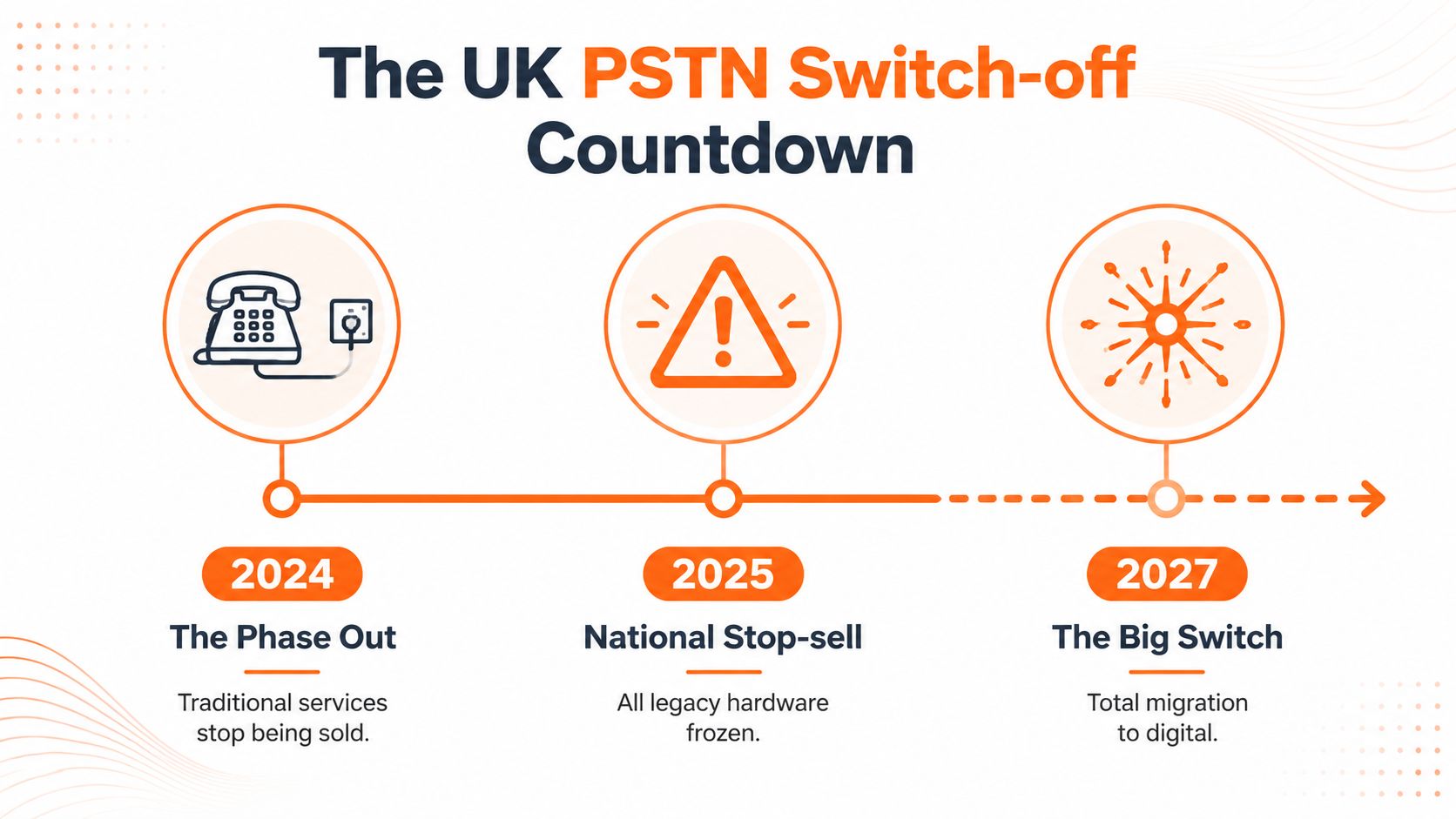
The upcoming January 2027 PSTN switch-off is the deadline most owners know about, but the underlying issue starts earlier. Carriers are already reducing support for legacy services, replacement parts are less attractive to maintain, and specialist knowledge around old ISDN and analogue setups is getting harder to find. In practice, that raises project risk for any business that leaves the review too late.
If you want context on how business telephony got here, this short guide to the evolution of phone calls is useful because it explains the shift from fixed-line voice to software-led communications in plain terms.
What the switch-off means in practice
For an SME, the impact often reaches well beyond the main switchboard number. I see four areas come up repeatedly during audits:
- User calling and call handling: desk phones, hunt groups, voicemail, auto attendants and call recording
- Site and operational services: alarms, entry systems, lift lines, PDQ terminals and analogue devices connected through adapters
- Remote and multi-site working: staff relying on diverts, mobile workarounds or inconsistent home setups
- Continuity planning: what happens to inbound and outbound calls if a site loses power or connectivity
Regulated businesses need to go further than a basic line inventory. Legal firms need to protect recorded conversations and client confidentiality. Financial firms need clarity on retention, resilience and supplier controls. Manufacturers often have older analogue dependencies on shop floors or at remote sites that are easy to miss until cutover planning starts.
Practical rule: treat PSTN replacement as an operational risk and compliance project, not a phone refresh.
The expensive mistakes are predictable. Businesses leave the audit too late, discover undocumented devices on old lines, rush number porting, and find their broadband, firewall rules or call recording setup are not ready for live traffic. That is where avoidable disruption appears.
Why early action is cheaper and safer
A planned migration gives you time to test failover, confirm every service using an analogue line, validate retention and recording requirements, and train staff before any legacy dependency becomes urgent. It also gives regulated SMEs time to complete supplier due diligence properly instead of signing off security and compliance checks under pressure.
For firms still mapping dependencies, this explanation of the UK PSTN switch-off and what it means for business systems is a practical starting point.
The businesses that handle this well are not buying newer handsets for the sake of it. They are reducing the risk of service interruption, removing unsupported legacy links, and putting voice onto a platform that can be managed, secured and audited properly.
Understanding Your Modern Telephony Options
PSTN is like analogue television. It did one job well for a long time, but it was built around fixed infrastructure and limited flexibility. VoIP is closer to streaming. It runs over your data connection, works across devices and supports features that would have needed separate systems in the past.
That doesn't mean there's one perfect answer for every SME. In business phone systems uk, the right fit depends on your sites, internet resilience, compliance requirements, internal IT capability and how tightly telephony needs to connect with line-of-business systems.
How VoIP actually differs from PSTN
With VoIP, your phone system converts voice into digital traffic and carries it over an IP network. On a stable UK broadband connection, modern VoIP systems achieve 99.9%+ uptime, and each concurrent call needs about 100kbps of bandwidth, with jitter buffers and automatic mobile failover helping maintain service quality, according to Connection Technologies.
That bandwidth figure is useful because it removes some of the mystery. Small offices often assume voice will swamp the connection. In practice, the bigger issue is usually poor network design, unmanaged traffic or weak failover planning, not raw bandwidth alone.
Hosted telephony also makes it easier to support remote and hybrid staff. Users can work from desk phones, softphones, mobile apps or a mix of all three. For firms running campaigns, satellite offices or dedicated response lines, guides on setting up virtual numbers for marketing can help you think through number strategy alongside the core system design.
Comparison of Business Phone System Models
Some businesses still need local survivability. Others want to move everything into the cloud. Many regulated SMEs land somewhere in the middle.
| Attribute | On-Premise PBX | Hosted/Cloud VoIP | Hybrid System |
|---|---|---|---|
| Core setup | PBX equipment sits on your site | Platform is hosted by the provider | Mix of on-site control and cloud services |
| Upfront spend | Higher, because you buy hardware and related infrastructure | Lower upfront, usually subscription-led | Moderate, depends on local equipment and cloud licences |
| Internal control | Strong local control if you have the skills to manage it | Less hands-on maintenance for your team | Shared control between site and provider |
| Remote working | Possible, but often needs more configuration | Usually the easiest option for remote and hybrid users | Good if designed properly |
| Resilience model | Depends on your local setup and backup planning | Depends on provider resilience and your internet access | Can suit sites that need local fallback |
| Best fit | Firms with specialist requirements and in-house technical ownership | SMEs that want flexibility and simpler support | Multi-site or operational environments with mixed needs |
| Typical drawback | Hardware lifecycle and maintenance burden | Reliance on provider choice and internet planning | More design complexity |
A hybrid setup often makes sense where office users can move fully to cloud telephony, but shop-floor, plant-room or legacy device dependencies still need local gateways.
If you're deciding between models, compare the support burden as much as the feature list. This breakdown of cloud telephony vs PBX for business communications is useful because it focuses on operating trade-offs rather than marketing language.
The right answer isn't the one with the longest feature sheet. It's the model your team can run securely, support properly and adapt as the business changes.
Essential Features That Drive Business Growth
A modern phone system shouldn't just replicate the old one. It should remove friction from how your team answers, routes, escalates and records conversations.

The best business phone systems uk are built around workflow. That usually means fewer missed handovers, clearer ownership of inbound calls and less dependence on one person knowing where every call should go.
Features that improve internal response
Unified communications matters because staff don't work in one place or one application anymore. When voice, presence, messaging, voicemail and meetings sit in one environment, teams spend less time switching channels and chasing context.
The features worth prioritising are usually these:
- Presence and availability: staff can see who's free, busy or away before transferring a client or supplier.
- Softphones and mobile apps: users can take business calls on a laptop or mobile without exposing personal numbers.
- Voicemail to email: missed calls become visible tasks, not forgotten messages sitting on one desk phone.
- Shared call handling: reception, accounts, support or fee earners can cover each other without awkward manual diverts.
These are ordinary features now, but they solve old problems that used to get accepted as normal.
Features that improve the customer journey
Inbound call handling shapes how organised your business sounds. A legal practice needs calls routed by department and urgency. A manufacturer may need different paths for sales, service and parts. A finance firm may need call recording and controlled access to it.
Look for:
- Auto attendants and IVRs: useful when they're short, clear and mapped to actual departments
- Call queues with overflow rules: important when demand shifts during the day
- Ring groups and hunt groups: practical for reception, service desks and on-call teams
- Reporting and call analytics: helps managers see abandoned calls, unanswered patterns and pressure points
- CRM or case-management integration: reduces rekeying and gives staff context before they answer
Good call flow design is usually simple. If callers have to guess where to go, the system has been designed for the business, not the customer.
A common mistake is buying every available feature and enabling too much at once. That often creates confusion, not efficiency. Start with the journeys that matter most: new enquiries, existing client support, urgent escalation and voicemail handling. Once those are working, add the more advanced pieces.
A strong system also supports growth without forcing another redesign. New users, new numbers, extra sites and departmental changes should be easy to add. If every change needs a mini-project, the system is too rigid.
Security and Compliance in the VoIP Era
For regulated SMEs, phone system security isn't a box-ticking exercise. If you handle sensitive legal matters, financial information, production data or recorded conversations, telephony becomes part of your risk surface the moment it moves onto IP networks.
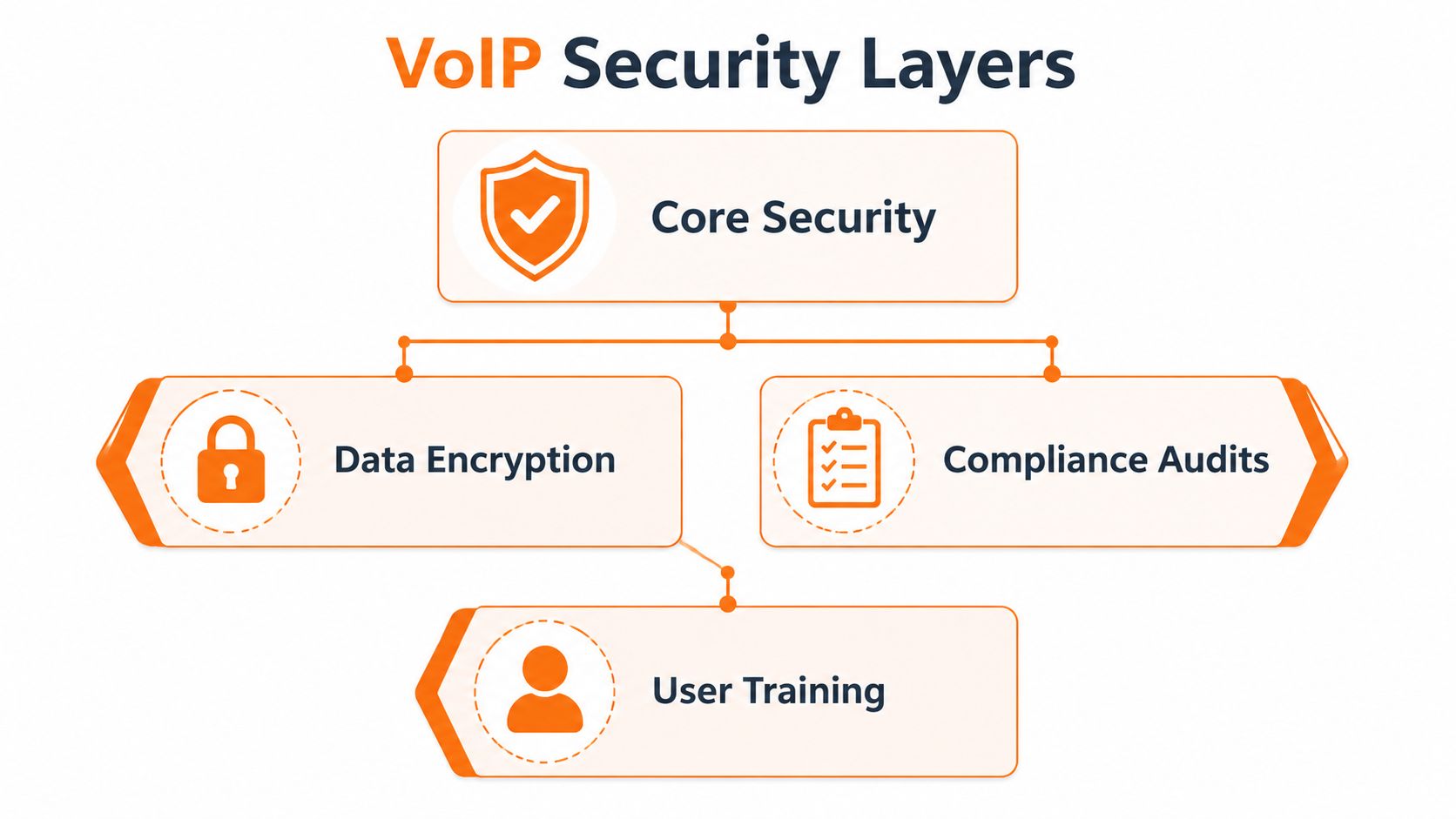
The old assumption that traditional lines are automatically “safer” doesn't hold up well. What matters is whether the modern system has the right controls around signalling, media, access, recording and user behaviour.
Encryption is the baseline
SRTP encryption is essential for regulated UK firms, and a 2025 Cyber Essentials audit found that 52% of North West financial SMEs using VoIP lacked proper end-to-end encryption, creating significant risk under FCA and GDPR rules, according to Expert Market. That single figure tells you a lot. Many firms have already adopted VoIP, but too many have done it without proper security architecture.
In practical terms, ask whether the provider supports:
- SRTP for voice media: protects the call content itself
- TLS for signalling: protects call setup information
- Role-based access: limits who can change routing, users or recordings
- Multi-factor authentication: especially for admin portals and softphone access
- UK-hosted or clearly governed data handling: important for GDPR, auditability and client assurance
If call recording is in scope, the questions get sharper. Where is it stored. How long is it retained. Who can access it. How is that access logged. Can you apply retention policies by user, department or matter type.
If a provider can't explain how recordings are protected and governed, they haven't solved the compliance problem. They've moved it.
Compliance checks before you sign a contract
The right provider should answer compliance questions without hand-waving. Don't settle for broad statements about “secure cloud technology”. Ask for the exact controls and the responsibilities on each side.
Use a procurement checklist like this:
Confirm encryption standards
Get written confirmation of how calls and signalling are protected.Review data location and handling
Make sure the provider can explain where call data, logs and recordings sit, and how they support GDPR obligations.Check admin security
Portal access, password controls, audit trails and user provisioning matter as much as the voice layer.Validate emergency calling behaviour
VoIP changes how services are delivered, so location handling and emergency access need clear understanding.Test call recording governance
Not every user should be able to retrieve, download or share recordings.Train staff properly
Softphones, voicemail access and mobile use create new habits. Untrained users create avoidable risk.
A legal or financial SME should also involve whoever owns compliance internally before the contract is signed, not after deployment. That may be a practice manager, compliance officer, operations lead or external adviser. Technical fit without governance fit is still a bad buy.
The strongest setups combine telephony security with wider controls such as endpoint detection, DNS filtering, identity protection and user awareness training. A phone system on its own doesn't create resilience. It has to sit inside the rest of your security model.
Evaluating Costs and Calculating Your Return on Investment
Most businesses start with monthly price per user. That's understandable, but it's too narrow. The total cost of business phone systems uk includes implementation time, device choice, support model, broadband suitability, integration work and what happens when something breaks.

A cheap licence can still be an expensive decision if your team spends months working around bad call flows, poor reporting or manual processes.
CapEx and OpEx in real terms
An on-premise route usually leans towards CapEx. You buy PBX hardware, associated equipment and often more of the responsibility for maintenance and lifecycle planning. A hosted system leans towards OpEx, where you pay recurring subscription costs and the provider handles more of the platform management.
Neither model is automatically better. The question is what fits your cash flow and operational model.
Watch for these common cost areas:
- User licences: what's included, and what sits behind premium tiers
- Handsets and accessories: desk phones, conference units, headsets and adapters
- Connectivity: your voice platform only works as well as the underlying broadband or leased line design
- Implementation work: call flow setup, number porting, testing and training
- Security add-ons: recording controls, admin protection and related services
- Support boundaries: what's covered in the monthly service and what becomes billable change
For owners trying to tighten software spend more broadly, this guide on reducing hidden SaaS expenses is useful because the same discipline applies to telephony subscriptions too.
Where ROI is won or lost
The strongest ROI cases usually come from operational improvements, not just replacing line rental. Ask what the new system changes in day-to-day work.
Examples include:
- Faster call handling: fewer transfers and missed messages
- Better visibility: managers can spot unanswered demand and staffing gaps
- Cleaner remote working: staff can answer from anywhere without ad hoc divert arrangements
- Less admin time: voicemail delivery, contact syncing and integration reduce manual effort
- Improved resilience: failover options reduce the impact of local disruption
Manufacturing firms need to be particularly careful here. North West IT surveys in 2025 showed 40% of UK manufacturing SMEs reported VoIP integration failures with legacy ERP systems, leading to productivity loss and weaker ROI, according to Aurora Tech Support. That's the kind of issue that turns a sensible telephony project into a frustrating one.
Commercial test: if telephony has to interact with ERP, CRM, case management or shop-floor processes, price the integration effort before approving the platform.
Before committing, review whether your connectivity is suitable for voice and failover. This explanation of business broadband and leased lines for UK organisations helps frame that part of the budget properly.
A realistic ROI model doesn't pretend every benefit can be reduced to one neat figure. It combines direct telecoms savings with service quality, staff efficiency and reduced operational risk.
Your Step-by-Step Migration and Implementation Plan
A successful migration is usually boring in the best possible way. Calls move over, numbers stay live, staff know what to press and the business carries on. That only happens when the groundwork is done properly.

The migration checklist
Work through the change in a strict order.
Audit every current service
List live numbers, hunt groups, direct dials, fax replacements, alarms, door entry links, conferencing devices and analogue dependencies.Map call flows Write down how inbound calls move today. Include overflow, voicemail, out-of-hours handling and escalation paths.
Assess connectivity
Confirm the primary connection is suitable for voice traffic and decide how failover will work if the site loses service.Choose endpoints
Not every user needs a desk phone. Some need handsets, others work better with softphones and quality headsets.Plan number porting carefully
Number retention is usually possible, but the paperwork and timing need to be right. Errors here cause the most anxiety because customers notice them immediately.Build and test before cutover
Test inbound, outbound, voicemail, transfers, groups, mobile apps, recording and any key integrations before go-live day.Train users by role
Reception needs different training from fee earners, finance staff or managers reviewing reports.Schedule support for the first days live
Small issues often appear only when real traffic starts. Fast support in that window matters.
What usually causes avoidable disruption
The technical platform is rarely the main problem. The avoidable issues are usually operational.
- Missing dependencies: a forgotten analogue line for a gate, alarm or older device
- Weak call flow design: old bad habits copied into the new platform
- Poor user preparation: staff don't know how to transfer, pick up voicemail or use the mobile app
- Late porting requests: timelines get compressed and confidence drops
- No rollback thinking: there's no agreed response if one element doesn't behave as expected
A short pilot helps. Move one team or one site first if the business structure allows it. That gives you a chance to fix small design issues before the main cutover.
Go-live day should be the final step in a tested plan, not the first time anyone hears a ring tone.
If your business has compliance-sensitive teams, include a sign-off step for recording rules, retention settings and admin permissions before users start making live calls.
Simplifying Your Transition with a Managed Provider
For most SMEs, the hardest part isn't choosing between handsets. It's coordinating telecoms, broadband, security, compliance, devices, user adoption and support without dropping something important.
That's why many firms choose a managed route rather than trying to stitch the project together across multiple suppliers. A good managed provider designs the system around the business, not the other way round.
Why SMEs use a managed approach
A managed provider should handle the parts owners and internal teams don't have time to orchestrate well:
- Discovery and scoping: identifying numbers, dependencies, workflows and risks
- Solution design: matching cloud, on-premise or hybrid options to the operating model
- Procurement and provisioning: reducing admin overhead and compatibility issues
- Implementation control: coordinating timelines, testing and cutover
- Security alignment: making sure telephony fits the wider compliance and cyber posture
That joined-up view matters most in regulated sectors. Legal and financial firms need clear controls around access, recording and data handling. Manufacturing businesses often need a sharper eye on integration, local resilience and operational edge cases.
What good support looks like after go-live
Support quality becomes obvious after the migration. You want one team that can handle telephony issues in the context of the broader estate, especially when the root cause sits between internet access, Microsoft 365, endpoint setup and the voice platform.
A managed provider is also useful because the phone system won't stay static. Teams change, sites move, departments split, compliance rules tighten and reporting requirements evolve. Ongoing ownership matters just as much as the initial install.
If you're weighing whether that model is right for your business, this overview of what a managed service provider does and why SMEs use one gives a clear picture of the support relationship.
The best migrations aren't just technically successful. They leave the business with less complexity than it had before.
If your business needs help reviewing business phone systems uk ahead of the 2027 switch-off, Blowfish Technology can help you assess legacy dependencies, compare hosted and hybrid options, plan secure migration paths and reduce the compliance and operational risk that often gets missed early on.

The Blowfish Technology team. Managed IT, cloud services, software development and connectivity for North West businesses since 1999.