
You're probably already doing “digital” work. Staff use cloud apps. Files live in more than one place. People work from home, on-site, and on the move. Yet the business still feels harder to run than it should. A system only one person understands keeps breaking. Security worries keep creeping into board conversations. New tools get bought, but old processes stay awkward.
That's the point where many UK SMEs start looking for a digital transformation service. Not because they want a fashionable IT project, but because they want fewer points of failure, clearer accountability, and a business that can keep operating when pressure hits.
For firms in legal, finance, engineering, and manufacturing, the issue isn't only efficiency. It's resilience. It's compliance. It's whether your systems support growth or resist it.
Table of Contents
- Rethinking Your Business for a Digital-First World
- What is a Digital Transformation Service
- The Core Components of a Modern Digital Strategy
- A Practical Roadmap for Your Business Transformation
- Measuring Success with Meaningful ROI and KPIs
- Transformation in Practice for Regulated UK Sectors
- Choosing Your Digital Transformation Partner
Rethinking Your Business for a Digital-First World
A digital transformation service isn't the same as buying Microsoft 365 licences, moving files to SharePoint, or replacing an old phone system. Those may be part of the answer, but on their own they're often just repairs.
Real transformation changes how the business operates day to day. It removes manual work that slows people down. It standardises security so risk doesn't depend on individual habits. It gives directors better visibility over systems, suppliers, and failure points. That's why UK organisations are investing so heavily in it. UK spending on digital transformation reached approximately £110 billion in 2022, up 17.6% year over year, and was projected to exceed £200 billion annually by 2026, with over 92% of UK businesses using cloud services according to UK digital transformation statistics.
The easiest way to think about it is this. Repainting a room makes a house look newer. Renovating the structure fixes the wiring, plumbing, insulation, and layout so the building works better. A digital transformation service should do the second job.
If you're wrestling with ageing applications, understanding technical debt matters. These legacy software insights for businesses are useful because they explain why old systems become expensive long before they completely fail.
Practical rule: If a process only works because one experienced employee knows all the exceptions, that process is a transformation candidate.
A proper review usually starts with awkward business questions, not technical ones:
- Where do delays happen: approvals, onboarding, reporting, document access, ticket handling.
- Where does risk sit: unmanaged devices, weak identity controls, missing backups, poor audit trails.
- Where does growth get blocked: new starters, second sites, acquisitions, remote access, customer response times.
For many SME owners, the first step is getting a clearer view of whether current systems can support the next stage of growth. A structured future-ready business IT assessment helps frame that conversation properly.
What is a Digital Transformation Service
A digital transformation service is a structured programme that changes how the business operates, not just the tools it buys. For a UK SME, that usually means replacing fragile workarounds with systems and controls that support growth, remote working, compliance, and recovery from disruption.

A simple test helps. If a fee earner cannot access the right document set without phoning a colleague, if a finance manager still relies on spreadsheets to track approvals, or if an engineering firm would struggle to restore drawings after an outage, the issue is bigger than software choice. The operating model needs work.
That is the essential service. It connects business goals to technical delivery, then keeps the changes usable and controlled after go-live. In regulated sectors, that matters because improvement without governance often creates a new risk. Faster access means little if permissions are loose. Cloud migration solves little if backup, retention, and audit trails are unclear.
What the service actually includes
In practice, a digital transformation service usually combines several areas that SMEs rarely have under one roof:
- Business review: identifying where delay, risk, cost, or rework is hurting the business most
- Technology planning: choosing which systems to keep, replace, integrate, or retire
- Implementation: handling migration, configuration, testing, rollout, and user training
- Operational control: managing patching, monitoring, backups, device standards, and support
- Governance: setting priorities, reviewing risk, tracking spend, and measuring whether the change is working
For many owners, this feels less like buying IT and more like hiring a part-time strategic technology function with delivery capability behind it.
That is also why the managed element matters. Day-to-day service, maintenance, and accountability are part of the result. If you want a clearer baseline for that side of the relationship, this guide on what a managed service provider does is a useful reference.
How it shows up in day-to-day operations
The easiest way to judge a transformation service is to ask what business problem it removes.
| Business problem | Typical service response |
|---|---|
| Staff struggle to work securely across office, home, and client sites | Microsoft 365 setup, identity management, device policies, secure file access |
| Ageing servers or line-of-business systems keep causing disruption | Cloud migration, infrastructure modernisation, application review |
| Compliance requirements are increasing | Access controls, audit logs, policy alignment, security baselines such as Cyber Essentials |
| Recovery after an outage is uncertain | Backup strategy, disaster recovery planning, restore testing |
| Phones, mobiles, and connectivity are managed separately | Unified telecoms, broadband, mobile integration, single support model |
| One key workflow does not fit standard software | Bespoke development or system integration |
For North West firms in legal, financial, and engineering sectors, the strongest transformation work usually starts with resilience. Can people work if the office is unavailable? Can access be controlled and audited? Can the business recover quickly after a cyber incident or supplier failure? Those questions shape better decisions than chasing features.
A good digital transformation service works like renovating the structure of a building while people still need to use it. The job is not to make the reception area look newer. The job is to fix the wiring, improve the locks, label the circuits, and make sure the business can keep trading when something goes wrong.
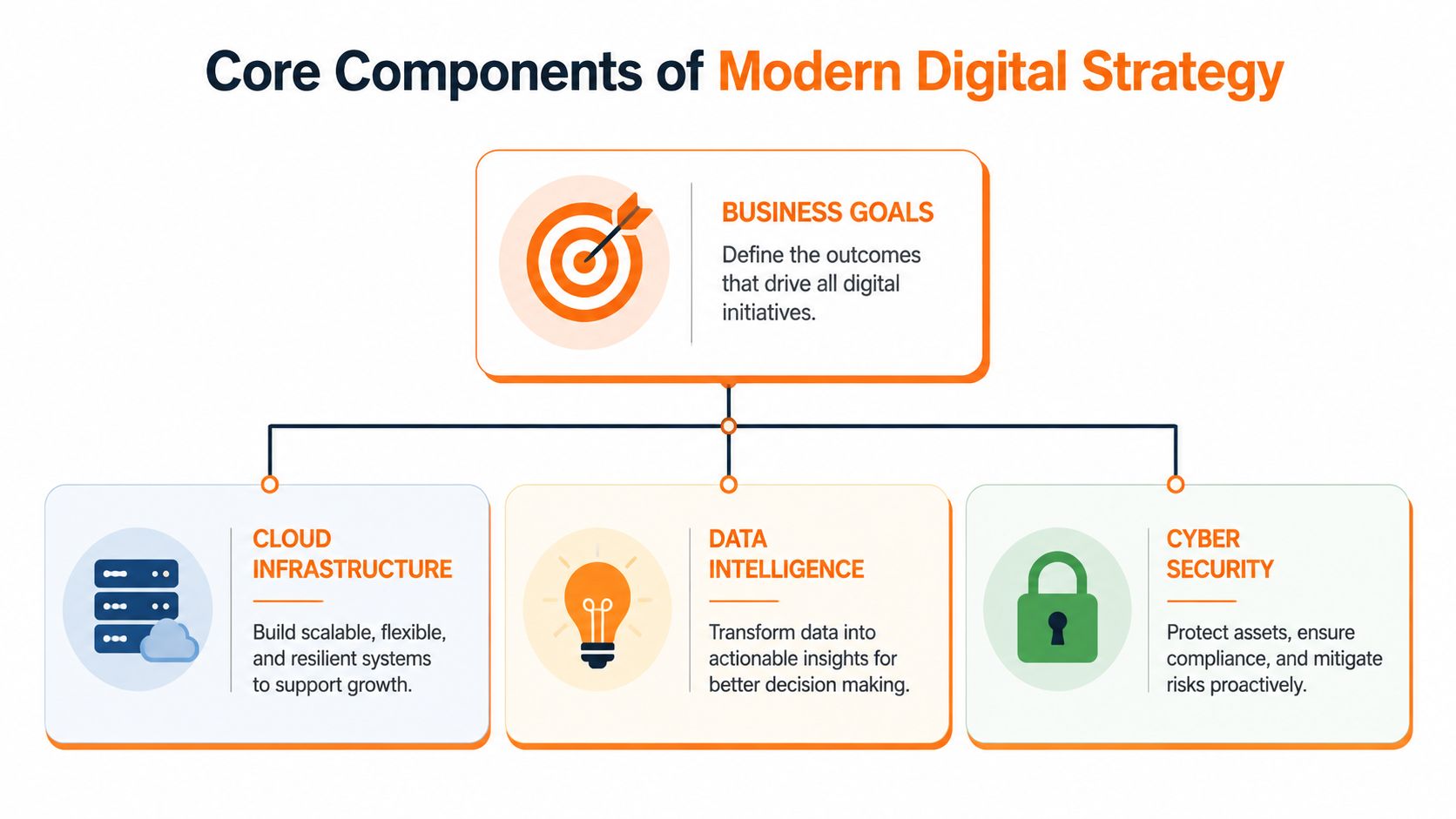
The Core Components of a Modern Digital Strategy
Modern digital strategy isn't a shopping list. It's a stack. Each layer supports the next one. If the foundations are weak, the visible tools on top will feel unreliable no matter how polished the demos looked.
Cloud and workplace foundations
Cloud migration is often the first meaningful move because it removes dependence on ageing on-premise hardware and opens the door to standardisation. Done properly, it gives the business better access, simpler scaling, and less exposure to a single office or server room becoming the point of failure.
Microsoft 365 and a modern workplace setup sit close behind. For most SMEs, this is less about buying familiar apps and more about creating a secure operating model. Identity, device control, file access, Teams collaboration, and mobile working all need to behave predictably.
What works is staged modernisation. What doesn't work is dumping files into a cloud platform without redesigning permissions, retention, and user behaviour.
A practical checklist usually includes:
- Identity first: secure sign-in, multi-factor authentication, and clear user lifecycle controls.
- Device consistency: managed laptops, mobile policies, update discipline, and standard builds.
- Collaboration structure: document libraries, naming standards, permissions, and ownership.
Security and continuity controls
Security has to sit inside the operating model, not next to it. That means endpoint protection, identity monitoring, password controls, user awareness training, DNS filtering, and policies that reflect how staff work.
For regulated firms, this matters even more because compliance isn't an extra layer added at the end. It shapes the design from the beginning. Access control, auditability, encryption, and incident response all need to support the way the sector is regulated.
Security that users bypass is badly designed security.
Backup and disaster recovery also deserve more respect than they usually get. Many businesses think they have backup because data exists in more than one place. That isn't enough. Recovery matters more than copy count. You need to know what can be restored, how quickly, by whom, and in what order.
Connectivity, telecoms, and bespoke systems
Connectivity tends to be undervalued until it fails. Broadband, Wi-Fi, remote access, and voice services are now operational infrastructure. If calls drop, video meetings lag, or remote users struggle to connect, the business feels disorganised even if the underlying work is strong.
VoIP and managed telecoms can simplify that mess when they're planned properly. The gain isn't only cost control. It's unified support, easier site changes, clearer reporting, and fewer disconnected suppliers blaming one another.
Custom software sits in a different category. You only need it when a process gives the business an edge or when off-the-shelf tools force expensive workarounds. The right use case is usually specific:
- A quoting workflow that depends on your own pricing logic.
- A compliance process that requires structured evidence capture.
- A job tracking system built around engineering, service, or manufacturing reality.
The mistake is building custom software to avoid fixing a broken process. Technology should support discipline, not replace it.
A Practical Roadmap for Your Business Transformation
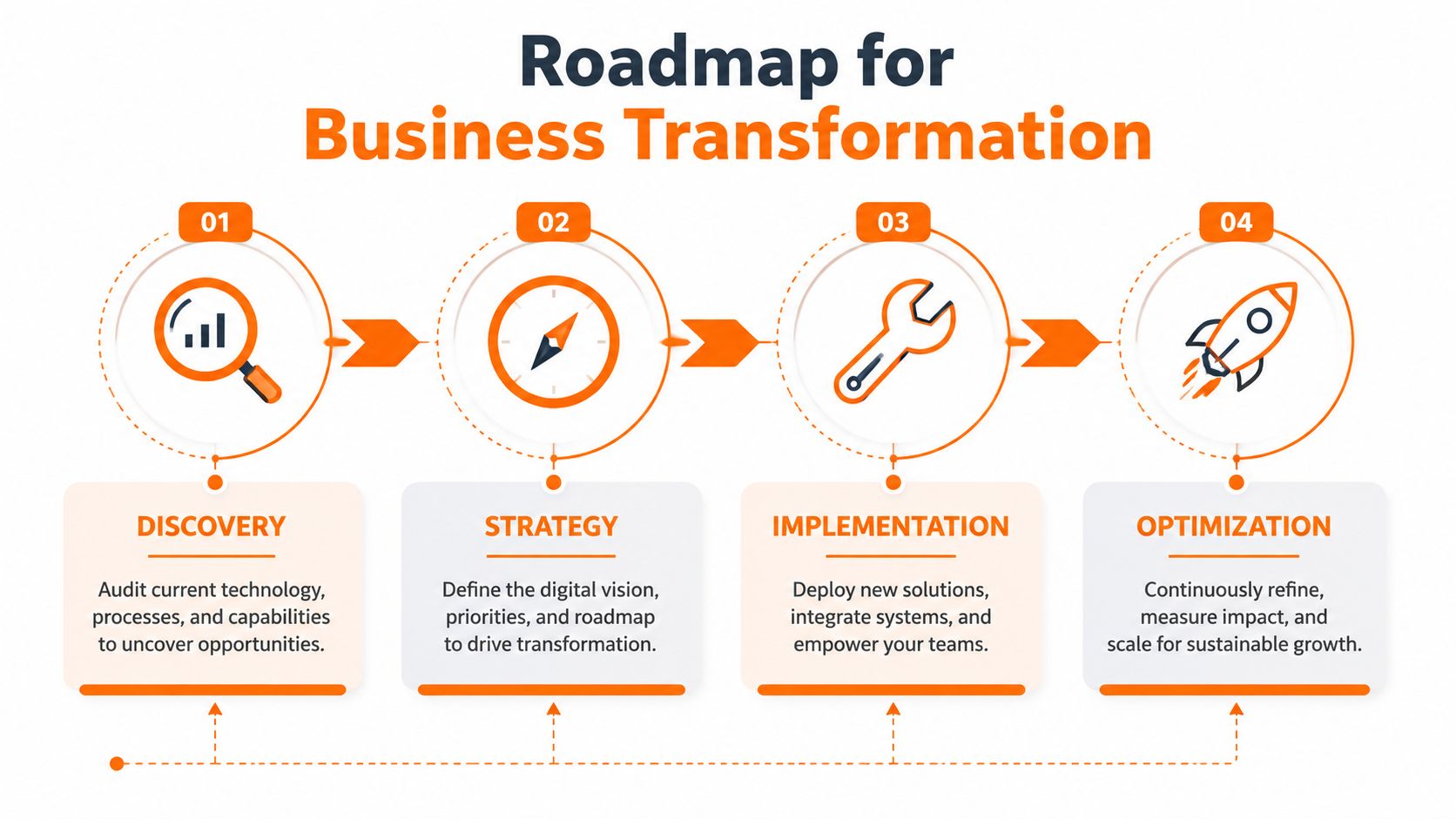
Transformation should feel controlled. If it feels chaotic, the programme is too broad, poorly sequenced, or missing ownership. The safer route is a phased roadmap that tests assumptions before the whole business depends on them.
Start with business friction, not products
The first stage is assessment and strategy. Map the workflows that waste time, the systems that fail too often, and the risks that directors would struggle to explain to an insurer, regulator, or customer.
The best discovery work combines technical audit with operational reality. Talk to the people who onboard staff, answer customer calls, process orders, manage compliance, and recover from incidents. They usually know where the true drag sits.
A useful output at this stage includes:
- Priority issues: what must be fixed first because it creates risk or blocks growth.
- Dependencies: what has to happen before the next change can land safely.
- Success measures: what you'll monitor to prove value after rollout.
If you need a planning reference, these Digital transformation best practices are worth reading alongside a formal technology roadmap for business growth.
A short visual summary helps when you're socialising the plan internally.
Pilot before you standardise
The second stage is a pilot. Many businesses get impatient and skip ahead during this phase. That's usually a mistake.
A pilot lets you test technical design and human adoption together. You might start with one department, one office, or one process such as document handling, secure remote access, or telephony. The point isn't to prove that technology works in theory. It's to see how your people use it under normal pressure.
Common pilot checks include:
- Does the new process save time or add clicks
- Do users understand the change without constant hand-holding
- Are permissions, approvals, and reporting behaving as intended
Roll out with training and ownership
Full rollout works when responsibility is clear. Someone owns technical delivery. Someone owns business adoption. Someone signs off process changes. If those roles blur, rollout drifts.
Training should be role-based, not generic. A finance user, a fee earner, and an engineering manager don't need the same examples. Tie each training session to the actual tasks people complete each week.
Rollout fails when leaders announce a new platform but leave old habits untouched.
Optimise with evidence, not assumptions
The final stage never really ends. Systems need review, permissions need cleanup, reporting needs refinement, and support data needs interpretation.
Good optimisation asks blunt questions. Are tickets dropping because systems are better, or because staff stopped reporting issues? Is remote working smoother, or are people using personal workarounds? Are you getting the resilience you paid for?
That's where transformation becomes an operating discipline rather than a project.
Measuring Success with Meaningful ROI and KPIs
If you only measure transformation by licence cost, you'll miss most of its value. The better test is whether the business runs with less friction, lower risk, and more predictable delivery.

Track operational proof points
The strongest KPIs are the ones directors already care about, even if they don't describe them as technology metrics. Look at service interruption, speed of onboarding, response times, failed handovers, reporting delays, and how long routine admin takes.
A practical scorecard often includes:
- Operational efficiency: support backlog trends, repeat incidents, onboarding speed, approval turnaround.
- User productivity: time to access systems, fewer duplicate steps, smoother remote work, less manual rekeying.
- Security posture: fewer policy exceptions, stronger identity hygiene, better recovery confidence, cleaner audit evidence.
- Customer impact: faster response, fewer communication gaps, better continuity during disruption.
Where you can track a before-and-after figure credibly, do it. Where you can't, use structured qualitative evidence such as manager feedback, user adoption patterns, and incident review notes. The point is disciplined measurement, not vanity reporting.
If you've ever had to justify marketing spend, the logic is similar. This framework on how to measure marketing impact of webinars is a good reminder that ROI gets clearer when you define the right metrics before the activity starts.
Choose a partner like a strategic hire
ROI depends heavily on who delivers the work. A cheap provider can turn into an expensive outcome if they leave you with weak adoption, poor documentation, and no clear owner after go-live.
Use criteria that go beyond procurement basics.
| What to assess | Why it matters |
|---|---|
| Sector understanding | Regulated firms need controls that fit legal, financial, and engineering realities |
| Support model | Fast, engineer-led response reduces operational drag |
| Strategic cadence | Roadmaps and review meetings keep change aligned to business priorities |
| Security depth | Identity, endpoint, backup, and user controls need to work together |
| Communication style | Clear explanations matter when non-technical leaders must make risk decisions |
Good ROI isn't just lower cost. It's fewer surprises.
Transformation in Practice for Regulated UK Sectors
The phrase “digital transformation service” can still sound abstract until you tie it to sector pressure. In regulated SMEs, the pressure is usually specific. Protect client data. Keep records accessible. Support hybrid working safely. Recover quickly. Prove control.

Legal and financial firms
A small legal practice often starts with a mix of legacy case files, local file shares, email-heavy workflows, and access rules that have grown informally over time. It may function adequately until hybrid working, staff turnover, or a compliance review exposes the cracks.
In that environment, transformation usually means tightening identity controls, structuring document access properly, improving auditability, and making remote work secure without making it painful. Microsoft 365, managed devices, conditional access, and documented backup routines can turn a fragile setup into one that's easier to govern.
The same pattern applies in financial firms, where client data, access control, and communication records need discipline. The aim isn't just convenience. It's evidencing good control when someone asks how information is protected, who accessed it, and how recovery would work after an incident.
The security benefit isn't theoretical. Digital transformation services that integrate Microsoft 365 and cloud adoption have shown a 35% reduction in operational downtime for SMEs in UK manufacturing and engineering sectors, while implementing Modern Workplace with strong security can reduce ransomware ingress by 62% in regulated industries like legal practices, according to UK digital transformation data on cloud and security outcomes.
Engineering and manufacturing businesses
Engineering and manufacturing firms usually feel transformation pressure differently. Their pain points often sit in downtime, connectivity between locations, poor visibility across teams, and the risk that one server or line-of-business system failure could slow operations badly.
A common example is a business with office staff using modern cloud tools while production planning, service scheduling, quality records, or stock information still depend on older systems and manual workarounds. That creates two speeds inside the same company. One side modernises while the other side carries operational risk.
Good transformation work in this sector tends to focus on:
- Continuity: backup and disaster recovery that reflects real recovery priorities.
- Connectivity: reliable internet, site-to-site consistency, and voice systems that support mobile teams.
- Access control: engineers, managers, and office staff each getting the right access without shared credentials.
- Integration: linking data flows so information doesn't need to be copied from one system into another.
When those basics are addressed well, the gains show up in calmer operations. Fewer workarounds. Less panic around outages. Better confidence when opening a second site or supporting field staff.
What regulated SMEs usually get wrong
The most common mistake is treating compliance as a box-ticking task that sits beside transformation. In practice, compliance should shape architecture, access, logging, backup, and user behaviour from the beginning.
The second mistake is assuming regulated businesses must move slowly. They do need control, but caution isn't the same as delay. A phased rollout with proper documentation is safer than clinging to old systems that nobody can support properly.
A third mistake is underestimating user behaviour. Password habits, document handling, mobile access, approval shortcuts, and local file saving all matter. If the transformed environment doesn't account for real human patterns, staff will route around it.
The best regulated setups are rarely the flashiest. They're the ones staff can follow consistently and managers can explain confidently.
Choosing Your Digital Transformation Partner
Partner choice shapes outcome more than most SMEs expect. A weak provider can leave you with fragmented tools, poor support handovers, and a programme that stalls after the initial launch.
The evidence on that point is stark. Only 32% of UK SME digital transformation initiatives were deemed fully successful in a 2023 survey, 61% of unsuccessful projects cited inadequate partner support as a key barrier, and SMEs that partner with a suitable MSP achieve a 2.1x higher ROI, according to UK SME digital transformation survey findings.
Questions worth asking before you sign
Ask direct questions that expose how the provider operates.
- Who owns the roadmap: if nobody owns it, the relationship will stay reactive.
- How do you handle regulated environments: look for practical answers on access, audit, user controls, and recovery.
- What does support look like after rollout: not just hours, but escalation, documentation, and named responsibility.
- How do you manage change: the answer should include training, communication, and staged adoption.
You should also review whether their service model matches your business. A multi-site engineering firm, a law office, and a financial advisory business may all need managed IT, but they won't need the same delivery rhythm.
What good support looks like in practice
Good support is structured, measurable, and understandable to non-technical leaders. You want clear ownership, documented standards, regular service reviews, and a team that can explain trade-offs in plain English.
A useful benchmark is whether the provider can support your whole environment, not just isolated pieces. If your cloud platform, telecoms, security stack, backups, and user support all sit with different suppliers, incident handling gets slower and accountability gets blurry.
For firms comparing providers, a managed service overview such as managed IT services in the UK can help you frame the right questions around coverage, support scope, and strategic fit.
If your business is juggling ageing systems, compliance pressure, and the need to support hybrid work without adding more risk, Blowfish Technology is one option to consider. The company provides managed IT, cloud services, telecoms, security, backup, and software development for UK SMEs, with a strong focus on regulated sectors and North West businesses that need practical, accountable support.

The Blowfish Technology team. Managed IT, cloud services, software development and connectivity for North West businesses since 1999.