
Most SME directors don’t decide to look for managed it services uk because they suddenly love IT strategy. They do it because technology starts stealing management time. A broadband fault knocks out calls for half a day. Microsoft 365 permissions are a mess. Backups exist, but nobody is fully sure they’ll restore cleanly. Staff keep raising the same support issues, and every supplier says they “do support” without making it clear who’s ultimately accountable when something goes wrong.
That’s the point where outsourced IT stops being an admin decision and becomes a business decision. If the systems your staff rely on are unstable, insecure, or badly joined up, growth slows down. Hiring gets harder. Compliance gets riskier. Senior people spend time chasing faults instead of running the business.
A good managed service changes that. It replaces ad hoc fixes with a defined operating model for support, security, infrastructure, cloud, and communications. It also gives you a partner that can help you make decisions in the right order, rather than adding more tools and hoping the problems disappear.
Table of Contents
- Moving from IT Firefighting to Strategic Growth
- What Are Managed IT Services Really
- The Core Components of a Modern Managed Service
- Key Business Benefits for UK SMEs and Regulated Sectors
- How to Evaluate and Choose a UK Managed IT Provider
- Managed IT in Action Real-World UK Examples
- Your Next Step Towards Strategic IT
Moving from IT Firefighting to Strategic Growth
Many firms stay in reactive mode longer than they should. They tolerate recurring issues because each one seems manageable on its own. A printer problem here, a VPN issue there, a mailbox permission problem on Friday afternoon. But the cumulative cost sits in the interruptions, the uncertainty, and the constant drain on managers who should be focused elsewhere.

The shift in the market reflects that reality. The UK managed services market is projected to grow from USD 23,335.6 billion in 2025 to USD 48,516.4 billion by 2033, a 9.7% CAGR projection according to Grand View Research’s UK managed services outlook. Businesses aren’t moving this way because outsourcing is fashionable. They’re doing it because reactive support doesn’t scale.
A proper managed service gives you a different operating rhythm. Instead of waiting for users to report failures, the provider monitors systems, standardises devices, patches vulnerabilities, manages access, and puts accountability around response times. The board-level benefit is simple. Fewer surprises, clearer costs, and better decisions on what to improve next.
Practical rule: If your leadership team is discussing the same IT problems every month, you don’t have an IT issue. You have an operating model issue.
That matters even more when communications, hybrid working, and customer responsiveness all depend on joined-up systems. If telephony is separate from IT support, or if cloud licensing is separate from device management, small faults turn into bigger service gaps. That’s why many firms also look at broader communications planning, including tools like SnapDial for unified team potential, as part of the same conversation rather than a separate project.
The best outsourcing decisions I’ve seen start with priorities, not products. What must be stable? What must be secure? What can’t afford downtime? Once those answers are clear, a provider can map the right sequencing, whether that means support first, cyber controls first, or a wider technology roadmap for business growth.
What Are Managed IT Services Really
The term “managed IT” often brings to mind an outsourced helpdesk. That’s too narrow. A managed service is closer to having an IT department on demand, with different specialisms available under one commercial model. You’re not just paying somebody to answer tickets. You’re paying for support, monitoring, security, infrastructure oversight, planning, and operational discipline.
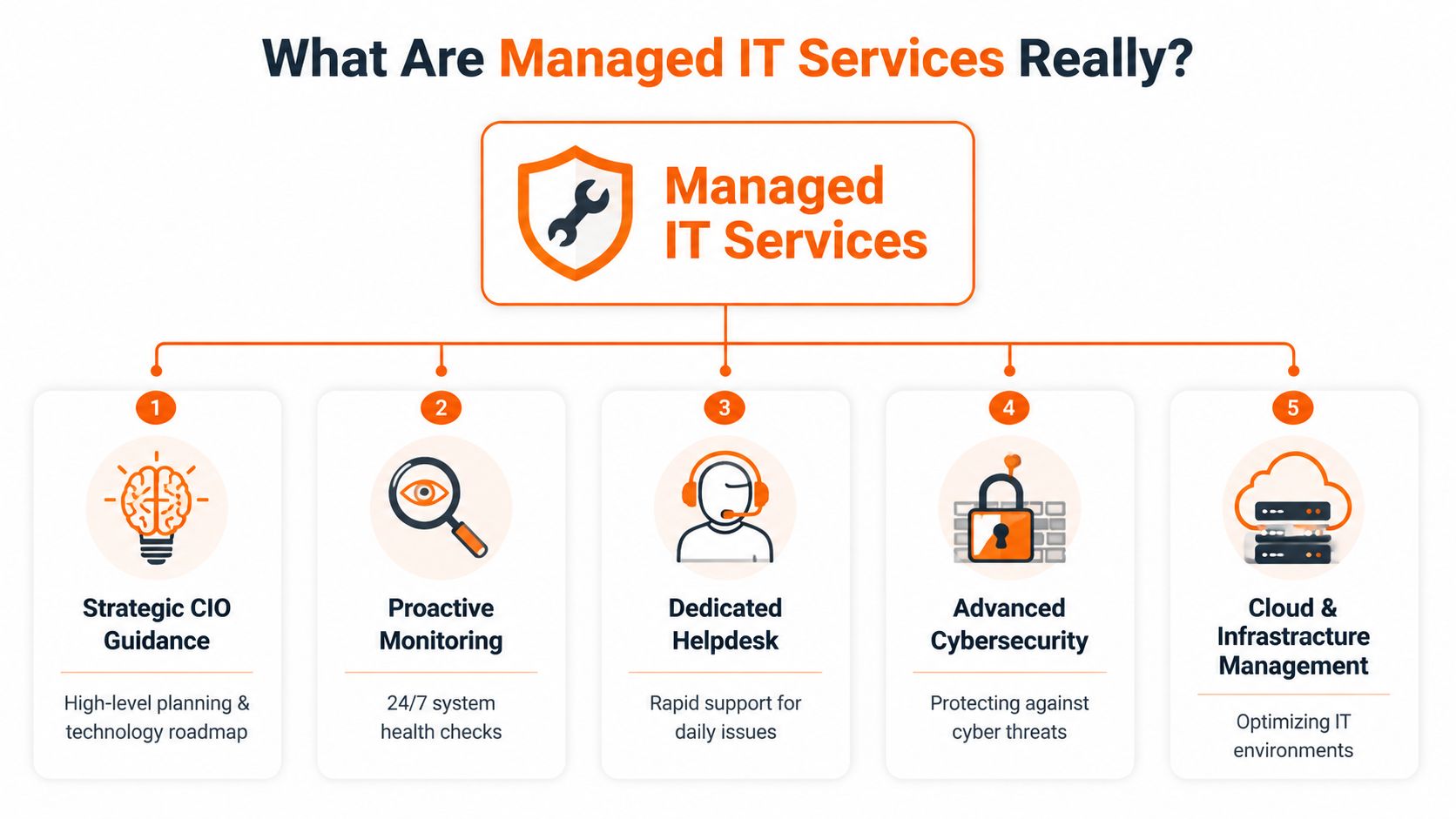
The easiest way to explain it is by contrast.
Break-fix support is reactive
Under the old break-fix model, the supplier gets paid when something breaks. That creates the wrong incentive. Prevention isn’t central to the service. Documentation often trails behind reality. Security improvements happen only when somebody pushes for them. The result is familiar: recurring faults, patchy visibility, and a lot of “we’ll need to investigate that”.
Managed services are built around prevention
With managed it services uk, the provider’s value comes from reducing avoidable disruption. That means standardising how laptops are configured, monitoring servers and networks, controlling software updates, tightening access, and spotting issues before users feel them. It also means looking at IT from the business end, not just the technical end.
A good provider should be able to explain your estate in plain language. Which systems are critical. Where the risks sit. Which licences are underused. Which devices need replacing. What happens if a key person leaves tomorrow. If they can’t explain those basics clearly, they probably don’t have enough control of the environment.
Managed IT should make the business easier to run, not just the technology easier to patch.
That broader support model also affects front-office operations. For example, if your service desk or call handling relies on internal staff juggling reception and support requests, it’s worth reviewing tools such as a virtual receptionist platform for MSPs when assessing how providers structure client contact and triage.
There’s also a governance layer many SMEs underestimate. The right partner doesn’t just maintain systems. They help set standards. They define what gets onboarded, what gets secured, what gets backed up, and what falls outside support. That clarity prevents endless grey areas later. If you want a practical baseline for that scope, this guide on what a managed service provider does is useful because it frames managed services as an operating model, not a shopping list.
The Core Components of a Modern Managed Service
A modern managed service works as an operating model, not a bundle of disconnected tools. The test is simple. When a user issue, security alert, or supplier fault lands at 9:07 on a Monday, someone should own the outcome from first report to resolution. If accountability is split across five providers, your internal team becomes the service integrator.

Support that prevents repeat issues
The visible layer is the helpdesk. The value sits in what happens behind it.
A capable provider uses tickets to identify trends, remove root causes, and improve the environment over time. If the same access problem hits five departments in a month, the right response is to fix the policy, application setup, or device standard causing it. Closing tickets quickly matters, but reducing ticket volume matters more.
Good support usually includes a few signs that the service is under control:
- Clean onboarding: Users, devices, licences, and business-critical systems are logged properly from day one.
- Consistent patching: Operating systems and core applications are updated to an agreed standard, with exceptions recorded.
- Asset planning: You get a clear view of what is in service, what is near end-of-life, and what should be replaced before it fails.
- Defined escalation: Second-line, third-line, vendor, and project escalation paths are clear, so complex issues do not stall in the queue.
That changes the working week. Routine faults still exist, but they stop consuming management time and interrupting revenue-generating work.
Security that matches how people work
Security has to fit the way your business operates. Hybrid staff use home broadband, mobile devices, Microsoft 365, SaaS platforms, and shared files. A managed service should reflect that reality with controls around identity, endpoints, email, user behaviour, network access, and recovery.
For most SMEs, the baseline is straightforward. Multi-factor authentication, patching, endpoint detection, email filtering, secure Microsoft 365 configuration, least-privilege access, and user awareness training should all be part of the discussion. In regulated firms, I would also expect clearer reporting, stronger evidence trails, and a defined process for policy exceptions.
That last point matters. Security only helps if it can be evidenced during an audit or after an incident. For firms with compliance obligations, AuditReady on security in regulated environments is a useful reference because it focuses on controls, proof, and recovery rather than broad marketing claims.
A provider should be able to explain its security stack in plain English. What gets monitored. What triggers an alert. Who responds. What is contained automatically. What still depends on your internal team. If those answers are vague, you are buying tools, not a managed security outcome.
One example of the security layer within a wider outsourced model is managed IT security services from Blowfish Technology, which sets out EDR, ITDR, filtering, awareness training, and Cyber Essentials support as part of day-to-day service delivery.
Here’s a useful explainer before you compare providers:
Cloud backup and communications as one operating model
Many SME estates often become messy. Microsoft 365 sits with one supplier. Backup sits elsewhere. Connectivity and telephony are bought on separate contracts. Each decision can look sensible on its own. During an outage, the gaps show up fast.
A stronger service brings cloud platforms, backup, recovery, connectivity, and voice into one support model with clear ownership. That does not mean one provider must supply every circuit or licence directly. It means one partner should coordinate the service, define responsibilities, and stay accountable when something breaks.
Backup is a good example of the difference between a vendor and a partner. A vendor may sell storage and call it covered. A partner should ask what you need to recover first, how long the business can tolerate downtime, whether Microsoft 365 data is protected separately, and how often restores are tested. Recovery objectives should come from business impact, not product defaults.
Communications need the same discipline. Poor call quality affects sales, support, booking teams, and client service within minutes. Stride Communications explains in its guide to UK VoIP network sovereignty and reliability how direct peering and UK network design can improve reliability for managed voice services. That is the kind of engineering detail worth checking if telephony matters to your operation.
If phones, broadband, cloud access, and user support are all owned separately, delays and blame-shifting become part of the service. A modern managed service reduces that friction by giving the business one accountable route to fix the problem.
Key Business Benefits for UK SMEs and Regulated Sectors
The commercial case for managed services is stronger when you stop looking at IT as a set of tools and start looking at it as a business system. SMEs usually care about four things: control of spend, lower operational risk, smoother day-to-day work, and the ability to grow without rebuilding everything every year.
Better financial control
An in-house team can make perfect sense at a certain size, but many SMEs sit in the awkward middle. They need more than one generalist can provide, but they’re not ready to recruit across infrastructure, security, cloud, and support. A managed service closes that gap with a predictable monthly model and broader coverage.
That doesn’t mean every outsourced contract is cheaper. It means the cost is usually easier to understand. You can budget for support, security, licensing, backup, and user onboarding without getting hit by constant project-style surprises for routine work.
Stronger risk and compliance posture
Managed services are often justified by resilience before they’re justified by cost. That’s sensible. Managed IT services that provide 24/7 monitoring and proactive maintenance resolve 75% of incidents on the same day, directly countering a 30% rise in ransomware attacks targeting UK SMEs, with average recovery costs of £12,000 per incident, according to Mintivo’s review of managed IT support, telephony and connectivity.
For regulated sectors, the value isn’t only technical defence. It’s consistency. Users get onboarded properly. Access gets reviewed. Endpoints are managed. Backups are checked. Security settings don’t drift for months. That discipline makes GDPR, Cyber Essentials, and client due diligence far easier to handle.
A compliance problem often starts as an operations problem that nobody owned early enough.
Productivity that people notice
The most visible benefit is often the least glamorous. Staff stop wasting time. They can log in, access what they need, make calls clearly, share files, and get support without chasing three people. Hybrid workers stop being second-class users. New starters become productive faster because the basics are ready on day one.
For legal practices, that might mean secure document access and cleaner inter-office communication. For manufacturers, it might mean stable connectivity between office staff, production planning, and remote sites. For a finance team, it might mean fewer access bottlenecks around month-end.
Growth gets easier too. When you open a new site, add staff, move applications, or tighten controls for a customer contract, you’re not starting from scratch. You already have a service framework that can absorb change.
How to Evaluate and Choose a UK Managed IT Provider
Expensive mistakes are common for firms. The UK has 12,867 active managed service providers as of March 2025, according to Glass.ai’s report on the UK MSP sector. That’s a crowded market. Plenty of providers can talk fluently about Microsoft 365, cyber, cloud, and support. Far fewer can show clear operating discipline and a good fit for your business.
Start with business fit not tool lists
Begin with your operating reality. Are you multi-site? Do you have line-of-business applications that can’t tolerate disruption? Are you in a regulated sector? Do you need hosted desktops, secure mobile working, VoIP, or formal onboarding and offboarding controls?
Then test how the provider responds. Good firms ask sensible questions back. They want to know how your users work, what systems are critical, where your current frustrations sit, and what success would look like in practical terms. Weak providers jump straight to products.
A useful benchmark when comparing suppliers is whether they can explain support scope, escalation, cyber controls, and account management in plain language. This guide on how to choose IT support is worth reading because it frames the decision around accountability and fit rather than generic feature lists.
Essential Questions for Your Potential IT Partner
| Area of Inquiry | Key Question to Ask | What a Good Answer Looks Like |
|---|---|---|
| Support model | Who answers the phone and handles first response? | A clear explanation of service desk coverage, escalation, and who owns unresolved issues |
| Monitoring | What do you proactively monitor across endpoints, servers, cloud, and connectivity? | Specific examples of monitored systems and what triggers action |
| Security | How do you deliver EDR, identity protection, filtering, patching, and user awareness? | A joined-up answer that covers prevention, detection, and response |
| Compliance | How do you support firms in legal, finance, or other regulated sectors? | Experience with evidence, policies, secure access, and structured controls |
| Backup and recovery | What is backed up, how is it tested, and who owns recovery planning? | Clear scope, recovery responsibilities, and proof that restore readiness is taken seriously |
| Commercial model | What is included in the monthly fee and what falls outside it? | Transparent boundaries, with no fuzzy wording around project work or excluded systems |
| SLA quality | Which service levels do you actually report against? | Measurable response and resolution commitments, not vague promises |
| Account management | Who helps us plan improvements over the next year? | Named ownership for roadmap, reviews, and prioritised recommendations |
Red flags worth taking seriously
Some warning signs keep repeating in failed outsourcing arrangements:
- Vague SLAs: If the proposal says “fast response” or “best endeavours” without measurable definitions, push harder.
- Security as an add-on: If core protections feel bolted on rather than embedded, expect gaps later.
- No onboarding method: Providers who can’t explain transition planning usually create a messy first quarter.
- Overreliance on one person: If all technical context sits with a single engineer, resilience is weak from day one.
- Too much yes, not enough challenge: Good MSPs don’t just agree. They tell you when a setup is risky, unsupported, or badly sequenced.
A provider should feel like an operational partner. If they feel like a reseller with a helpdesk attached, keep looking.
Managed IT in Action Real-World UK Examples
A good managed service should make operational pressure easier to control. The clearest way to test that is to look at situations that match the way UK SMEs work day to day, not just at a feature list.
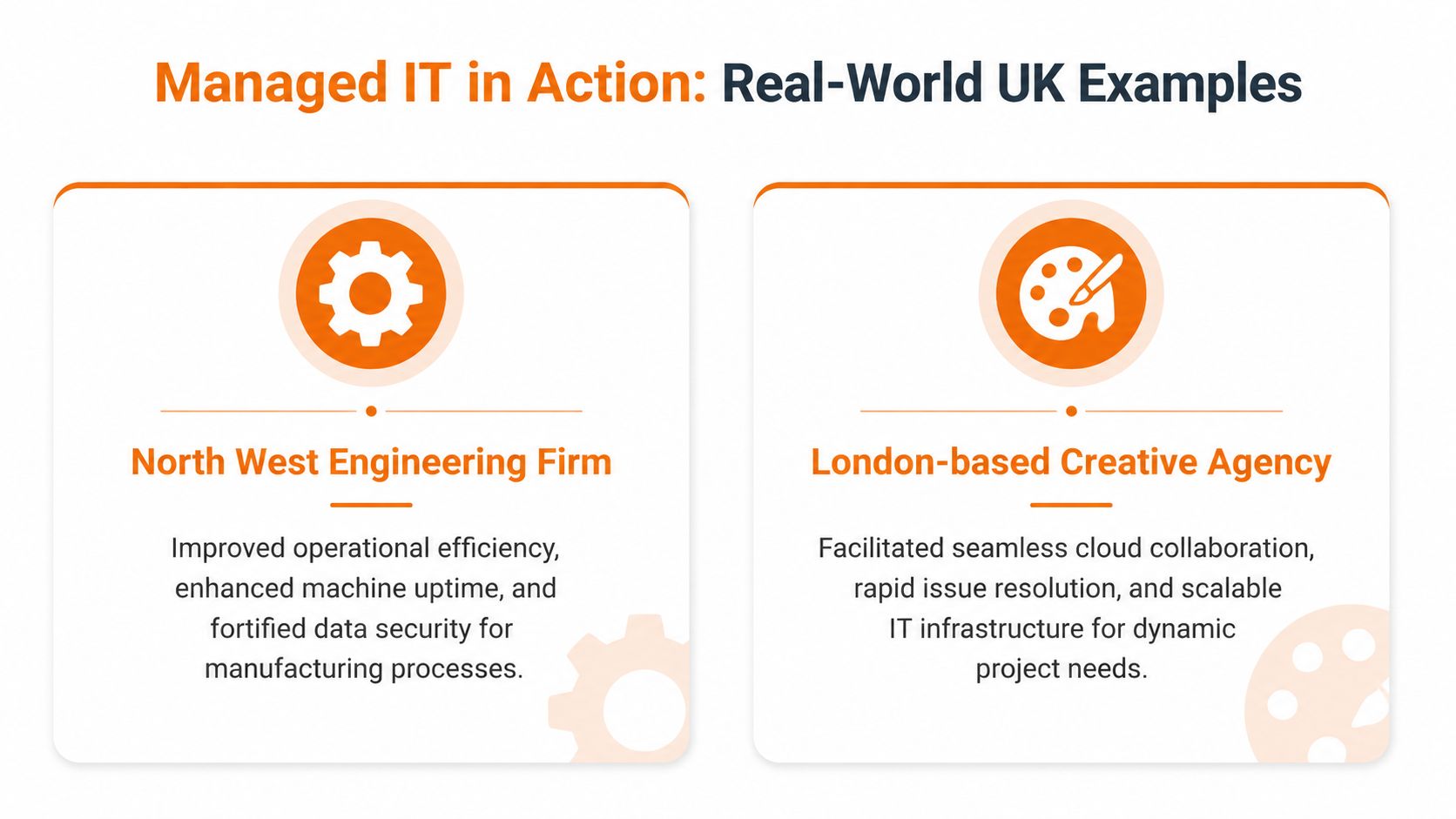
Engineering firm with remote design and recovery risk
A North West engineering firm had a pattern I see often in growing businesses. The design team needed dependable remote access to drawings and project files, but permissions had drifted over time as staff changed roles and projects expanded. Backups existed, yet nobody had clearly defined who owned restores, testing, or the decision-making during an incident. The board also wanted better preparation for Cyber Essentials without creating extra friction for engineers.
The right answer was a managed service built around the way the business operated. Microsoft 365 administration needed tighter control. Backup needed defined restore ownership and regular testing. Endpoints needed active protection, and identity needed stronger access controls tied to user roles. Device standards also had to be tightened so remote access worked consistently across the estate.
That changed the outcome in practical terms. Engineers could work remotely with fewer access problems. Directors had a clearer view of recovery responsibility. The business reduced the risk of finding, during an outage, that backup existed but recovery had never been properly planned.
Security depth matters in this kind of environment. As noted earlier, many providers still talk about protection in broad terms rather than showing how endpoint, identity, and recovery controls work together. For a firm handling intellectual property and client project data, that is not a detail. It is a selection test.
Ask a provider to explain how they would secure identity, endpoints, and recovery for your workflow. If the answer stays at product level and never reaches user roles, file access, restore decisions, and remote working controls, expect gaps later.
Legal practice with multi-site communication issues
A multi-site legal practice had a different problem. Systems were available, but the working day felt disjointed. Calls between offices lacked consistency. User access varied too much by location. New starters took longer than they should to become productive. Fee earners spent too much time working around systems instead of serving clients.
A stronger managed setup brought those parts under one operating model. Secure VoIP, hosted desktops, clearer onboarding and offboarding, and tighter document access controls reduced the number of handoffs between separate suppliers and internal staff. Support became easier to route because ownership was clearer. Management also gained better oversight of who had access to what, and how services were performing across offices.
The business impact was wider than IT. Staff could move between sites and home working with less disruption. New joiners were provisioned more consistently. Partners and practice managers had fewer low-grade operational issues draining time from billable work and client service.
These examples show what managed IT should do for an SME. It should turn scattered technical purchases into an accountable service that supports how the business runs, grows, and controls risk. The provider that fits best is usually the one that understands your operating model, decision points, and compliance pressures, not the one with the longest product list.
Your Next Step Towards Strategic IT
If your business is still treating IT as a set of separate purchases, you’ll keep seeing separate problems. Support won’t line up with security. Backup won’t line up with recovery. Communications won’t line up with how staff work. Managed it services uk is valuable because it brings those moving parts under one accountable structure.
For SMEs, that creates room to operate properly. Directors get predictability. Staff get reliable tools. Regulated firms get a stronger foundation for audit, access control, and resilience. Growth becomes easier because systems are managed with intent, not patched together as the business expands.
The right provider won’t just promise responsiveness. They’ll show how they onboard, document, secure, support, and improve your environment over time. That’s the difference between buying a vendor and choosing a partner.
If you’re reviewing your current setup, Blowfish Technology can help you assess where support, security, backup, Microsoft 365, and communications need tightening, then map out a practical next step with no-obligation guidance for your business.

The Blowfish Technology team. Managed IT, cloud services, software development and connectivity for North West businesses since 1999.