
A Monday morning outage rarely begins with a clean technical failure. It begins with people asking different questions at the same time. Which orders can still ship? Can fee-earner documents be opened? Who tells clients? Does the phone system work? Are backups usable, and which service should be restored first?
That confusion is the gap a business impact analysis is designed to close. It connects business priorities to recovery decisions, so an engineering firm, legal practice or finance SME can defend its thresholds to directors, insurers, auditors and managed service providers. The useful output isn't a polished spreadsheet. It's a live decision layer that tells people what matters, how quickly it must return, and which dependencies make recovery possible.
Table of Contents
- When the Phones Went Dead and the Plan Was Missing
- What Business Impact Analysis Actually Means
- Why UK SMEs Cannot Afford to Skip a BIA
- The Seven-Step BIA Process From Scoping to Sign-Off
- Getting RTO, RPO and MTPD Right
- BIA in Practice for Engineering, Legal and Finance SMEs
- Turning BIA Findings Into a Mitigation Roadmap
- Your 30/60/90-Day BIA Implementation Checklist
When the Phones Went Dead and the Plan Was Missing
At a North West engineering firm, a ransomware incident encrypts a shared file server before the first design meeting. The phones technically remain online, but the switchboard is jammed with calls from staff, suppliers and customers. The operations director knows the business has backups. Nobody can agree whether to restore the finance system, the CAD vault, production scheduling or the document management platform first.
That distinction matters. Having backups isn't the same as knowing what to recover first. A backup gives you a potential recovery mechanism. A business impact analysis gives you the priorities, thresholds and dependencies that determine whether the mechanism is fit for purpose.
The first hour exposes gaps that a template often hides:
- Ownership: Nobody has confirmed who can authorise a restore or accept a temporary workaround.
- Sequence: The team hasn't documented whether identity, networking, storage or an application must return first.
- People: The person who understands the production planning system is unavailable.
- Communications: Staff can't tell customers what happened because the call-handling process depends on the same disrupted environment.
- Evidence: The business can't show which recovery targets were approved or tested.
A legal practice faces a different version of the same problem. Client confidentiality, matter deadlines and access to case files compete for attention. A finance firm may need to prioritise transaction processing, client money controls or regulatory communications. In each case, the technical incident is only the trigger. The business impact determines the recovery order.
Practical rule: If your team can't name the first three services to restore, the organisation doesn't yet have a usable recovery priority.
A BIA should sit alongside a practical effort to test your incident response plan, including decisions about escalation, communications and authority. Connectivity deserves the same scrutiny. A documented recovery sequence is of limited value if staff have no reliable route into core services, which is why business broadband failover solutions belong in the dependency discussion.
What Business Impact Analysis Actually Means
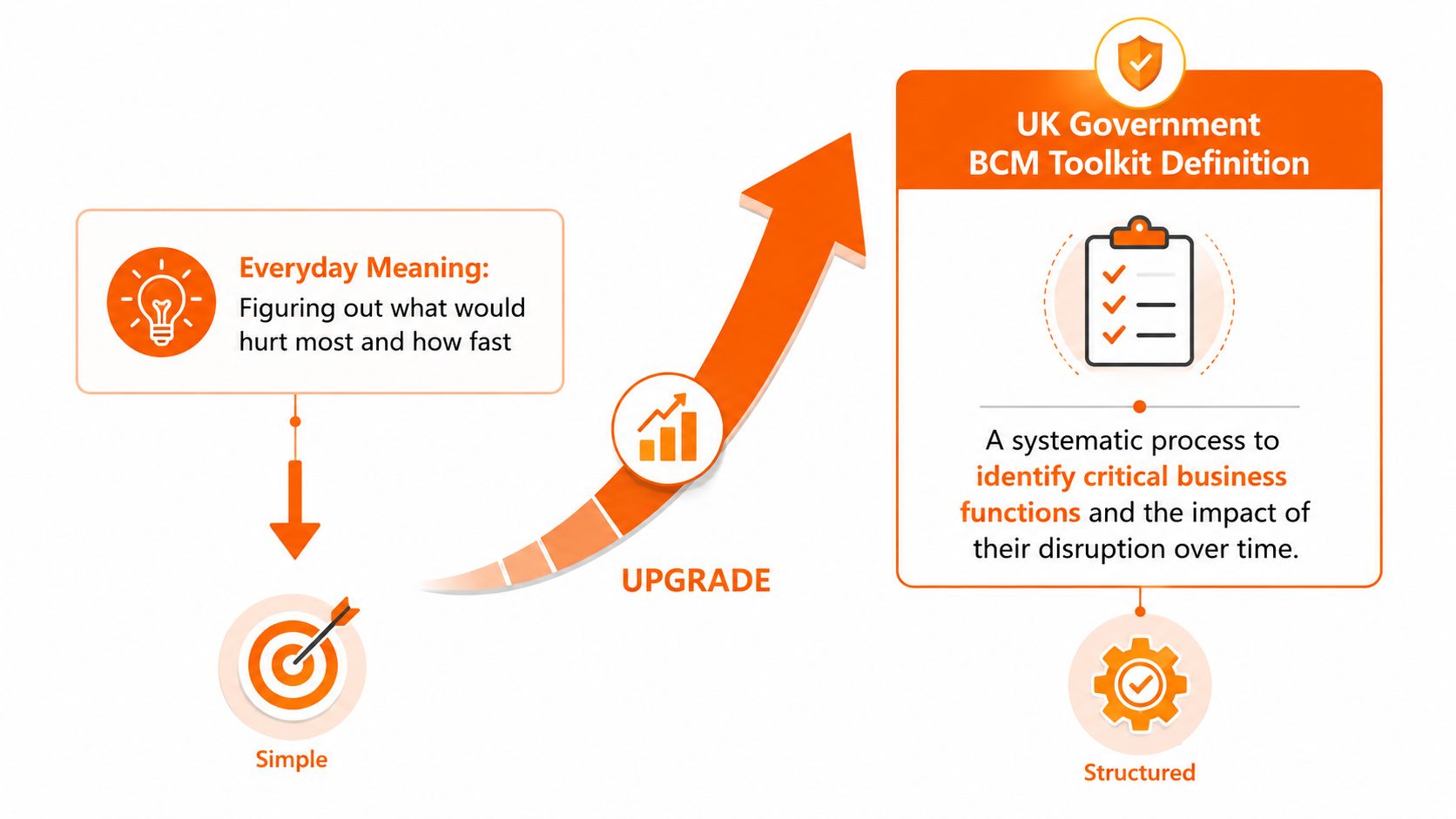
In plain English, a BIA means figuring out what would hurt most and how fast. You identify the products, services and activities that keep the firm operating, then assess how disruption affects customers, cashflow, compliance, safety, reputation and staff as time passes.
The UK Government Business Continuity Management Toolkit gives that idea a more structured shape. It describes BIA as a process for identifying key products and services, the critical activities needed to deliver them, the impacts of disruption and the resources required to resume operations. It also connects the analysis to recovery thresholds, including maximum tolerable downtime, recovery time objective and recovery point objective. The UK Government BCM Toolkit therefore places BIA at the point where business priorities become recovery decisions.
Where BIA fits
A BIA isn't a risk register, although it uses information from risk management. Risk assessment asks what could happen and how likely a threat might be. BIA asks what happens to the business when a service, activity, person, site or supplier becomes unavailable.
It also isn't the complete continuity plan. The BIA establishes priorities and thresholds. The business continuity plan explains how people continue working, communicating and serving customers. IT disaster recovery turns system requirements into technical restoration procedures. Incident response manages the live event, including containment, investigation and escalation.
A sound project involves more than IT. Operations owners understand customer commitments and manual workarounds. Finance identifies payment, payroll and cashflow consequences. HR contributes workforce and key-person dependencies. Legal and compliance teams interpret confidentiality, contractual and regulatory exposure. Facilities and supplier owners identify property, utilities and third-party constraints.
The result should answer practical questions:
- Which products or services are critical?
- Which activities deliver them?
- What must be available for each activity to operate?
- How quickly must service return?
- How much data can the organisation lose?
- What happens if the required people, premises or supplier aren't available?
That makes BIA the decision layer for investments in backup, security, connectivity, hosted desktops and recovery testing. Without it, a supplier can offer a technically impressive service that still misses the organisation's actual business requirement.
Why UK SMEs Cannot Afford to Skip a BIA
UK SMEs aren't a peripheral audience for resilience planning. At the start of 2024, the country had 5.5 million SMEs, representing 99.8% of the UK business population, and those firms employed 16.637 million people, just under 60% of total UK employment, according to the UK Government evidence annex for small and medium-sized businesses.
The same source records £107.9 billion of SME goods exports in 2023, equivalent to 25.6% of total UK goods exports. The practical implication is direct. A disruption at a small firm can affect jobs, orders, supplier commitments, customer service and trade performance. The SME structure makes continuity a business issue, not a niche technology concern.
The House of Commons Library reports that SMEs account for 60% of UK employment and 48% of business turnover, while a parliamentary SME Finance briefing cites around 5.55 million SMEs and about 8,000 large businesses in 2023. Those figures are available through the ONS Business Insights and Conditions Survey bulletin, which represents the wider move towards recurring, near-real-time monitoring of financial performance, workforce, trade and resilience.

Turning disruption into a defensible cost decision
Government-backed economic modelling estimates the average cost of a significant cyber attack at almost £195,000 per individual business, with a projected annual UK-wide cost of £14.7 billion, or 0.5% of GDP. These figures come from the economic modelling of sector-specific cyber-attack costs.
A BIA doesn't prevent every incident. It can, however, establish which downtime and data-loss windows create unacceptable exposure. That gives the board a basis for deciding whether the firm needs more frequent backups, a different recovery architecture, resilient communications, additional staff cover or a tested manual process.
For regulated SMEs, the analysis also supports evidence-led conversations about ICO expectations, FCA operational resilience, SRA obligations, Cyber Essentials and Cyber Essentials Plus. The BIA shouldn't claim that certification alone makes a business resilient. It should show how controls support specific services and where gaps remain. For a practical view of how downtime can affect a North West organisation, review the real cost of an hour's IT downtime, then replace assumptions with figures your own leadership team accepts.
The Seven-Step BIA Process From Scoping to Sign-Off
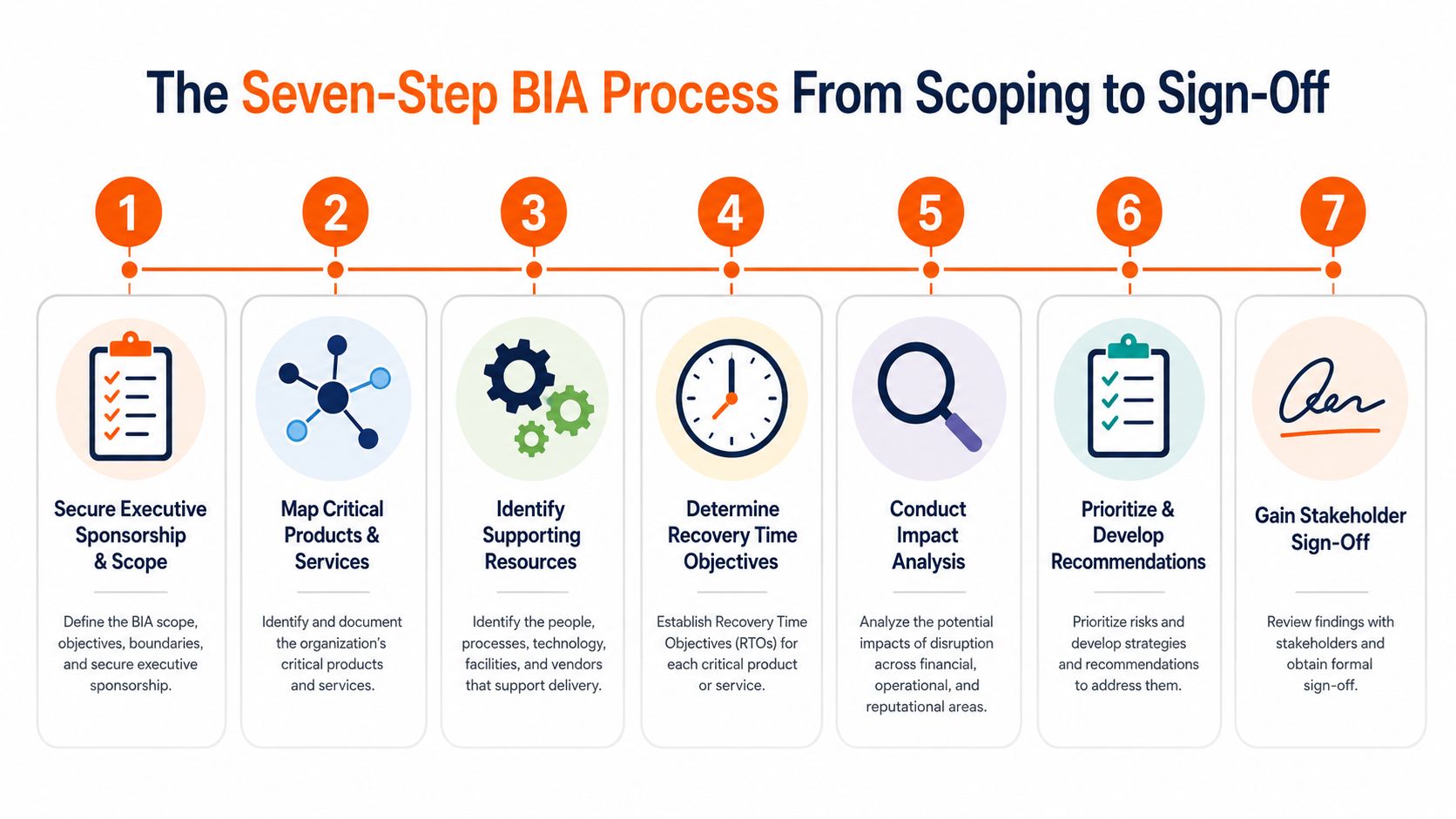
A BIA works best as a sequence of evidence and decisions. Each stage produces an artefact that the next stage can challenge or improve.
Start with authority and a controlled scope
Secure executive sponsorship and scope. Name the accountable director, define the locations and business units included, and agree which decisions the project must support. The output is a signed project brief, not an open-ended request for every department to describe every process.
Map critical products and services. Begin with what customers, regulators or trading partners rely on. An engineering firm might start with design delivery and production scheduling. A legal practice might start with active matters and client communication. The output is a service catalogue with owners and priority candidates.
Identify supporting activities and dependencies. Trace each service through applications, data, devices, premises, suppliers, staff, skills and internal hand-offs. Ask what happens if Microsoft 365, the internet connection, a third-party SaaS platform or a particular specialist is unavailable. Produce a dependency map and record confidence levels where information is uncertain.
Convert business knowledge into thresholds
Assess impacts over time. Don't use a single “high” or “low” rating and stop there. Record what disruption means during the first period, after a working day, after several days and beyond the point where the business can no longer meet its obligations. The output is an impact profile or time-loss curve covering financial, operational, legal, regulatory, reputational and safety effects.
Define MTPD, RTO and RPO. Set the maximum tolerable period of disruption, the target restoration time and acceptable data loss for each important activity. The output is an approved threshold register. Keep business targets separate from supplier promises.
Identify minimum resources. Document the people, locations, equipment, applications, information and suppliers required to run at an agreed minimum service level. Include deputies, manual workarounds and access arrangements. The output is a minimum operating requirement for each critical activity.
Make the findings actionable
Produce a signed report. Summarise priorities, dependencies, thresholds, gaps, investment choices, owners and review dates. Directors should be able to see what the business accepts, what it funds and what residual risk it retains.
The project length depends on scope, data quality and stakeholder availability. Don't promise a fixed timetable before confirming those conditions. A small, focused BIA can produce useful decisions quickly, while a multi-site or regulated environment needs more validation.
Getting RTO, RPO and MTPD Right
These terms matter because vague recovery language creates vague technical designs.
- MTPD: The longest period an activity can be disrupted before the resulting impact becomes unacceptable.
- RTO: The target time for restoring the activity or service after disruption.
- RPO: The maximum acceptable age of the data available after recovery, expressed as a point in time.
Suppose a firm decides that a client-facing document service must return within four hours, while the business can tolerate no more than one hour of lost work. The target RTO is four hours and the RPO is one hour. The MTPD might be longer, because the organisation has a defined but increasingly damaging workaround after the target restoration time. The exact values must come from the activity owner and leadership, not from a supplier's standard package.
The thresholds must drive the design
| Threshold | What It Means | Drives | Typical Design |
|---|---|---|---|
| MTPD | The point at which disruption becomes unacceptable | Business continuity position | Manual workaround, alternate site, staffing and escalation |
| RTO | Target time to restore service | Disaster recovery architecture | Active-active, pilot light, warm recovery or cold standby |
| RPO | Acceptable data loss window | Backup and replication cadence | Frequent backups, replication, immutable copies and restore validation |
A common mistake is treating MTPD and RTO as interchangeable. They aren't. The RTO is an operational target, while the MTPD describes the outer limit of tolerable disruption. Another mistake is setting RPO to zero without funding the replication, application consistency and testing needed to approach that outcome. A third is writing an RTO that ignores working hours, staff availability, authentication, connectivity and supplier response.
When reviewing an MSP proposal, ask which service component meets each threshold. A managed backup platform may address data recovery but not application rebuild time. An EDR service may help contain an attack but won't restore a damaged file share. A recovery time objective should therefore be tied to a tested recovery procedure, not presented as a marketing label.
Recovery targets are business commitments first and technology specifications second.
BIA in Practice for Engineering, Legal and Finance SMEs
The same questionnaire produces poor results when every department is forced into identical assumptions. Sector context changes the critical activity, the impact curve and the dependency that deserves attention.
Engineering and manufacturing
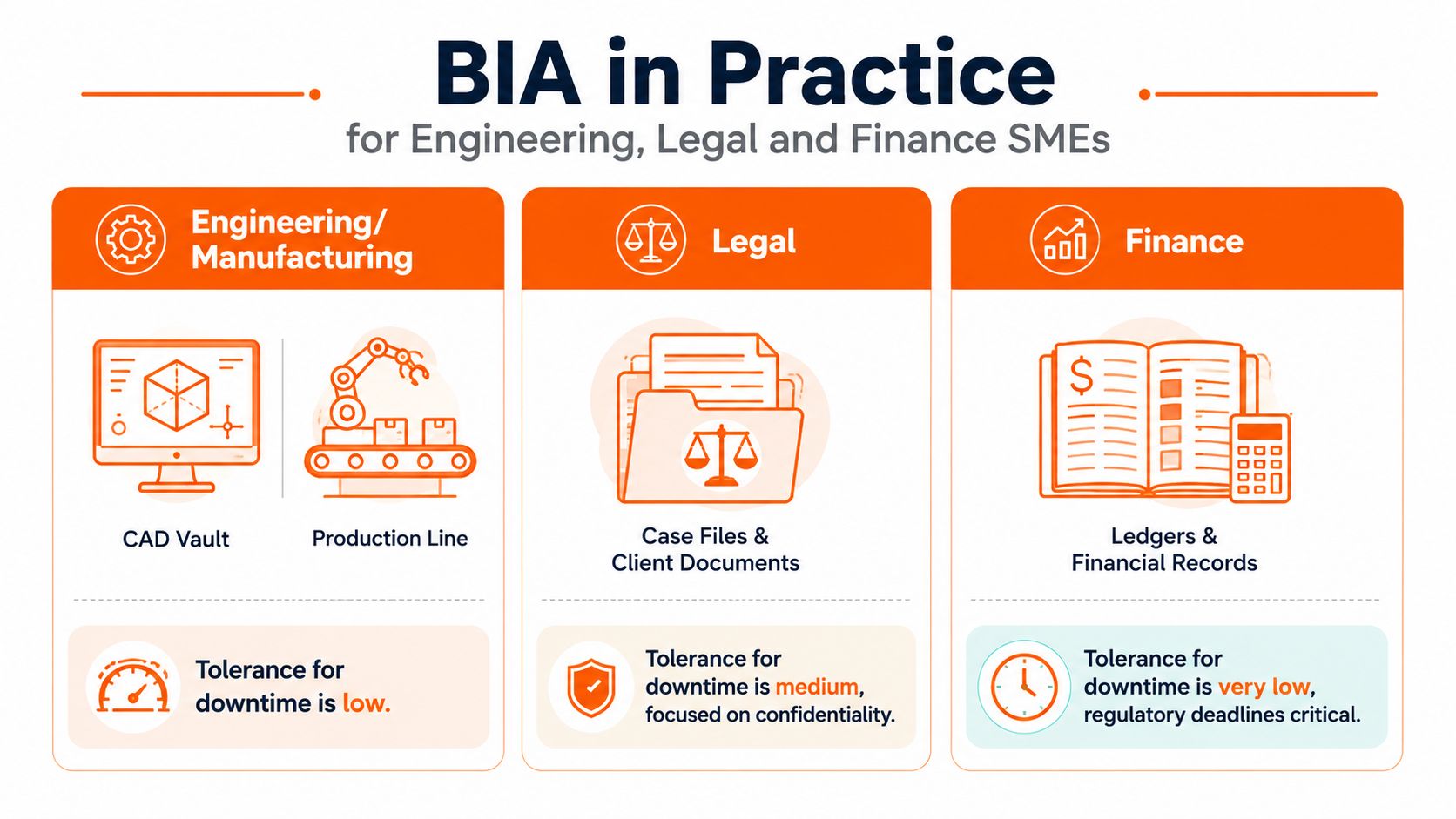
A design and manufacturing firm might rank the CAD vault, production planning and the production-line HMI near the top. A temporary interruption to a low-priority administrative system may be manageable, but losing design IP can create a more serious and longer-lasting consequence than simple downtime.
The BIA should test whether drawings exist in recoverable, version-consistent copies, whether the production line can run safely in manual mode, and whether the specialist who understands a machine or application is available. It should also examine supplier portals, site access, power, network connectivity and the relationship between design approval and production release.
Legal practices
A legal SME may prioritise active matter management, document repositories, email, time recording and client communications. The recovery requirement for an active matter can be much tighter than for internal knowledge content, particularly where confidentiality, court deadlines or client instructions are involved.
The dependency map should include secure access, identity controls, third-party case management, paper files, fee-earner availability and the ability to work from an alternate location. A short RTO alone doesn't prove resilience if restored users can't access the correct matter data or if the firm has no tested confidentiality process for emergency document handling.
Finance firms
A finance practice may place transaction processing, ledgers, client money controls and regulated reporting ahead of general administration. Trading windows, payment deadlines and client communications can create narrow recovery requirements, while a service that appears secondary to IT may be essential to operational resilience.
Map the financial platform, banking interfaces, authentication, key staff, outsourced processing and failover arrangements. Test whether the alternate service preserves transaction integrity rather than merely providing access to an empty environment. The board should approve the thresholds and understand which dependencies remain outside the firm's direct control.
The useful comparison isn't which sector has the “most critical” systems. It's whether each firm has translated its own obligations into tested recovery decisions.
Turning BIA Findings Into a Mitigation Roadmap
A BIA earns its keep when every material gap becomes an owned action. The roadmap should connect the finding, the required threshold, the proposed control, the test evidence and the person responsible.
| BIA finding | Service or action to consider | Evidence to request |
|---|---|---|
| Backup doesn't meet the approved RPO | Managed backup, including Microsoft 365 backup where relevant | Restore records, retention design and test results |
| Recovery cannot meet the RTO | Managed disaster recovery or a redesigned restoration sequence | Exercise timings and application dependency evidence |
| Cyber incident threatens availability | Managed EDR, ITDR, DNS filtering, MFA and user awareness controls | Alert handling, containment and recovery procedures |
| Certification work lacks structure | Cyber Essentials or Cyber Essentials Plus support | Scope, remediation log and certification evidence |
| Staff can't work from the primary site | Hosted or remote desktops | Identity, device, application and connectivity tests |
| Telephony or internet is a single point of failure | Managed VoIP and business broadband resilience | Failover test, call routing and escalation records |
These services don't solve every BIA finding. Key-person risk needs deputies, cross-training and documented procedures. Paper records need secure access, prioritised scanning or controlled manual handling. A supplier dependency needs contractual review, exit planning and an alternative process. Property loss needs premises and facilities planning, not just cloud technology.
For a broader operational perspective on how to keep your firm running, continuity planning should be treated as a business operating discipline rather than an IT-only task. The technical recovery plan should then reflect the thresholds approved in the BIA. A useful disaster recovery plan links each service to its owner, dependency chain, recovery method and test schedule.
Blowfish Technology is one option for SMEs that want managed IT, backup and disaster recovery, EDR, hosted desktops, VoIP, connectivity and Cyber Essentials support considered within a technology roadmap. The key decision isn't the supplier name. It's whether the proposed service can demonstrate the recovery outcome your BIA requires.
Your 30/60/90-Day BIA Implementation Checklist
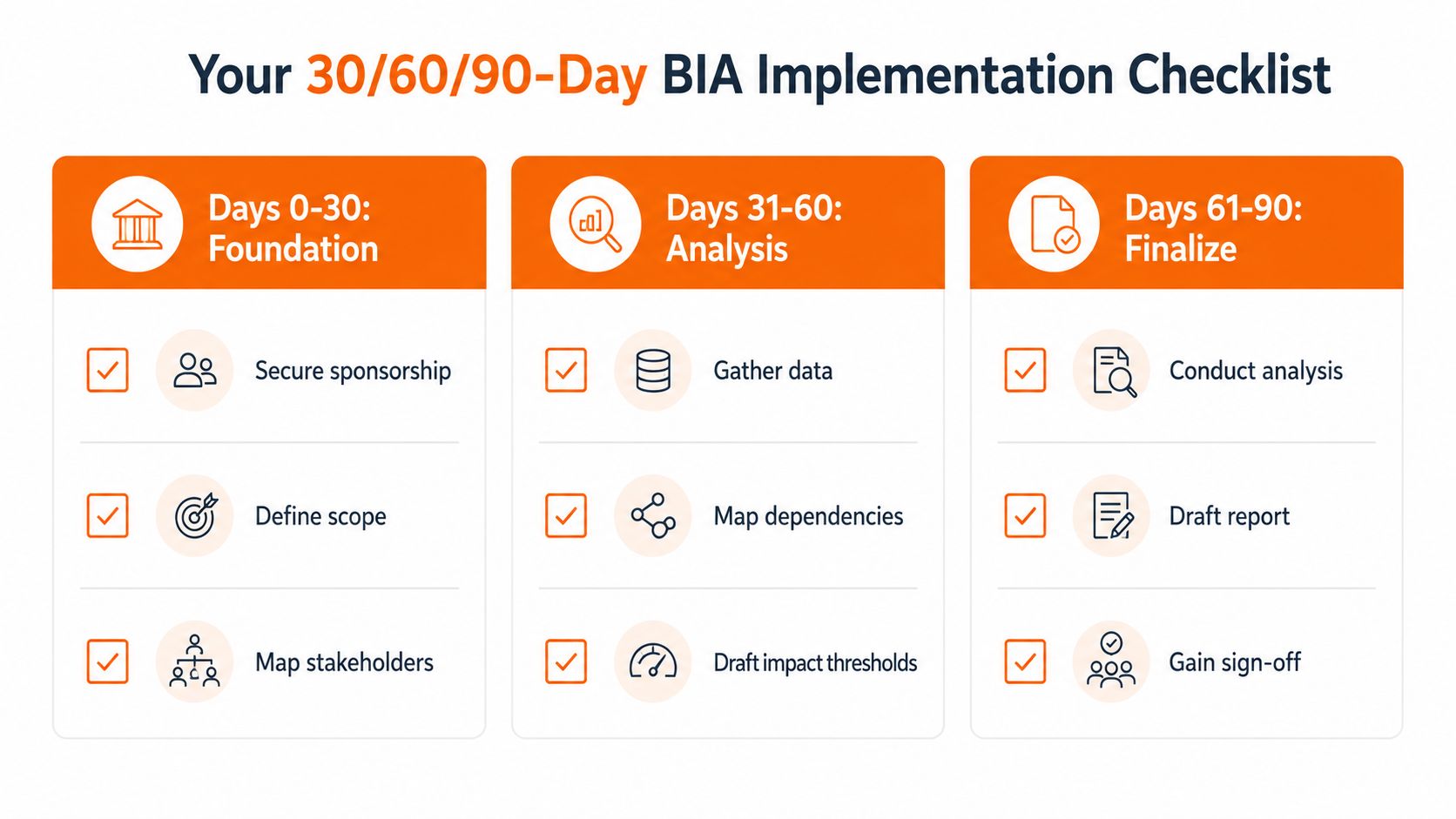
Use the first month to secure sponsorship, define scope and map stakeholders. In the next phase, gather process data, dependencies and draft MTPD, RTO and RPO thresholds. The final phase should complete the analysis, close the report, obtain sign-off, brief suppliers and set the first review date.
Track approved thresholds, recovery test pass rates, unresolved dependency gaps, Cyber Essentials progress and service performance against agreed SLAs. Avoid unowned actions, untested recovery claims and spreadsheets that nobody reviews.
Blowfish Technology can help North West SMEs translate a business impact analysis into managed backup, disaster recovery, cybersecurity, hosted desktop, VoIP and connectivity decisions. Visit Blowfish Technology to discuss your recovery thresholds, dependency gaps and a practical technology roadmap with its team.

The Blowfish Technology team. Managed IT, cloud services, software development and connectivity for North West businesses since 1999.