
Every organisation today faces an unprecedented challenge: keeping business operations secure whilst maintaining productivity and growth. The digital transformation that has revolutionised how companies operate has simultaneously exposed them to sophisticated cyber threats that evolve daily. For businesses across the North West and throughout the UK, understanding how to implement comprehensive security measures isn't merely a technical consideration but a fundamental requirement for survival and success in 2026.
The Foundation of Business Secure Operations
Creating a business secure environment begins with understanding the core components that protect your organisation. Security isn't a single product or service; it's a holistic approach that encompasses technology, processes, and people working in harmony.
Physical and digital security converge in modern organisations. Your infrastructure requires protection at multiple levels, from network perimeters to individual endpoints. This multi-layered defence strategy ensures that if one security measure fails, others remain in place to prevent breaches.
The concept of defence in depth has become essential. Consider these fundamental layers:
- Network security through firewalls and intrusion detection systems
- Endpoint protection with advanced malware prevention
- Data encryption both at rest and in transit
- Access management through identity verification protocols
- Continuous monitoring with real-time threat detection
Each layer contributes to making your business secure against different attack vectors. Cybersecurity basics from NIST provide excellent guidance on establishing these foundational elements.
Implementing Multi-Factor Authentication
Multi-factor authentication (MFA) has evolved from optional best practice to mandatory requirement. This security measure makes your business secure by requiring users to verify their identity through multiple channels before accessing systems.
Implementation challenges exist, particularly in organisations with legacy systems. However, the security benefits far outweigh the initial configuration effort. MFA reduces the risk of unauthorised access by up to 99.9%, even when credentials become compromised through phishing or data breaches.
Modern MFA solutions integrate seamlessly with cloud services, on-premise applications, and hybrid environments. They support various authentication methods including biometrics, SMS codes, authenticator apps, and hardware tokens.

Data Protection and Backup Strategies
Your data represents your business's most valuable asset. Making this data secure requires comprehensive protection strategies that address multiple scenarios, from accidental deletion to ransomware attacks.
Regular backups form the cornerstone of data protection. However, simply creating backups isn't sufficient. Your backup strategy must follow the 3-2-1 rule: three copies of data, on two different media types, with one copy stored offsite.
| Backup Type | Frequency | Retention | Location |
|---|---|---|---|
| Full Backup | Weekly | 12 months | On-site + Cloud |
| Incremental | Daily | 30 days | On-site |
| Critical Systems | Hourly | 7 days | On-site + Off-site |
| Archive | Quarterly | 7 years | Cloud Storage |
Understanding the real cost of IT downtime emphasises why robust backup systems remain non-negotiable for modern organisations. A single hour of downtime can cost thousands of pounds in lost productivity, damaged reputation, and missed opportunities.
Cloud Security Considerations
Cloud services have transformed business operations, but they introduce unique security challenges. Making your business secure in cloud environments requires understanding the shared responsibility model between you and your cloud provider.
Your cloud provider secures the infrastructure, whilst you remain responsible for securing your data, applications, and user access. This division of responsibility means organisations must implement additional security controls beyond what providers offer by default.
Cloud migration services should always incorporate security planning from the outset. Retrofitting security after migration proves significantly more complex and expensive than building it into your cloud strategy initially.
Encryption serves as fundamental protection for cloud-stored data. All sensitive information should be encrypted before transmission to cloud services, ensuring that even if unauthorised parties intercept data, they cannot read it without encryption keys.
Network Security and Access Control
Creating a business secure network infrastructure requires sophisticated approaches to monitoring and controlling data flow. Traditional perimeter-based security models have given way to zero-trust architectures that verify every access request regardless of origin.
Zero-trust security assumes breach. Rather than trusting everything inside your network perimeter, this model requires continuous verification of every user, device, and application attempting to access resources.
Implementation steps for zero-trust include:
- Identify all data and assets across your organisation
- Map data flows to understand how information moves
- Architect your network with micro-segmentation
- Create granular access policies based on least privilege
- Monitor and log all network activity continuously
- Implement automated responses to detected threats
Following ten cybersecurity best practices helps organisations build comprehensive security frameworks that address modern threats effectively.
Securing Remote and Hybrid Work
The shift to remote and hybrid work models has permanently changed how organisations approach security. Making your business secure now means protecting endpoints across diverse locations and network environments.
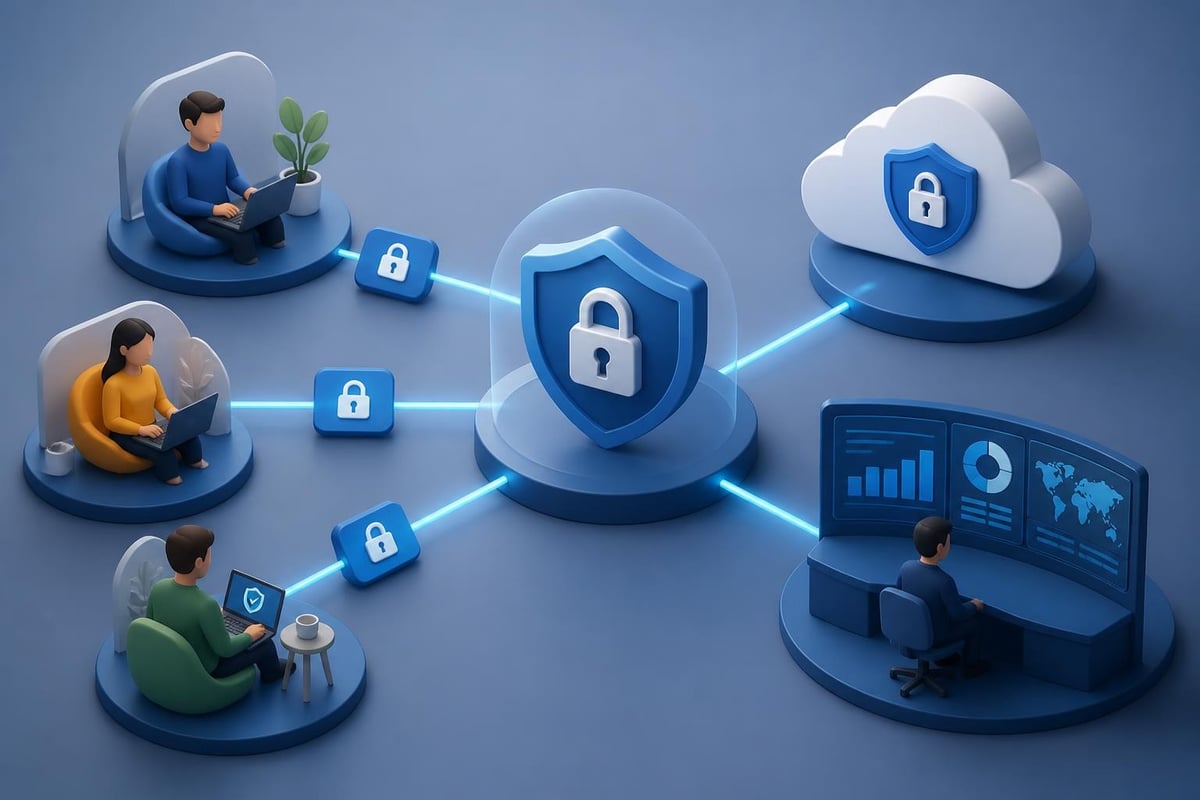
Virtual Private Networks (VPNs) provide encrypted tunnels for remote workers accessing company resources. However, VPNs alone don't constitute complete remote security. Organisations must also implement endpoint detection and response (EDR) solutions that monitor devices for suspicious activity.
Managed IT support becomes particularly valuable for organisations without dedicated security teams, ensuring continuous monitoring and rapid response to threats regardless of where employees work.
Employee Training and Security Awareness
Technology alone cannot make your business secure. Human factors account for approximately 82% of data breaches, making employee education critical to comprehensive security strategies.
Regular security training reduces risk dramatically. Employees who understand common attack vectors, recognise phishing attempts, and follow security protocols serve as your first line of defence rather than your weakest link.
Effective training programmes should cover:
- Phishing recognition with simulated exercises
- Password hygiene and credential management
- Social engineering tactics attackers employ
- Data handling procedures for sensitive information
- Incident reporting processes when threats are identified
- Mobile device security for smartphones and tablets
Understanding whether employees represent security’s weakest link helps organisations target training efforts effectively. Security awareness isn't a one-time event but an ongoing cultural shift.
Creating a Security-Conscious Culture
Building a business secure culture extends beyond formal training sessions. Security must become ingrained in daily operations and decision-making processes throughout your organisation.
Leadership commitment drives cultural change. When executives prioritise security and model secure behaviours, employees follow suit. Regular communication about security importance, sharing relevant threat intelligence, and recognising employees who demonstrate security awareness all contribute to cultural transformation.
Gamification makes security training engaging. Organisations implementing competitive elements, rewards for identifying threats, and interactive learning modules see significantly higher engagement rates than those relying solely on traditional training methods.
Compliance and Regulatory Requirements
Operating a business secure enterprise means meeting various regulatory requirements that govern data protection and privacy. Non-compliance carries severe consequences including substantial fines, legal liability, and reputational damage.
GDPR compliance remains mandatory for UK organisations handling personal data. The regulation requires organisations to implement appropriate technical and organisational measures to protect personal information.
| Regulation | Applicability | Key Requirements | Penalty for Non-Compliance |
|---|---|---|---|
| GDPR | All UK businesses processing personal data | Data protection by design, breach notification, consent management | Up to £17.5 million or 4% of annual turnover |
| Cyber Essentials | Government contractors, increasingly private sector | Five technical controls implementation | Contract exclusion, competitive disadvantage |
| PCI DSS | Organisations processing card payments | Secure network, cardholder data protection | Fines, loss of processing privileges |
| ISO 27001 | Optional certification | Information security management system | N/A (voluntary standard) |
Cyber Essentials certification increasingly becomes a contract requirement across the North West, demonstrating baseline security competence to clients and partners.
Industry-Specific Security Requirements
Manufacturing and industrial sectors face unique challenges in keeping operations business secure. Operational Technology (OT) systems that control physical processes require different security approaches than traditional IT systems.
Air-gapping critical systems provides one layer of protection, but modern manufacturing increasingly requires connectivity for efficiency gains. Manufacturing cybersecurity must balance security requirements with operational needs.
The convergence of IT and OT creates new attack surfaces. Organisations must secure industrial control systems, SCADA networks, and IoT devices whilst maintaining the reliability and uptime essential to manufacturing operations.

Incident Response and Recovery Planning
Even the most robust security measures cannot guarantee complete protection. Making your business secure requires planning for incident response and recovery alongside preventive measures.
Incident response plans outline specific steps your organisation takes when detecting security incidents. These plans should define roles, responsibilities, communication protocols, and technical procedures for containing and remedying breaches.
Effective incident response follows six phases:
- Preparation through policy development and team training
- Identification of security events through monitoring
- Containment to prevent incident escalation
- Eradication of threats from affected systems
- Recovery of normal operations and services
- Lessons learned through post-incident analysis
Regular testing validates your incident response plan effectiveness. Tabletop exercises and simulated incidents reveal gaps before real attacks occur, allowing refinement of procedures and training.
Disaster Recovery and Business Continuity
Business continuity extends beyond cybersecurity to encompass all potential disruptions. Your disaster recovery plan ensures critical operations continue regardless of circumstances, from cyber attacks to natural disasters.
Recovery Time Objectives (RTO) and Recovery Point Objectives (RPO) define acceptable downtime and data loss for each system. Critical systems might require near-zero tolerance, whilst less essential services may accept longer recovery windows.
Testing disaster recovery procedures proves their viability. Annual or bi-annual full recovery tests, alongside quarterly partial tests, ensure backups function correctly and recovery procedures remain current as systems evolve.
Emerging Threats and Future Considerations
The threat landscape evolves continuously, requiring organisations to adapt their approach to staying business secure. Artificial intelligence introduces both opportunities and challenges in the cybersecurity domain.
AI-powered threats grow sophisticated. Attackers leverage machine learning to create convincing phishing campaigns, identify vulnerabilities faster, and evade traditional security measures. The evolving cybersecurity landscape demonstrates how AI transforms both offensive and defensive capabilities.
Simultaneously, AI enhances defensive capabilities through improved threat detection, automated response systems, and predictive analytics that identify potential breaches before they occur. Organisations must embrace AI-driven security tools whilst remaining aware of AI-enabled threats.
Quantum Computing and Cryptographic Implications
Quantum computing threatens current encryption standards. Whilst practical quantum computers capable of breaking modern encryption remain years away, organisations must begin planning for post-quantum cryptography.
Cryptographic agility enables organisations to update encryption algorithms quickly when quantum-resistant standards become necessary. Maintaining inventory of encrypted data and systems using specific algorithms facilitates future transitions.
The FTC’s guidance on cybersecurity emphasises staying informed about emerging threats and maintaining flexible security architectures that adapt to changing threat landscapes.
Selecting Security Partners and Solutions
Few organisations possess the internal expertise to address all security requirements independently. Selecting appropriate partners and solutions proves critical to maintaining business secure operations.
Managed security service providers (MSSPs) offer expertise and resources beyond most organisations' internal capabilities. When evaluating potential partners, consider their experience in your industry, security certifications, response times, and service level agreements.
Key criteria for security solution selection include:
- Comprehensive coverage across multiple security domains
- Integration capabilities with existing systems
- Scalability to accommodate business growth
- Automated threat response capabilities
- Regular updates addressing emerging threats
- Vendor reputation and market presence
- Support quality and responsiveness
Implementing data security solutions requires careful planning to ensure compatibility with existing infrastructure whilst providing necessary protection levels.
Cost-Benefit Analysis of Security Investments
Security investments compete with other business priorities for limited budgets. Justifying security expenditure requires demonstrating return on investment through risk reduction and business enablement.
Calculate potential breach costs including regulatory fines, recovery expenses, lost productivity, and reputational damage. Compare these costs against security investment requirements to establish clear business cases for proposed solutions.
Resources from the Small Business Administration help organisations understand cybersecurity economics and make informed investment decisions aligned with risk profiles and business objectives.
Creating a truly business secure environment requires comprehensive approaches addressing technology, processes, and people across your organisation. The strategies outlined demonstrate that security isn't a destination but an ongoing journey requiring continuous adaptation and improvement. Blowfish Technology delivers managed IT services, cybersecurity, and cloud solutions specifically designed for businesses across the North West and throughout the UK, providing the expertise and proactive support organisations need to stay secure in an evolving threat landscape.

The Blowfish Technology team. Managed IT, cloud services, software development and connectivity for North West businesses since 1999.