
The digital transformation sweeping across British businesses has accelerated cloud adoption at an unprecedented rate. As organisations migrate critical workloads and sensitive data to cloud environments, the importance of implementing secure cloud technologies has never been more paramount. Understanding how to protect your digital assets whilst leveraging the flexibility and scalability of cloud services requires a comprehensive approach to security architecture, compliance, and risk management.
Understanding the Foundation of Secure Cloud Technologies
Secure cloud technologies encompass a broad spectrum of tools, protocols, and practices designed to protect data, applications, and infrastructure within cloud environments. These technologies form the backbone of modern business operations, enabling organisations to maintain confidentiality, integrity, and availability of their critical systems.
The shared responsibility model represents a fundamental concept in cloud security. Whilst cloud service providers manage the security of the underlying infrastructure, businesses retain responsibility for securing their data, applications, and user access. Understanding cloud security fundamentals helps organisations navigate this division of responsibilities effectively.
Core Components of Cloud Security Architecture
Implementing secure cloud technologies requires attention to several interconnected elements:
- Identity and Access Management (IAM) controls who can access resources and what actions they can perform
- Data encryption protects information both at rest and in transit
- Network security establishes secure perimeters and monitors traffic flows
- Threat detection and response identifies and mitigates security incidents
- Compliance monitoring ensures adherence to regulatory requirements
The benefits of cloud infrastructure for business extend far beyond cost savings when security measures are properly implemented. Organisations gain resilience, scalability, and operational efficiency whilst maintaining robust protection against evolving threats.
Data Protection Strategies in Cloud Environments
Data represents the lifeblood of modern enterprises, making its protection within cloud environments absolutely critical. Secure cloud technologies employ multiple layers of defence to safeguard sensitive information from unauthorised access, corruption, or loss.
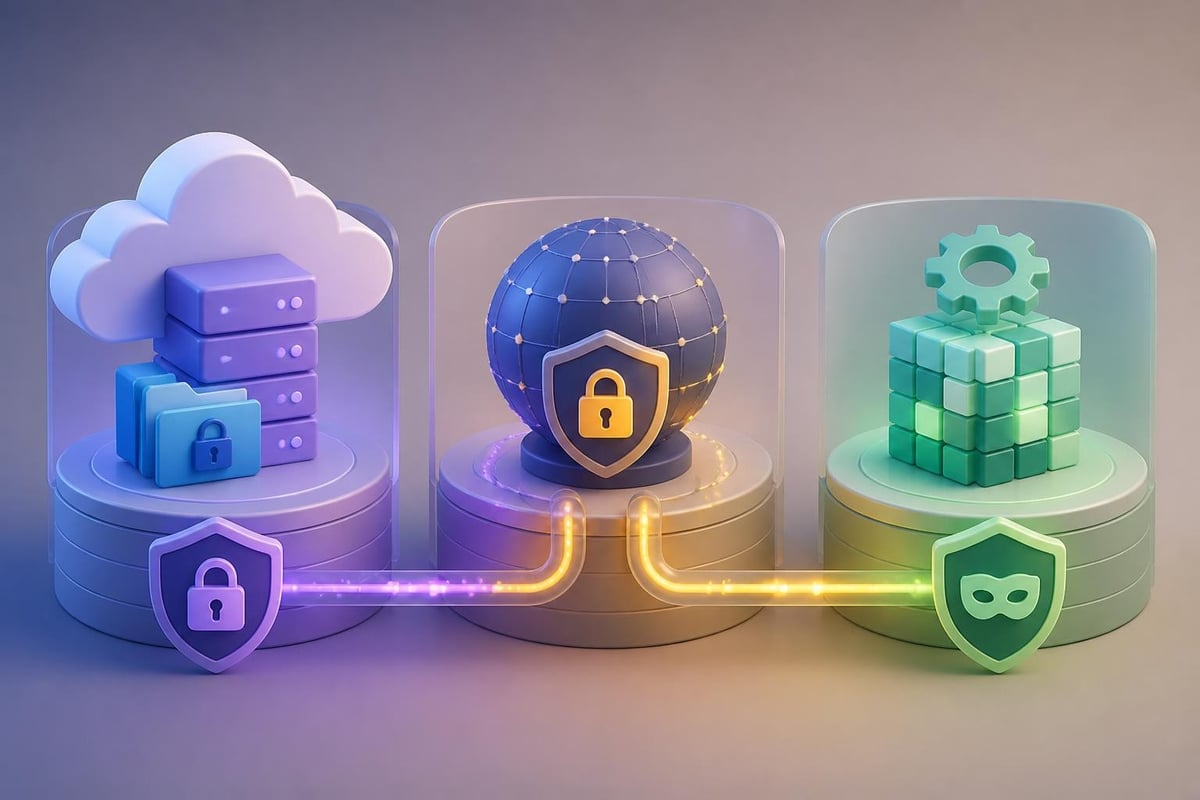
Encryption serves as the cornerstone of data protection strategies. Modern approaches utilise AES-256 encryption standards for data at rest, whilst TLS 1.3 protocols secure data in transit between users and cloud services. However, encryption alone proves insufficient without proper key management practices.
Advanced Data Security Techniques
Recent developments in confidential computing techniques enable organisations to process sensitive data securely even in untrusted cloud environments. These approaches utilise hardware-based trusted execution environments to isolate data during processing, preventing even cloud providers from accessing plaintext information.
| Security Layer | Purpose | Key Technologies |
|---|---|---|
| Encryption at Rest | Protects stored data | AES-256, BitLocker, FileVault |
| Encryption in Transit | Secures data movement | TLS 1.3, IPSec, VPN |
| Encryption in Use | Protects processing data | Intel SGX, AMD SEV, ARM TrustZone |
Implementing comprehensive data security solutions requires businesses to assess their specific risk profiles and regulatory obligations. Financial services organisations face different requirements compared to manufacturing firms, necessitating tailored approaches to data classification and protection.
Access Control and Identity Management
Controlling who accesses cloud resources and under what conditions represents a critical component of secure cloud technologies. Modern identity and access management systems extend far beyond simple username and password combinations, incorporating multi-factor authentication, conditional access policies, and continuous verification.
Zero Trust architecture has emerged as the dominant paradigm for cloud security. This approach assumes no user or device should be automatically trusted, regardless of their network location. Every access request undergoes rigorous verification before granting permissions.
Implementing Robust Authentication Mechanisms
- Multi-factor authentication (MFA) requires users to provide multiple forms of verification
- Single sign-on (SSO) streamlines access whilst maintaining security controls
- Privileged access management (PAM) restricts and monitors administrative accounts
- Just-in-time (JIT) access grants temporary permissions only when needed
- Adaptive authentication adjusts security requirements based on risk signals
Microsoft’s comprehensive approach to cloud security emphasises the importance of integrating identity protection across hybrid environments. Businesses operating both on-premises and cloud infrastructure require unified identity platforms that maintain consistent security policies regardless of where resources reside.
The role of managed service providers becomes particularly valuable when implementing these sophisticated access control mechanisms. Expertise in configuring and maintaining identity platforms ensures organisations avoid common misconfigurations that frequently lead to security breaches.
Network Security and Segmentation
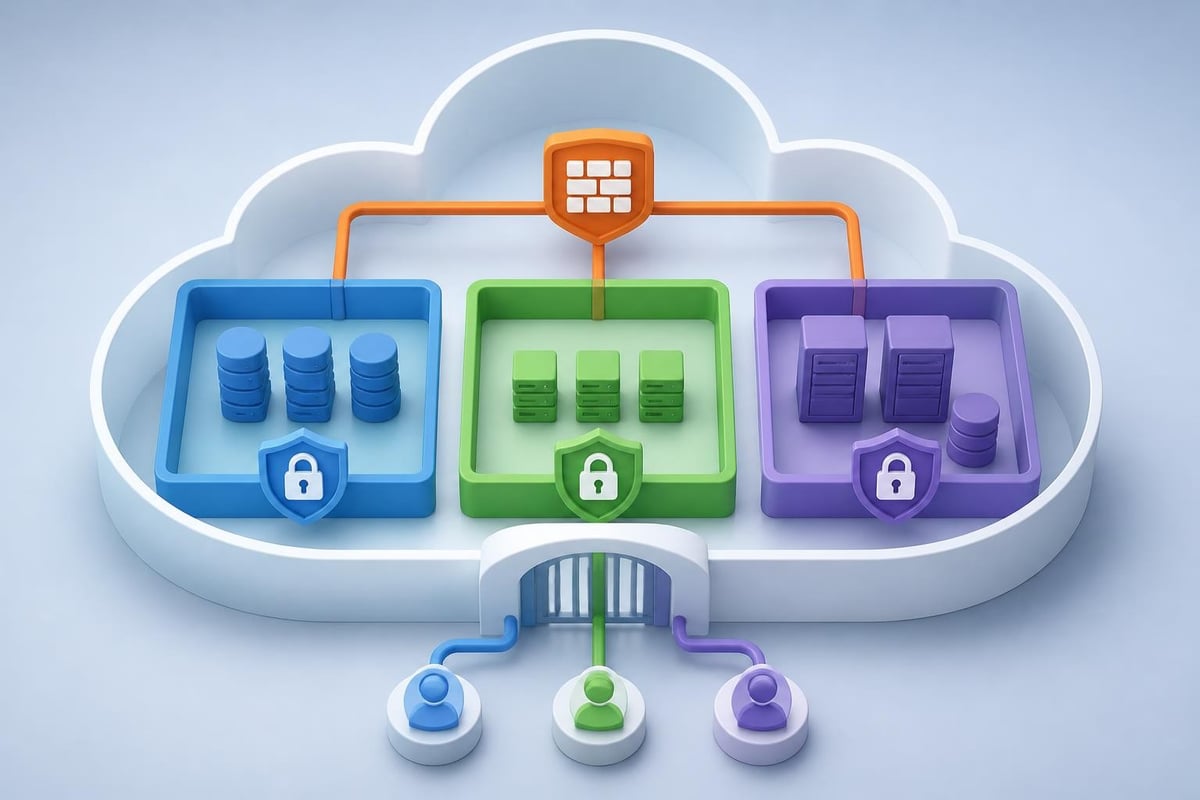
Network security within cloud environments demands different approaches compared to traditional on-premises infrastructure. Secure cloud technologies leverage software-defined networking, micro-segmentation, and distributed firewalls to create robust defensive perimeters.
Virtual private clouds (VPCs) establish isolated network environments where organisations can define their own IP address ranges, create subnets, and configure routing tables. These logical separations prevent unauthorised lateral movement between different workloads and applications.
Cloud-Native Security Controls
- Security groups function as virtual firewalls controlling inbound and outbound traffic at the instance level
- Network access control lists (NACLs) provide an additional layer of security at the subnet boundary
- Web application firewalls (WAF) protect internet-facing applications from common exploits
- DDoS protection services mitigate volumetric attacks and ensure service availability
- Virtual private networks (VPN) establish encrypted tunnels for secure remote access
The importance of business broadband and leased lines cannot be overstated when considering cloud connectivity. Secure cloud technologies require reliable, high-bandwidth connections to ensure both performance and security measures function effectively.
Compliance and Regulatory Considerations
Operating within cloud environments introduces complex compliance requirements that vary by industry, geography, and data types. Secure cloud technologies must address regulations such as GDPR, UK Data Protection Act, ISO 27001, Cyber Essentials, and sector-specific frameworks.
Data residency presents a particular challenge for UK businesses. GDPR mandates that certain categories of personal data remain within the European Economic Area, requiring careful selection of cloud regions and service configurations. Google Cloud’s security framework provides comprehensive tools for managing data location and sovereignty requirements.
Key Compliance Requirements for UK Businesses
| Framework | Primary Focus | Key Requirements |
|---|---|---|
| GDPR | Data privacy | Consent, right to erasure, breach notification |
| Cyber Essentials | Basic security hygiene | Firewalls, secure configuration, access control |
| ISO 27001 | Information security management | Risk assessment, security controls, continuous improvement |
| PCI DSS | Payment card data | Network security, encryption, access monitoring |
The growing emphasis on Cyber Essentials certification reflects how baseline security standards are becoming contractual obligations across the North West business community. Implementing secure cloud technologies aligned with these frameworks demonstrates commitment to protecting customer data and maintaining trust.
Regular compliance audits verify that security controls remain effective and aligned with regulatory requirements. Automated compliance monitoring tools within cloud platforms continuously assess configurations against industry benchmarks, alerting administrators to potential violations before they create risk.
Threat Detection and Incident Response
Proactive threat detection represents a critical capability within secure cloud technologies. Modern cloud environments generate vast quantities of log data from various sources, requiring sophisticated analytics to identify genuine security incidents amongst routine operational events.
Security Information and Event Management (SIEM) systems aggregate logs from cloud services, applications, and network devices, applying correlation rules and machine learning algorithms to detect suspicious patterns. These platforms enable security teams to investigate potential incidents and coordinate response activities.
Building an Effective Cloud Security Operations Centre
- Continuous monitoring tracks user activities, network traffic, and system changes in real-time
- Automated alerting notifies security teams when suspicious behaviours or policy violations occur
- Threat intelligence integration incorporates global threat data to identify known attack patterns
- Forensic capabilities preserve evidence and enable detailed investigation of security incidents
- Orchestration and automation accelerates response times through pre-defined playbooks
Understanding how to reduce IT downtime connects directly to incident response capabilities. Swift detection and remediation of security incidents minimises business disruption and prevents minor issues from escalating into major breaches.

AWS’s comprehensive security approach emphasises the importance of architecting secure infrastructure from the outset. Building security into cloud deployments proves far more effective than attempting to retrofit protections after implementation.
Disaster Recovery and Business Continuity
Secure cloud technologies extend beyond preventing breaches to ensuring business resilience when incidents occur. Disaster recovery capabilities leverage cloud infrastructure to maintain operations during unexpected disruptions, whether from security incidents, natural disasters, or technical failures.
Cloud-based backup solutions provide automated, encrypted copies of critical data stored across geographically distributed data centres. This approach offers several advantages over traditional tape-based backups, including faster recovery times, reduced storage costs, and simplified management.
Essential Disaster Recovery Components
The 3-2-1 backup rule remains relevant in cloud environments: maintain three copies of data, on two different media types, with one copy stored off-site. Cloud storage naturally satisfies the off-site requirement whilst offering virtually unlimited scalability.
Recovery Time Objective (RTO) defines how quickly systems must be restored following an incident, whilst Recovery Point Objective (RPO) specifies the maximum acceptable data loss measured in time. Secure cloud technologies enable organisations to achieve aggressive RTO and RPO targets through continuous replication and automated failover mechanisms.
| Recovery Strategy | RTO Target | RPO Target | Typical Use Cases |
|---|---|---|---|
| Backup and Restore | Hours to days | Hours | Non-critical systems, archive data |
| Pilot Light | Minutes to hours | Minutes | Essential services, moderate criticality |
| Warm Standby | Minutes | Near-zero | Business-critical applications |
| Multi-Site Active-Active | Seconds | Zero | Mission-critical systems, high availability |
Planning for business cloud migration services must incorporate disaster recovery requirements from the beginning. Organisations transitioning to cloud environments should define their resilience objectives and architect solutions accordingly.
Multicloud Security Challenges and Solutions
Many UK businesses adopt multicloud strategies, utilising services from multiple providers to avoid vendor lock-in, optimise costs, and leverage specialised capabilities. However, this approach introduces complexity in maintaining consistent security policies across disparate platforms.
Hidden gaps in cloud security fabric often emerge at the boundaries between different cloud providers. Each platform employs unique security models, terminology, and configuration interfaces, creating opportunities for misalignment and oversight.
Cloud Native Security Fabric (CNSF) represents an emerging approach that embeds security directly into cloud infrastructure rather than treating it as an external layer. This paradigm shift enables more granular control and reduces the attack surface across multicloud deployments.
Strategies for Multicloud Security Management
- Implement centralised identity and access management across all cloud platforms
- Establish unified security monitoring and logging aggregation
- Deploy consistent encryption standards regardless of cloud provider
- Automate compliance checking and policy enforcement through infrastructure-as-code
- Maintain vendor-neutral security tools that integrate with multiple cloud environments
For businesses seeking managed IT support for small business operations, navigating multicloud security complexity often exceeds internal capabilities. Partnering with experienced providers ensures consistent protection across diverse cloud environments.
Emerging Technologies and Future Trends
The landscape of secure cloud technologies continues evolving rapidly as new threats emerge and defensive capabilities advance. Several trends are reshaping how organisations approach cloud security in 2026 and beyond.
Artificial intelligence and machine learning increasingly power threat detection systems, identifying anomalous behaviours that traditional rule-based approaches miss. These technologies analyse user behaviour patterns, network traffic flows, and system logs to detect sophisticated attacks that evade conventional security controls.
Quantum computing poses both opportunities and threats for cloud security. Whilst quantum algorithms could break current encryption standards, quantum-resistant cryptography is already being deployed to protect against future threats. Forward-thinking organisations are beginning to implement post-quantum encryption within their secure cloud technologies.
Innovation Areas Shaping Cloud Security
- Edge computing security extends protection to distributed processing nodes beyond centralised data centres
- Container security addresses vulnerabilities in containerised applications and orchestration platforms
- Serverless security protects function-as-a-service deployments where traditional perimeter defences prove ineffective
- DevSecOps integration embeds security controls directly into development pipelines and CI/CD workflows
- Privacy-enhancing technologies enable data analysis whilst preserving individual privacy through techniques like differential privacy
Understanding specialised applications such as cyber security for manufacturing companies highlights how secure cloud technologies must adapt to sector-specific requirements. Industrial control systems, IoT devices, and operational technology introduce unique security considerations that generic cloud security frameworks may not adequately address.
Practical Implementation Considerations
Deploying secure cloud technologies requires careful planning, phased implementation, and ongoing management. Organisations should begin by conducting comprehensive risk assessments to identify their most critical assets and potential vulnerabilities.
Creating a cloud security roadmap helps prioritise initiatives based on risk levels and available resources. Quick wins that address high-risk areas should take precedence, followed by longer-term projects that enhance overall security posture.
Staff training represents a frequently overlooked but essential component of cloud security. Even the most sophisticated secure cloud technologies prove ineffective if users lack awareness of security policies and best practices. Regular training programmes should cover topics including phishing recognition, password hygiene, data classification, and incident reporting procedures.
The value of outsourced IT departments for SMEs becomes apparent when considering the expertise required to implement and maintain secure cloud technologies effectively. Small and medium-sized enterprises often lack the internal resources to manage complex security architectures, making external partnerships essential.
Implementing secure cloud technologies requires a strategic, comprehensive approach that addresses technical controls, operational processes, and human factors. As cyber threats continue evolving and regulatory requirements become more stringent, businesses across the North West must prioritise cloud security to protect their digital assets and maintain customer trust. Blowfish Technology delivers expert managed IT services, cyber security solutions, and secure cloud computing tailored to UK businesses, ensuring your organisation benefits from robust protection whilst leveraging the full potential of cloud technologies.

The Blowfish Technology team. Managed IT, cloud services, software development and connectivity for North West businesses since 1999.