
You run a growing business, take card payments, and assume the card machine, website checkout, or payment provider has most of it covered. Then an acquirer asks about your PCI status, your insurer wants evidence of controls, or your team starts taking more payments over the phone and suddenly the question becomes uncomfortable. Are you compliant, or just hoping your suppliers are?
That uncertainty is common in UK SMEs. I see it most often in firms that don’t think of themselves as “payment businesses” at all. Engineering companies taking deposits, legal practices collecting retainers, manufacturers running phone payments through accounts, and multi-site firms using a mix of terminals, e-commerce, and virtual terminals all have the same issue. They touch card data, but no one has translated the rules into day-to-day business actions.
PCI DSS matters because it gives you a practical security standard for protecting cardholder data. It isn't there to create paperwork for the sake of it. It tells you how to reduce risk, prove that controls exist, and avoid finding out after a breach that your systems, staff habits, and suppliers left gaps. If your wider estate includes Microsoft 365, hosted desktops, cloud apps, or VoIP, the job gets broader fast. That’s why it also helps to understand adjacent guidance on securing modern cloud-native platforms, especially when payment processes sit inside a larger modern IT environment.
Table of Contents
- Your Guide to PCI Compliance in the UK
- Understanding PCI DSS and Its Role in UK Business
- How to Determine Your UK PCI Compliance Level
- The Core Requirements of PCI DSS Explained
- Achieving Compliance SAQs QSAs and Remediation
- PCI Compliance and UK Data Protection Laws
- Maintaining Compliance with Ongoing Monitoring
- PCI Compliance UK Frequently Asked Questions
Your Guide to PCI Compliance in the UK
The most common PCI compliance mistake UK SMEs make is assuming outsourced payments remove all accountability. They do not.
A typical example is a retailer that uses a hosted checkout, takes the odd payment over the phone, and keeps customer notes in a CRM. The owner assumes the payment provider covers PCI DSS. The acquirer still expects the business to understand its card data exposure, control staff access, and prove that the right safeguards are in place. The PCI Security Standards Council makes that shared responsibility clear in its guidance for merchants.
That gap between assumption and reality is where smaller businesses get caught. PCI DSS rarely sits neatly in one system. It reaches into the website, laptops used for admin, telephony, email, remote access, backups, and any supplier touching the payment journey. If those controls are already being reviewed as part of cybersecurity for SMEs, PCI becomes easier to handle because the same decisions often improve more than one requirement.
The practical issue is not just card security. It is control sprawl.
Many SMEs add payment processes in stages. An online gateway comes first. Then someone starts taking mail order or telephone order payments during busy periods. A finance user exports reports to a shared drive. Support staff can see more data than they need. None of those choices looks serious on its own, but together they create PCI scope, GDPR risk, and avoidable audit friction.
The warning signs are usually easy to spot once someone maps the process properly:
- Phone payments without a controlled script or system. Staff hear card numbers, repeat them aloud, write them down temporarily, or key them into a virtual terminal from a general-use device.
- Mixed-use workstations. The same machine handles card-related activity, email, web browsing, downloads, and day-to-day office tasks.
- Over-reliance on suppliers. The business assumes Stripe, PayPal, a terminal vendor, or a SaaS platform covers the whole compliance picture.
- Evidence gaps. Controls may exist, but nobody can show policies, access reviews, patch records, or staff guidance when asked.
The quickest way to reduce pain is to map the payment journey first, then reduce scope. In practice, that means keeping card data out of business systems wherever possible, limiting who can touch in-scope devices, and separating payment handling from general admin. That same exercise often supports Cyber Essentials control decisions and strengthens your GDPR position because fewer systems, fewer users, and less retained data mean less risk to manage.
Good PCI work in a UK SME should never happen in isolation. Businesses get better results when PCI DSS, Cyber Essentials, and data protection controls are treated as one operating model instead of three separate projects. A managed security partner can usually speed this up by reviewing suppliers, tightening endpoint and access controls, and documenting evidence once for multiple compliance needs, especially in firms securing modern cloud-native platforms.
Handled that way, PCI stops being an annual form-filling exercise and becomes a controlled, repeatable part of running the business.
Understanding PCI DSS and Its Role in UK Business
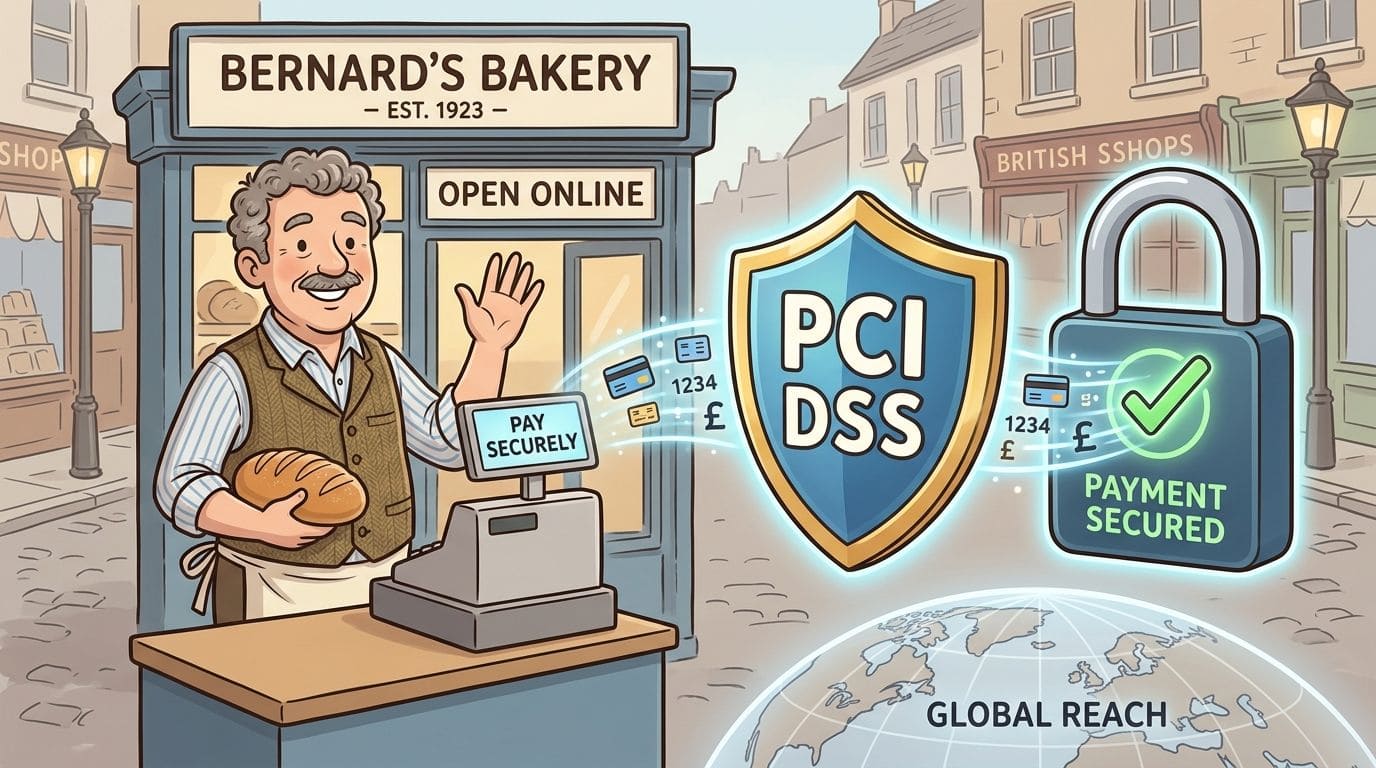
PCI DSS is best thought of as a building code for payment security. If you were fitting out business premises, you’d expect rules around locks, fire safety, alarm systems, and restricted access. Card data needs the same kind of discipline in digital form.
Why PCI DSS exists
PCI DSS is a global security standard for organisations that accept, process, store, or transmit cardholder data. In the UK, that means it applies whether you take payments in person, online, over the phone, or through a mixed model across branches and teams.
It isn’t a UK statute in the same way as data protection law. It’s a contractual requirement tied to the card ecosystem and enforced through acquirers and card brands. That distinction matters. Businesses sometimes relax when they hear “it’s not law”, but contracts still carry consequences, and those consequences are commercial, operational, and reputational.
If your business is software-heavy or runs subscription platforms, this essential PCI DSS guide for SaaS companies is a useful companion read because it frames the standard around modern application and service environments rather than only retail scenarios.
Why UK SMEs can’t ignore it
PCI DSS works because it forces basic security discipline in places where shortcuts often happen. The historical evidence is strong. In 2010, as PCI DSS adoption began to gain traction, UK card fraud dropped 17% from 2009 levels, while losses from cloned or skimmed cards fell 41%, according to Procheckup’s analysis of UK PCI compliance and fraud trends.
That doesn’t mean compliance is effortless. The same historical picture shows businesses often struggled to understand the requirements, especially in sectors handling customer payments every day. That remains true now. The challenge isn’t usually lack of concern. It’s lack of translation from technical standard to business routine.
A useful starting point is to connect PCI with broader SME security basics such as access control, patching, endpoint protection, and staff awareness. That’s why many firms benefit from reading practical security guidance like understanding cybersecurity for SMEs alongside PCI-specific material.
PCI DSS is most effective when it stops being “the payment project” and becomes part of how the business runs systems, staff access, and supplier control.
How to Determine Your UK PCI Compliance Level
Determining your PCI merchant level is the first practical step, because it sets the validation route your business is likely to follow. Get this wrong and teams often choose the wrong SAQ, miss required scans, or prepare for an audit they did not need.
For UK SMEs, the starting point is usually transaction volume, but that is only part of the picture. Card brands publish merchant level criteria, and your acquiring bank can apply its own reporting expectations, particularly if you have had a breach, use higher-risk payment channels, or operate across multiple entities. The PCI Security Standards Council’s merchant level guidance is the best reference point for the standard categories.
PCI DSS Merchant Compliance Levels in the UK 2026
UK businesses are generally grouped into four merchant levels. In practice, Level 1 businesses face the heaviest validation burden, while Levels 2 to 4 usually self-assess unless the acquirer requires more formal assurance.
| Level | Annual Transaction Volume (All Channels) | Typical Validation Requirements |
|---|---|---|
| Level 1 | Over 6 million transactions annually | Annual Report on Compliance (ROC) by a Qualified Security Assessor (QSA), quarterly ASV scans, and Attestation of Compliance (AOC) |
| Level 2 | 1 to 6 million transactions annually | Annual ROC or Self-Assessment Questionnaire (SAQ), quarterly ASV scans, and AOC |
| Level 3 | 20,000 to 1 million e-commerce transactions or up to 1 million total depending on card brand | Annual SAQ, quarterly scans, and AOC |
| Level 4 | Fewer than 20,000 e-commerce transactions or up to 1 million total | Requirements set by the acquiring bank, typically annual SAQ and scans if applicable |
The table helps, but real scoping problems usually come from how payments flow through the business.
A small retailer with low volume can still create a large PCI scope if staff key card details into virtual terminals from ordinary office laptops, take payments by phone, or let recordings capture card numbers. By contrast, a business with higher volume but a properly isolated hosted payment page may have a cleaner validation process because card data never touches its own systems. Volume determines level. System design determines how painful compliance becomes.
What your level changes in practice
For many SMEs, the practical difference is how you prove compliance and how much independent scrutiny you should expect. Lower-level merchants often complete an SAQ and support it with evidence such as policies, scan reports, firewall settings, access reviews, and supplier details. Level 1 merchants usually need a far more formal assessment, with a QSA testing controls in depth and documenting them in a ROC.
That distinction matters for budgeting and planning. It also matters for wider UK compliance work. PCI controls around patching, MFA, secure configuration, least privilege, logging, and supplier oversight overlap heavily with Cyber Essentials, Cyber Essentials Plus, and UK GDPR security expectations. Businesses save time when they treat those as one control set with different reporting outputs, rather than three separate projects run by different suppliers.
A simple way to determine your likely level and scope is to check four things:
- Count payment channels such as in-store terminals, e-commerce checkout, MOTO, virtual terminal, and recurring payments.
- Confirm annual transaction volumes using acquirer reports and card scheme information where available.
- Map where card data appears across websites, desktops, call flows, terminals, recordings, and third-party platforms.
- Ask your acquirer what validation it expects before you choose an SAQ or assume self-assessment is enough.
Businesses usually struggle most with the third and fourth points. That is where an MSP adds value. A provider that understands PCI, Cyber Essentials, Microsoft 365, endpoint controls, and UK data protection can reduce duplicate work and tighten scope before the assessment starts. If you need a clearer view of that role, this guide on what a managed service provider does gives useful context.
In practice, the best first move is to confirm your merchant level with the acquirer, then map your payment environment before touching any questionnaires. That sequence avoids a lot of expensive guesswork.
The Core Requirements of PCI DSS Explained
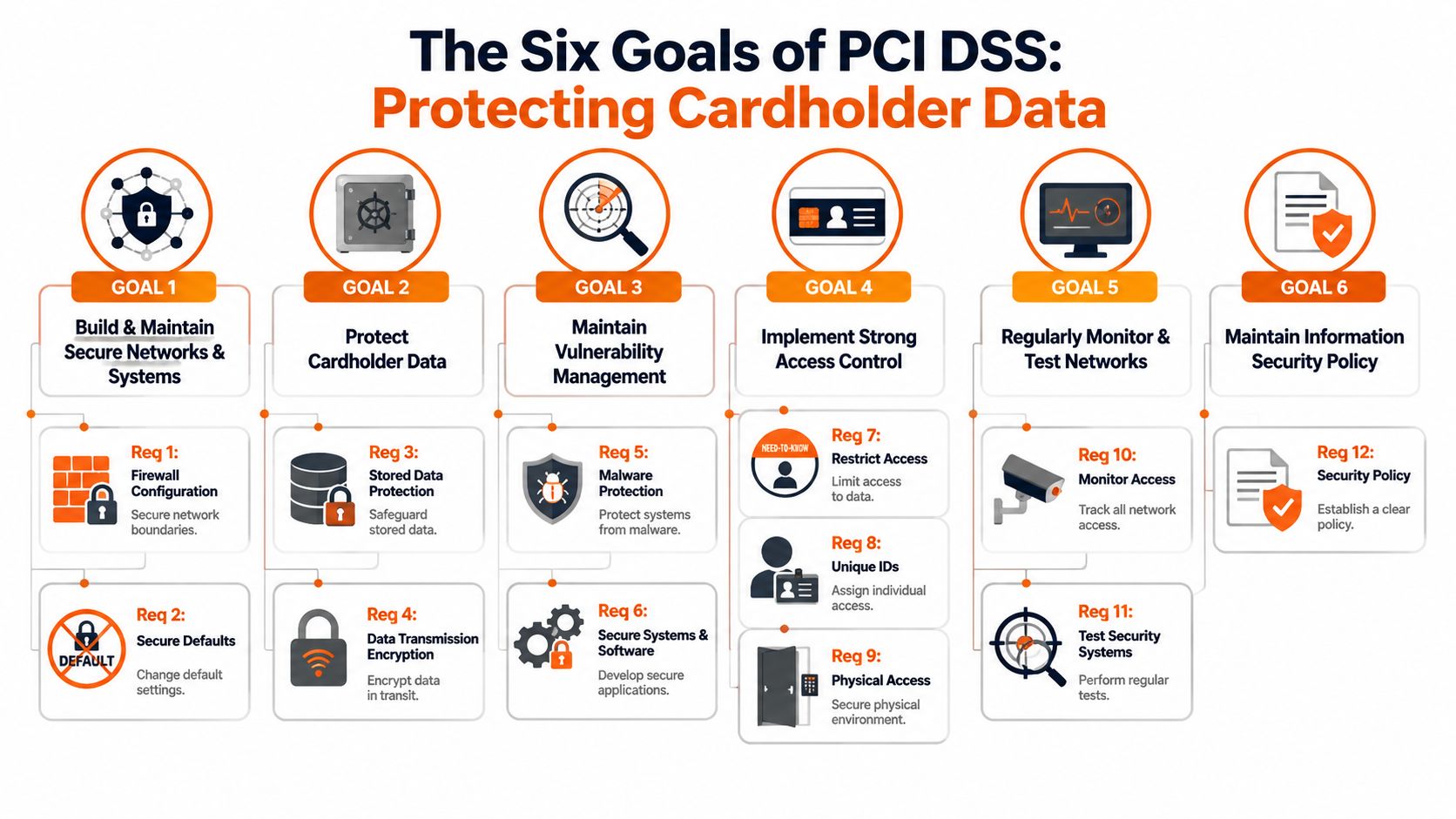
PCI DSS has 12 core requirements, but reading them as a flat list makes them harder than they need to be. In practice, they work best when grouped into six security goals. That turns a compliance checklist into something a business owner can readily reason through.
The six goals in business language
Build and maintain secure networks and systems
This covers perimeter controls and secure configuration. In plain terms, don’t run payment-related systems with weak defaults, unnecessary services, or open internal access.Protect cardholder data
If you store card data, it must be protected. If you transmit it, that transmission must be encrypted. The practical lesson for most SMEs is to avoid storing card data wherever possible.Maintain vulnerability management
Systems need anti-malware where relevant, patching, secure software maintenance, and a process for fixing weaknesses before criminals find them first.Implement strong access control
Not everyone needs access to payment systems. Unique accounts, restricted permissions, and stronger authentication sit here.
A common stumbling block is authentication. PCI controls often overlap with MFA and identity hygiene already being introduced elsewhere in the business. This is one reason firms often tighten controls through broader security projects such as two-factor authentication, rather than trying to solve payment access in isolation.
After the policy side, it helps to see the framework visually. This short explainer gives a clear walkthrough:
What this looks like on real systems
The remaining two goals are often where businesses discover how broad scope really is.
- Regularly monitor and test networks. Logging, scan results, and evidence reviews matter because auditors and acquirers want proof, not verbal reassurance.
- Maintain an information security policy. Staff need documented rules, training, and incident processes. Payment security cannot live only in one technical person’s head.
Secure payment handling is rarely broken by one dramatic flaw. It’s usually weakened by small operational habits. Shared logins, old devices, weak admin access, and poor change control.
For Level 1 organisations, some technical detail becomes explicit. Level 1 merchants processing over 6 million transactions must have an annual ROC conducted by a QSA, including checks that strong cryptography is used for all non-console administrative access under PCI DSS requirement 2.3, as explained in this Airwallex PCI DSS overview. Even if you’re nowhere near Level 1, that gives you a good benchmark for what “serious” looks like.
Achieving Compliance SAQs QSAs and Remediation
Once you know your level and understand the core control areas, the next step is proving compliance properly. This step frequently presents challenges for many SMEs. They download an SAQ, realise they can’t answer several questions cleanly, and then either delay the job or guess.
Most SMEs start with the SAQ
The Self-Assessment Questionnaire, or SAQ, is the route many UK SMEs use to validate PCI DSS. The right version depends on how you take payments and how much of the payment process is outsourced. That distinction matters.
A fully outsourced e-commerce flow usually has a different compliance profile from office staff keying card details into a virtual terminal. A standalone terminal on a segmented network is different again from a payment workflow that sits on an ordinary workstation with web access, email, and shared software. The SAQ needs to match that reality, not the system you wish you had.
A sensible SAQ process usually follows this order:
- Map the payment flow. Identify every device, user, application, and supplier involved.
- Define scope clearly. Include call recordings, remote access, shared folders, backups, and admin paths.
- Match the SAQ to the payment method. Don’t select the shortest form because it looks easier.
- Collect evidence as you go. Screenshots, policies, scan reports, system lists, and access records matter.
Remediation is where projects succeed or stall
Gap analysis is the useful part. The SAQ itself just exposes the gaps. The business value comes from fixing them in the right order.
What usually works:
- Removing stored card data where the business doesn’t need it.
- Separating payment devices or workflows from general office use.
- Cleaning up user access so only named staff can reach in-scope systems.
- Documenting operational controls such as onboarding, offboarding, patching, log review, and incident handling.
What usually doesn’t work:
- Treating policy as a substitute for technical control.
- Assuming the payment provider covers endpoints, staff behaviour, and local admin access.
- Leaving remediation to the month before renewal.
For larger organisations, the validation route is stricter. Level 1 businesses need a Report on Compliance completed by a Qualified Security Assessor, and that process is a formal on-site review rather than a self-declared exercise. Even for smaller firms, working with someone who can challenge assumptions is often the difference between a clean submission and a last-minute scramble.
PCI Compliance and UK Data Protection Laws
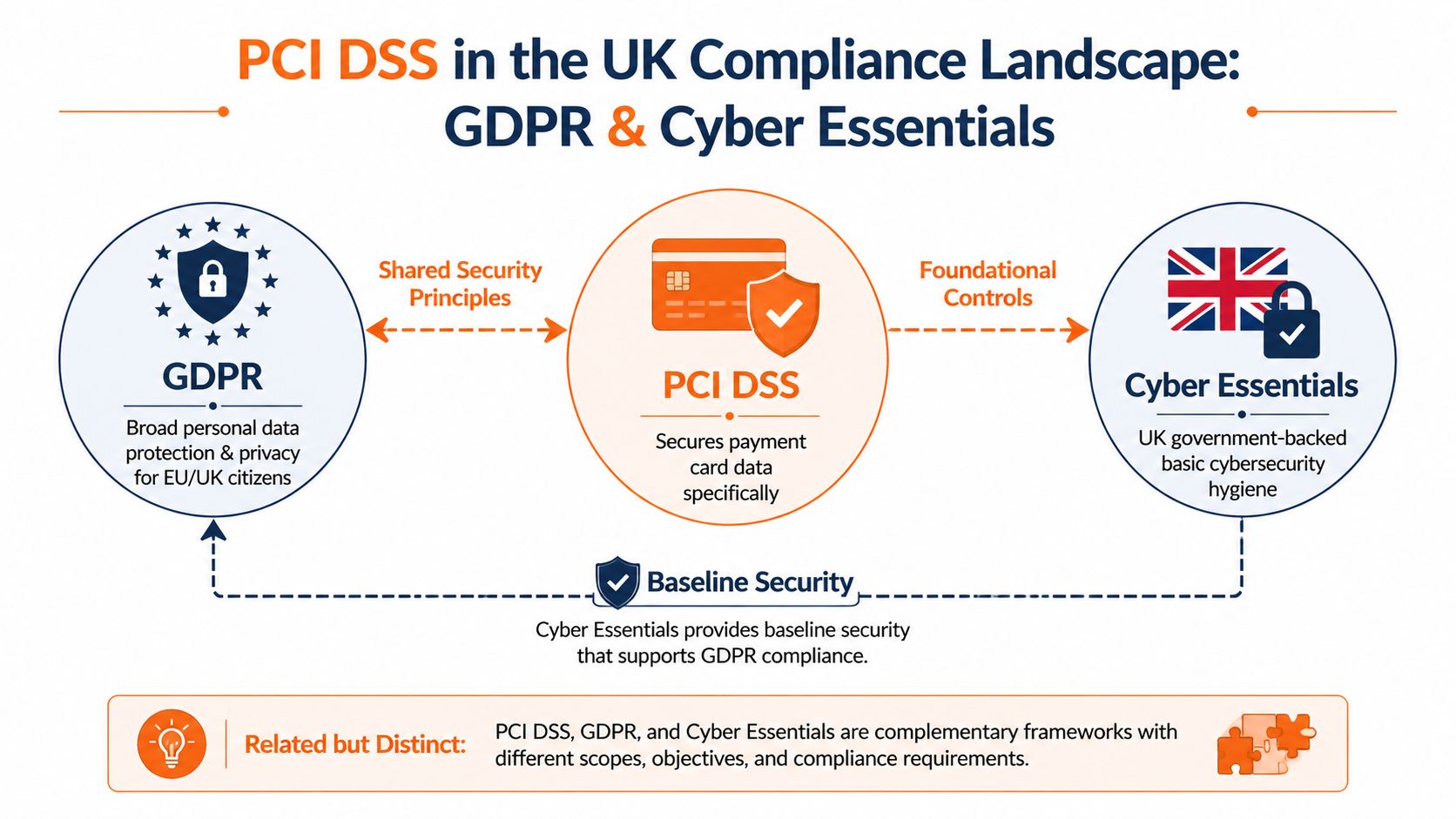
PCI DSS doesn’t sit alone in a UK business. If you handle payment data, you’re usually also dealing with GDPR duties, Cyber Essentials controls, cyber insurance requirements, and client contract security clauses. Treating each framework as a separate project creates duplication and drift.
Where PCI DSS overlaps with GDPR and Cyber Essentials
The scopes are different. PCI DSS is focused on cardholder data. GDPR is broader and governs personal data. Cyber Essentials gives you a baseline of security hygiene expected in many UK supply chains and public-sector adjacent environments.
The overlap is practical, not identical. Controls around access restriction, secure configuration, patching, malware protection, and authentication support all three in different ways. That’s one reason the latest standard is important. With PCI DSS v4.0 becoming mandatory in March 2025, its emphasis on customised, risk-based approaches creates significant overlap with Cyber Essentials Plus evidence requirements. Data from 2025 shows only 12% of UK SMEs achieve combined certification, often because they lack guidance on integrating shared controls like MFA and EDR, according to this UK PCI v4.0 and Cyber Essentials analysis.
A related issue is data location and control. Businesses using cloud services, hosted desktops, backup platforms, and Microsoft 365 need to understand where regulated data sits and how it’s protected. This broader perspective is covered well in data sovereignty and data security in the UK, especially when payment-related records intersect with wider business data.
Why a unified compliance approach works better
A fragmented approach creates repeated work. You harden endpoints for Cyber Essentials, then separately review access for PCI, then separately document processing controls for GDPR. The controls are related, but the evidence is scattered and the ownership is unclear.
A unified approach is more efficient because it asks one operational question. How do we secure the systems, people, and suppliers involved in sensitive data handling across the business?
That usually means:
- Using the same identity controls across frameworks. MFA, named accounts, role-based access.
- Applying one patching and vulnerability process rather than multiple compliance-specific routines.
- Aligning policy reviews and staff training so users aren’t getting conflicting messages.
- Keeping one evidence trail for scans, device inventories, admin controls, and incident records.
Working rule: PCI, GDPR, and Cyber Essentials don’t merge into one certificate. They do share enough control areas that one joined-up operating model is far easier to maintain.
Maintaining Compliance with Ongoing Monitoring
The biggest mistake in pci compliance uk is treating certification as the finish line. It isn’t. PCI is only credible if the controls still exist after the questionnaire is filed, the scan report is uploaded, or the assessor leaves site.

What ongoing compliance really involves
Ongoing compliance means keeping the environment stable and evidenced. That typically includes quarterly ASV scans where applicable, regular review of logs and alerts, patching, access reviews, policy maintenance, and staff training. It also means revisiting scope whenever the business changes how it takes payments.
The practical pain point is that change happens subtly. Someone installs remote access software for convenience. A team starts using a new browser-based payment portal. Call recording settings change. An old admin account remains active after a role move. None of those look dramatic in isolation, but each can alter scope or weaken control.
Useful maintenance habits include:
- Reviewing in-scope systems after operational changes
- Checking who still has access to payment-related tools
- Keeping evidence organised all year
- Testing assumptions about outsourced suppliers
For teams working on mobile apps, portals, or custom systems, a technical review of securing app data with PCI DSS is a practical complement because application-layer weaknesses often undermine otherwise decent infrastructure controls.
Why managed monitoring changes the picture
Continuous monitoring matters for more than compliance status. It also affects financial recovery after a breach. Many UK business insurance policies contain negligence clauses, and 75% of insurers may void cyber liability coverage if the business can’t provide evidence of maintained PCI compliance, according to Clover’s UK PCI compliance overview citing 2025 ABI data.
That’s why the annual scramble is such a weak model. Businesses do better when monitoring, endpoint protection, vulnerability management, access review, backup assurance, and audit evidence are all maintained as routine service functions rather than ad hoc admin tasks. When the controls are always on, compliance becomes far more defensible and far less disruptive.
PCI Compliance UK Frequently Asked Questions
Does using Stripe, PayPal, or another gateway make us PCI compliant
No. It usually reduces your scope, but it doesn’t remove your responsibility. You still need to understand how card data enters your environment, what systems remain in scope, and what your acquirer expects you to validate.
If we only take occasional phone payments, do we still need PCI DSS
Yes. Frequency doesn’t remove the requirement. If staff, devices, call flows, or recordings interact with card data, PCI DSS still applies.
Is PCI DSS the same as GDPR or Cyber Essentials
No. They overlap in controls, but they have different scopes and purposes. PCI protects payment card data specifically. GDPR covers personal data more broadly. Cyber Essentials sets a UK baseline for security hygiene.
What’s the first thing to do if we’re unsure
Map the payment journey. List every payment channel, supplier, device, user, and system involved. Until that’s documented, any compliance answer is guesswork.
If your business needs help turning pci compliance uk from a vague obligation into a manageable process, Blowfish Technology can help you assess scope, tighten the underlying security controls, and align PCI work with Cyber Essentials, GDPR, and day-to-day IT operations. That’s especially useful for SMEs that need practical guidance, clear ownership, and an environment that stays compliant between audit dates, not just on them.

The Blowfish Technology team. Managed IT, cloud services, software development and connectivity for North West businesses since 1999.