
Shared hosting in the UK typically costs £2 to £10 per month excluding VAT, while managed hosting starts at £35 per month excluding VAT. The three-year bill can be higher after VAT, renewal increases, domain fees and add-ons.
An independent 2026 comparison found that 26 shared-hosting plans with introductory discounts rose by a median of 184% at renewal. Compare the total payable over the contract, not just the advertised monthly rate, and check what the provider manages.
Table of Contents
- UK Website Hosting Costs by Hosting Type
- Why Headline Prices Understate the Real Bill
- What Pushes UK Hosting Prices Up
- Add-On Costs Most Quotes Leave Out
- Realistic Annual Budgets for Four Business Types
- Three Resilience Tiers and What Each Covers
- Confirm the Full Three-Year Cost Before You Sign
UK Website Hosting Costs by Hosting Type
Shared plans sit at the bottom of the UK market, dedicated servers sit at the top, and the correct position for a business depends on traffic, control and how much management is included. Headline rates are normally shown excluding VAT, so a like for like comparison needs the tax basis confirmed first.
| Hosting type | Typical monthly cost (ex VAT) | Best for | Usually included |
|---|---|---|---|
| Shared hosting | £2-£10 | Brochure sites and low-traffic blogs | Control panel, SSL setup, basic email |
| VPS | £15-£60 | Growing sites needing dedicated resources | Dedicated resources, root access, self-managed |
| Cloud hosting | £20-£150+ | Sites with variable or spiky traffic | Pay-as-you-go compute and storage, self-managed or managed |
| Managed WordPress | £35-£249 | Business sites needing updates and support | Updates, optimisation, SSL, UK-based support |
| Dedicated server | £100-£300+ | High-traffic or compliance-heavy workloads | Whole physical server, managed by provider or customer |
Shared hosting remains the cheapest route for a brochure site or low traffic blog. Dozens or hundreds of accounts draw on the same machine, which keeps the monthly fee low. The compromise is performance under load and limited isolation from other users. Maintenance cover is often thin, so the business carries more of the routine work.
A VPS assigns dedicated virtual resources with root access. That suits a growing site that needs consistent performance, custom software or separate staging environments. Control brings maintenance work. An unmanaged VPS leaves patching, hardening and backups with the customer, while a managed VPS moves that labour into the monthly fee.
Cloud hosting fits workloads that rise and fall through the day or season. Compute and storage scale up for a sales peak, then scale back down, with billing tied to use. Budget to the upper bound of expected demand, not the quiet month. Check whether the fee covers platform management, monitoring and backup restores, or compute alone.
Managed WordPress plans typically start at around £35 per month plus VAT, with higher tiers costing more as capacity and support increase, so compare the specific tiers each provider offers. The provider handles core updates, caching, security checks and SSL, plus support for WordPress specific faults. Higher tiers usually add staging sites, larger storage limits, higher visit allowances and faster response times.
A dedicated server gives one customer the whole physical machine. High traffic stores, large databases and compliance heavy workloads use it for predictable performance and full configuration control. The fee reflects exclusive hardware, power, network and either provider management or customer administration.
Select by traffic pattern and support need first. Then model the three year position with VAT, renewal pricing, domain charges and any management add-ons, rather than ranking options on the first month figure.
Why Headline Prices Understate the Real Bill
A £10 monthly price excluding VAT becomes £12 per month, or £432 over 36 months if the rate stays constant. That calculation still leaves out any renewal increase or add-ons.
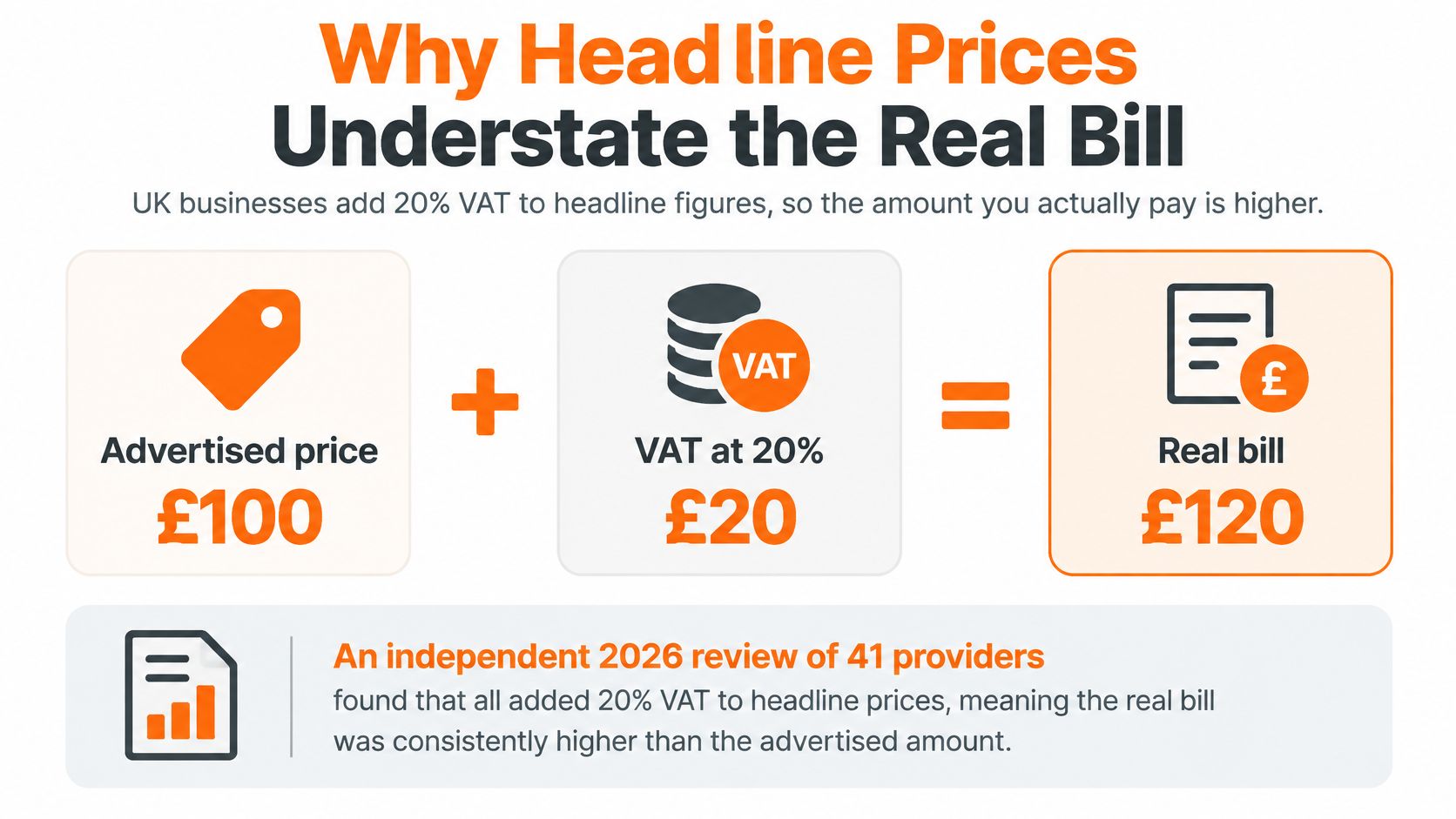
An independent 2026 comparison of 41 shared-hosting plans from 11 providers found a median three-year entry-plan cost of £231 including VAT. The cheapest plan was £86 and the most expensive was £432; among the 26 plans offering an introductory discount, the median price increased by 184% at renewal, according to the UK hosting renewal-price comparison. Ten of the 11 providers displayed prices excluding VAT, so a business comparing headline figures should check whether tax is included.
| Headline price (ex VAT) | Monthly including VAT | Total over 36 months including VAT |
|---|---|---|
| £3 per month | £3.60 | £129.60 |
| £5 per month | £6 | £216 |
| £10 per month | £12 | £432 |
These totals hold the same monthly rate for all 36 months. They exclude renewal increases, domains and extras. For a separate example, 123 Reg advertises an Economy plan at £1.99 per month, requires a three-year term and lists the renewal price at £251.64; its Economy hosting plan states that the advertised price excludes VAT. A low first-year price therefore isn't enough to forecast the whole commitment.
Use this four-step calculation for each provider:
- Annualise the price: Multiply the monthly charge by the number of months in the contract.
- Add VAT: Apply 20% to any price quoted excluding VAT.
- Add renewals: Use the renewal rate for the months after the introductory period, not the promotional rate.
- Add extras: Include the domain, email, backups, migration and any paid support.
The point of the calculation is to compare like with like. Before you assess plans, write down one three-year total for each provider. If you need a template for comparing packages, this unlimited web hosting in the UK overview can help frame what a plan includes alongside its price.
What Pushes UK Hosting Prices Up
Hosting providers pay to run servers, cooling, networking and backup infrastructure continuously. Electricity is therefore a recurring operating cost, not just an initial investment in equipment.
A House of Commons Research Briefing says UK data centres consume approximately 2.5% of national electricity demand, with annual use expected to rise from about 5 terawatt-hours (TWh) to 22 TWh by 2030. The same briefing reports that the average UK non-domestic electricity price reached 25.8 pence per kilowatt-hour in 2024, more than double the 2020 level. These figures help explain the cost of operating facilities, but they don't set the price of an individual hosting plan. The House of Commons Research Briefing also cites a Social Market Foundation estimate of £226.5 million a year for electricity at a 100-megawatt UK data centre, compared with £56.8 million in the United States and £156.3 million in France.
For a small business, the practical question is what its plan includes. A low monthly fee may leave the customer with fewer backups, less support or more responsibility for keeping the site secure. A higher-priced plan may include monitoring, backup management or a clearer support commitment, rather than just a larger amount of storage.
Set your non-negotiables: Write down the performance, security, backups, service level and data location your business requires. Then compare plans against that list.
If your business requires UK-hosted infrastructure, Blowfish Technology's cloud infrastructure is UK-hosted and GDPR-aligned, with cloud data stored in UK-based data centres. Its cloud infrastructure for business information provides a starting point for assessing the role of data location in your hosting decision.
Add-On Costs Most Quotes Leave Out
A domain is separate from hosting, even when a provider bundles them in one package. Nominet's wholesale price for a .uk, .co.uk, .org.uk or .me.uk registration or renewal is £3.90 per year before VAT for Nominet members; the retail registrar sets the price a business pays. Non-member registrars face a fee of £80 plus VAT per .uk domain, although almost all mainstream retail registrars use the member route, according to Nominet's fee schedule. Domain fees recur whether the website is hosted in the UK or elsewhere.
| Add-on | Typical cost | Notes |
|---|---|---|
| UK domain (.uk, .co.uk) | £3.90 per year wholesale ex VAT | Retail registrar prices are higher; renews every year |
| SSL certificate | Free to around £50 per year | Free certificates are common; check managed plans include setup |
| Backups | £5-£30 per month | Check retention and whether databases and email are covered |
| Site migration | £50-£500 one-off | Check site size, database and number of email accounts |
| Staging environment | £5-£20 per month | Lets you test changes before they go live |
| Email hosting | £1-£5 per mailbox per month | Often billed separately from the website plan |
The table's costs are indicative, and providers may bundle features or price them separately. An SSL certificate encrypts connections, but check whether the provider will configure and renew it. For backups, ask how long copies are retained, whether databases and email are included, and whether restores are tested. A “backup included” label alone doesn't tell you whether you can recover the site when you need it.
Migration charges can reflect the site's size, database complexity and number of email accounts that need moving. Staging is useful when you want to test a change before it reaches the live site. Email may also be a separate service, so confirm the price per mailbox and whether it's included in the hosting package.
For broader help assessing the work that continues after launch, Zee Palm's ongoing website maintenance guide offers context on website care. You can also use this small-business cloud backup explainer to help define what backup coverage needs to include.
Ask every provider to itemise hosting, domain registration and renewal, VAT, SSL, backups, migration, staging, email and support. Blowfish Technology's policy is that any additional costs must be approved by the client before they're invoiced, a clear safeguard to look for in a provider's terms.
Realistic Annual Budgets for Four Business Types
An annual budget becomes easier to compare when you match a business need to a plan tier, then convert the monthly price to a yearly total including VAT. The estimates below use the monthly figures shown and exclude domains and add-ons.
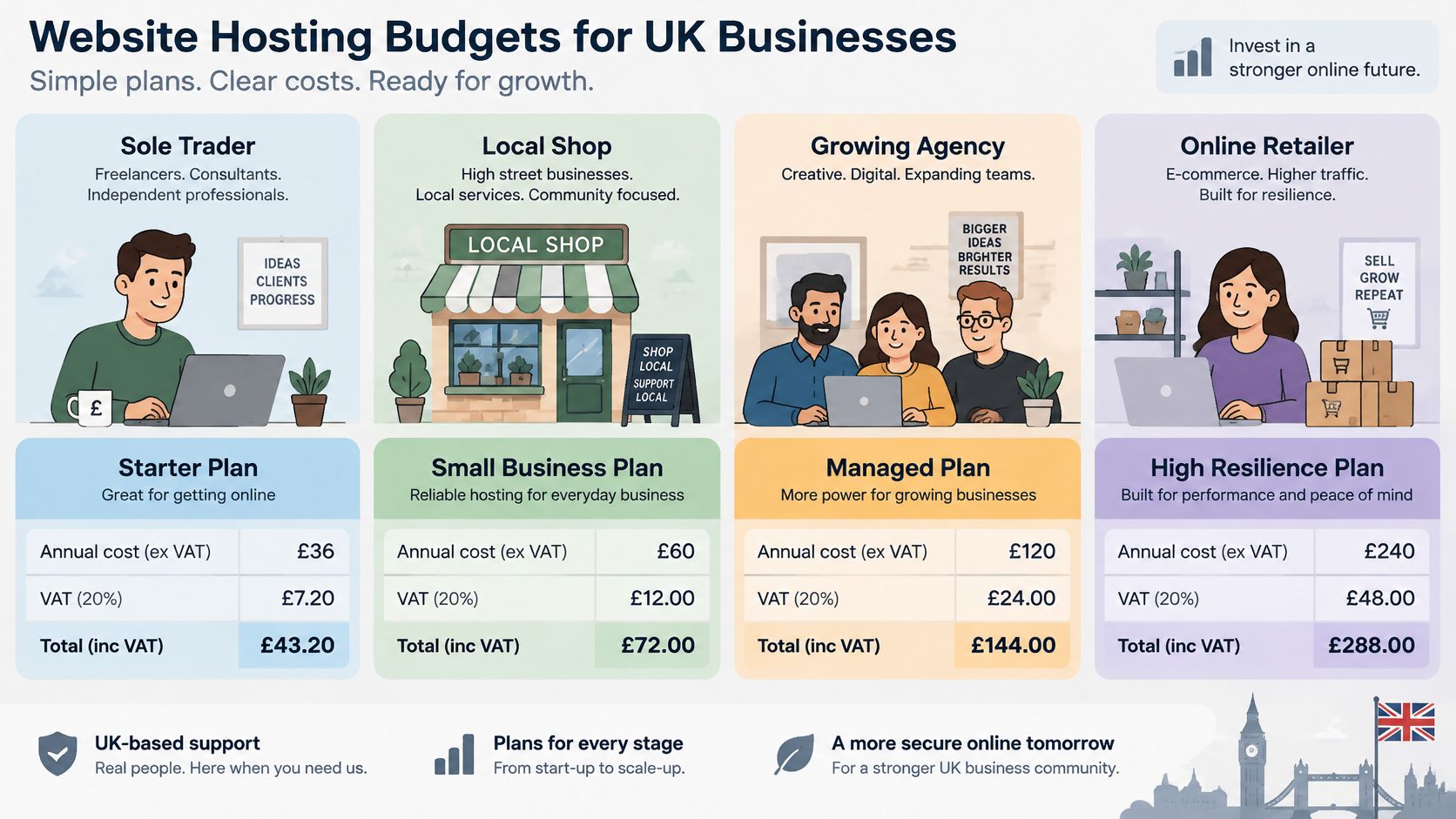
| Business need | Typical plan | Monthly (ex VAT) | Annual total including VAT |
|---|---|---|---|
| Sole trader brochure site | Shared hosting | £3-£5 | £43.20-£72 |
| Small firm with a managed site | Managed WordPress entry tier | £35 | £504 |
| Growing e-commerce store | Managed higher tier | £95 | £1,368 |
| Regulated firm with tested backups | Managed higher-resilience tier | £249 | £3,585.60 |
For the sole trader, the arithmetic is £3-£5 × 12 months × 1.2, giving £43.20-£72 a year including VAT. That can suit a simple brochure site if the owner is comfortable handling the tasks the provider doesn't manage.
For a small firm that wants updates and support handled, an entry managed tier at £35 per month works out to £504 a year including VAT. A growing online shop may need more capacity and a higher support tier; at £95 per month, the annual hosting total is £1,368 including VAT.
A regulated firm may put greater weight on tested backups and recovery arrangements. At £249 per month, the yearly total is £3,585.60 including VAT. These tiers are examples, not a universal price list: service scope and provider pricing vary. Blowfish Technology describes its website hosting as UK-based, fast and secure, with proactive monitoring, security scanning and managed updates.
Domains and the add-ons in the previous table aren't included in these annual hosting totals. For a more complete site budget, a website budgeting guide for small businesses can help put hosting alongside other website expenses.
Use this video as another way to think through the difference between hosting packages and the broader needs of a business site.
Place your business in the row that best reflects the work your site supports, then add the domain and any required extras to estimate the actual annual budget.
Three Resilience Tiers and What Each Covers
An hour of downtime can have very different consequences for a brochure site, an online shop and a professional firm that depends on enquiries. Hosting resilience is therefore a business decision as well as a technical one: the appropriate level depends on how quickly the site needs to return and what disruption the business can absorb.
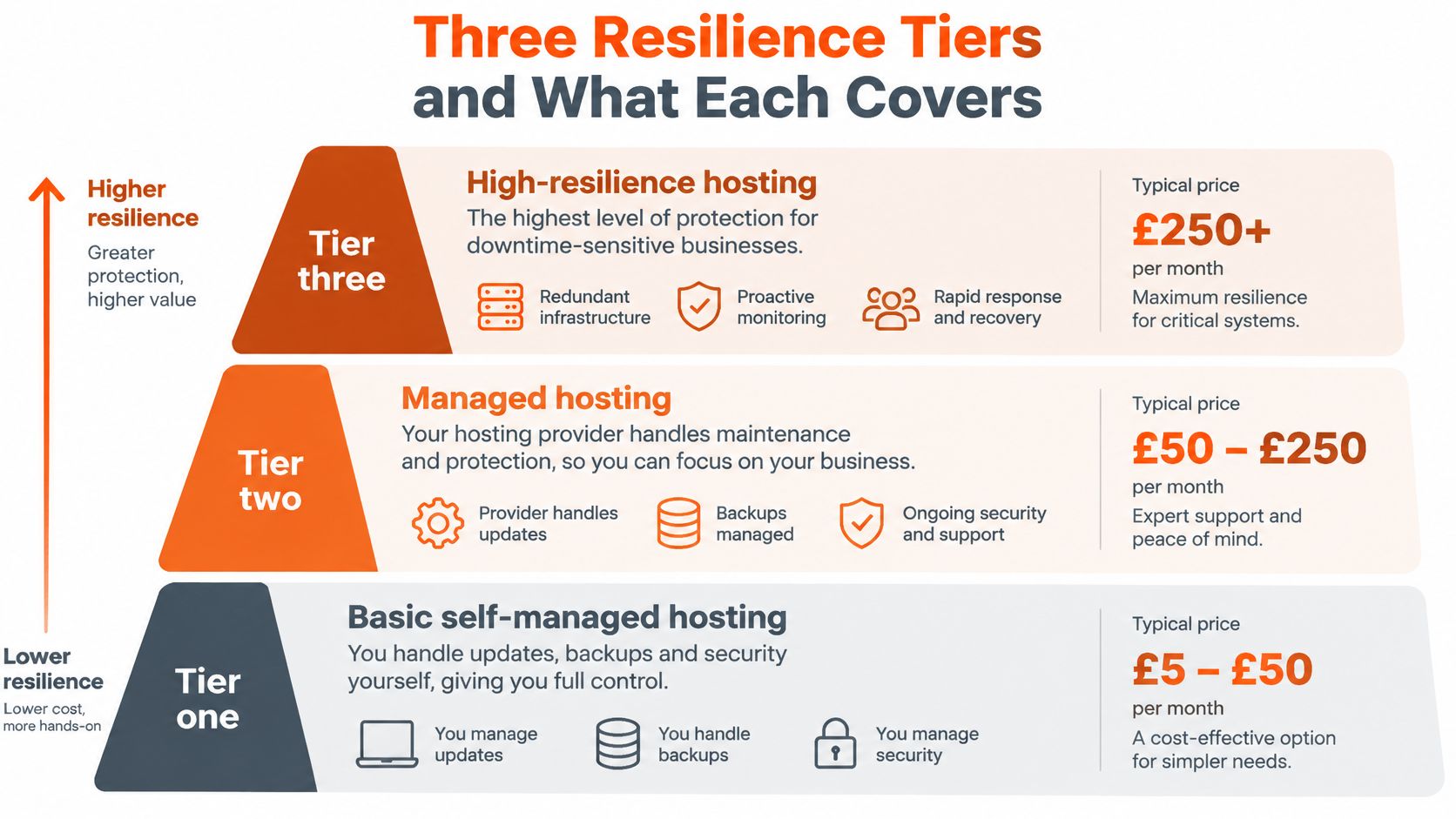
Tier one is basic self-managed hosting. The business handles updates, backups and security, so the provider's service covers less. The owner or internal team must also take responsibility for maintenance and recovery.
Tier two is monitored managed hosting. The provider takes on agreed maintenance and protection tasks. Blowfish Technology's UK-based website hosting includes proactive monitoring, security scanning and managed updates. Confirm which tasks are included, and which responsibilities remain with your business, before comparing prices.
Tier three is higher-resilience hosting. It suits businesses that need a defined recovery approach, including tested backups and clear restoration expectations. Blowfish Technology's infrastructure is held in a Tier 4 datacentre in Milton Keynes and a second facility at Bletchley Park. The facilities have dual power, dual air conditioning and dual 10Gb internet, and hold ISO 27001 certification.
Resilience has running costs beyond server capacity. Cooling and power infrastructure contribute to a data centre's overhead, while additional backup and recovery arrangements can affect the hosting price. Compare what each tier includes rather than treating a higher monthly fee as a guarantee of faster recovery.
SSL encrypts connections, but it does not protect against compromised administrator accounts, ransomware or accidental deletion. Backups also need to cover the right data and be restorable within a timeframe that suits the business. A recovery time objective guide can help you set a target for how quickly the website must be available again.
Estimate the cost of one hour offline, including missed sales or enquiries and disruption to staff. Choose a tier whose recovery arrangements address a loss your business could not comfortably absorb.
Confirm the Full Three-Year Cost Before You Sign
Ask every provider for a comparable three-year quote. Use this checklist to catch costs or responsibilities that a monthly headline figure may leave out.
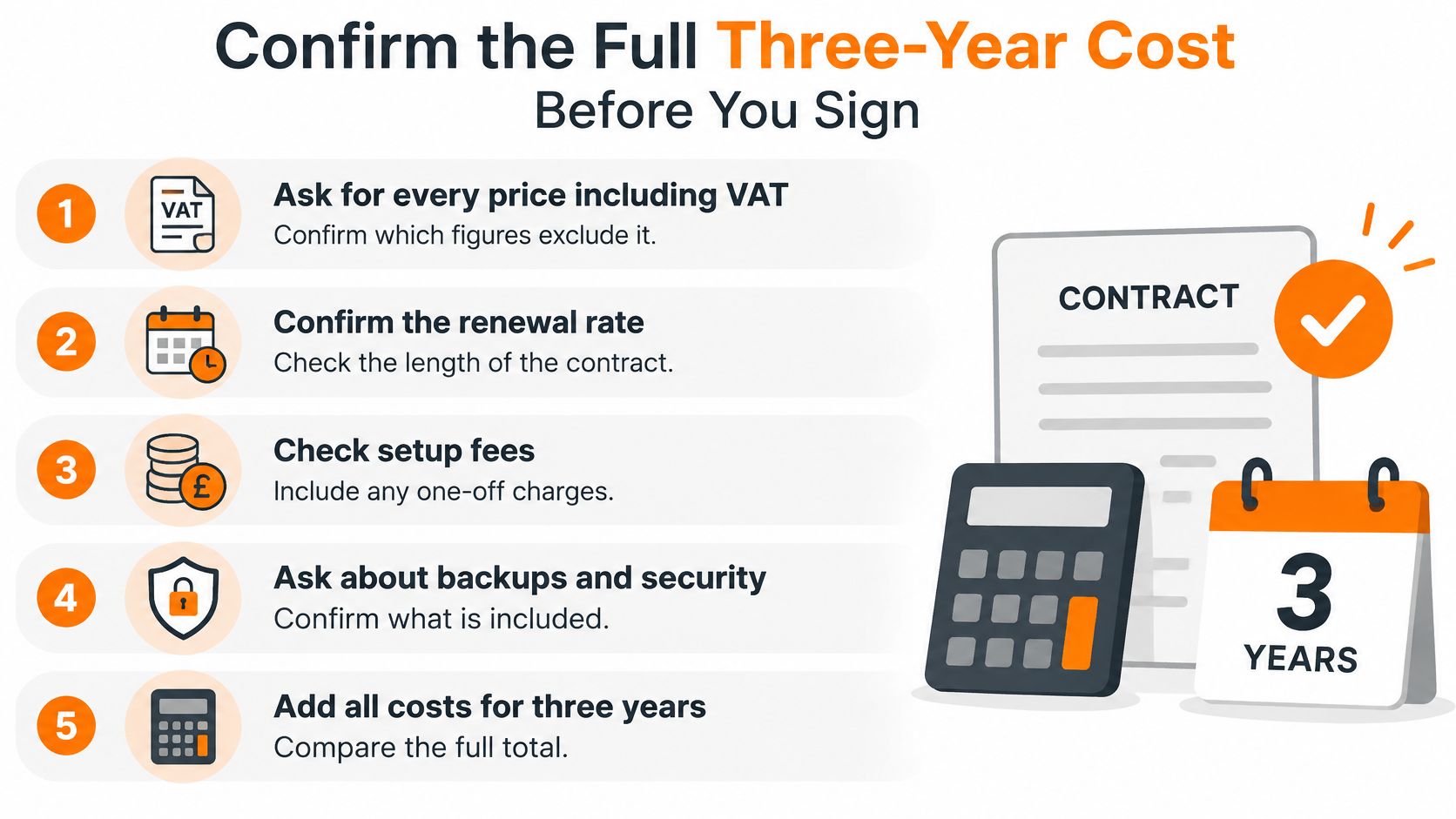
- Get every price including VAT. Confirm which figures exclude it, so the totals are comparable.
- Confirm the renewal rate. Check when the promotional price ends and how long the contract runs.
- List the domain separately. Include both registration and renewal charges.
- Check backups and security. Confirm retention, restore testing and whether databases and email are covered.
- Review support and service levels. Record support hours, response commitments and the escalation route.
- Confirm data location. Check where cloud and hosting data is stored and whether the service is GDPR-aligned.
- Clarify additional charges. Get confirmation that extra costs require your approval before invoicing.
Blowfish Technology offers a free, no-obligation cloud assessment that reviews your current setup and recommends a solution. After reviewing your current licences, it can provide a personalised quote with an exact monthly cost before you commit.
Request a three-year cost model from at least three providers. Compare the totals, including renewal charges, VAT, domains and add-ons, rather than choosing on the headline monthly price.
If you want to compare a hosting budget with the support and resilience your business needs, Blowfish Technology offers UK-based website hosting with proactive monitoring, security scanning and managed updates. Request a free, no-obligation cloud assessment to review your current setup and receive a personalised quote before you commit.
