
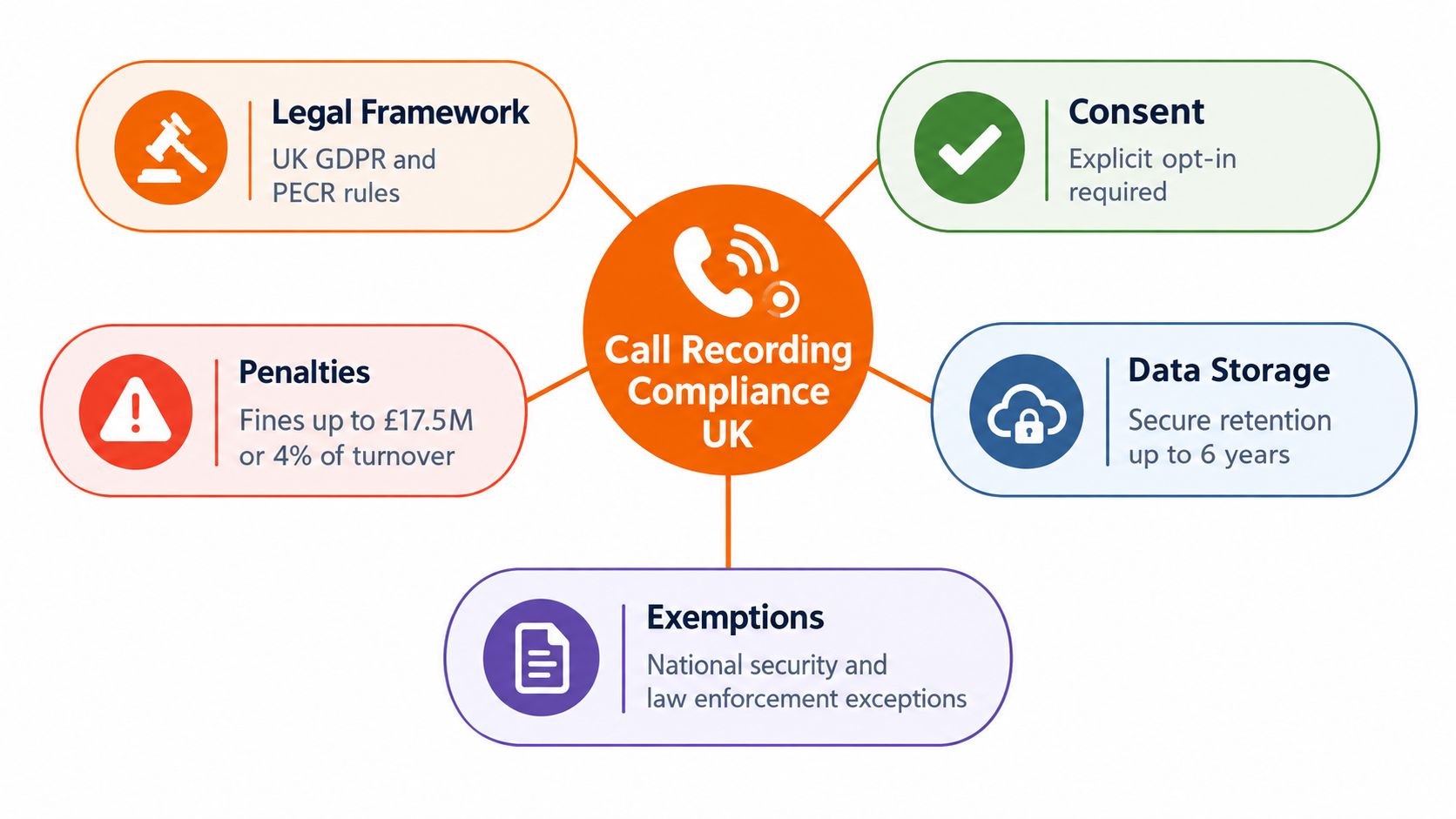
If your business records calls in the UK, the risk is bigger than commonly realised. The most severe GDPR penalty can reach £17.5 million or 4% of global annual turnover, whichever is higher, and that's why call recording compliance has to be treated as a governance issue, not a phone-system setting.
Too many SMEs still think compliance starts and ends with “this call may be recorded”. It doesn't. The test is whether you can explain why you recorded the call, control who can access it, delete it when the purpose ends, and, if you work in a regulated sector, produce, index, redact, and retain it on demand. That gap between recording and being able to evidence control is where businesses get exposed.
Table of Contents
- Understanding Call Recording Compliance in the UK
- The Three Legal Pillars of Compliance
- Ordinary versus Regulated Business Requirements
- Implementation Checklist for Call Recording Compliance
- Common Compliance Failures and Risk Scenarios
- Choosing VoIP and Hosted Telephony Providers
- Building a Sustainable Compliance Strategy
Understanding Call Recording Compliance in the UK
UK GDPR penalties can reach £17.5 million or 4% of global annual turnover, as noted in this UK call recording compliance overview. For UK SMEs, that should settle the argument quickly. Call recording sits inside data protection, records management, and operational control. It is not just a telephony feature.
In the UK, call recording compliance rests on three connected laws: the Telecommunications (Lawful Business Practice) (Interception of Communications) Regulations 2000, the Data Protection Act 2018, and UK GDPR. The practical effect is straightforward. You need a valid reason to record, people need clear notice, and recordings cannot sit in storage indefinitely. Ofcom's data protection and complaint guidance reflects that wider expectation of fair handling and proper control.
Permission is not the same as compliance
A recorded message at the start of a call helps with transparency. It does not prove control.
The test is whether your business can treat recordings as retrievable business records. Can you find the right call quickly? Can you restrict access by role? Can you remove payment data or sensitive personal information before sharing it? Can you delete recordings in line with policy and prove that deletion happened? In regulated sectors, especially financial services, that gap between recording a call and producing, indexing, redacting, and retaining it on demand is where generic advice falls apart.
Use a simple standard. If you cannot explain who can access a recording, where it is stored, how it is searched, how long it is kept, and how it is deleted, your setup is not under control.
That is why this topic belongs alongside wider governance work such as SMB employment compliance strategies. Policies matter. Evidence matters more.
The real issue for SMEs
Many UK SMEs buy a phone system that captures audio and assume the compliance box is ticked. It is not.
The problem usually appears later. A customer disputes what was said. An employee asks for their data. A complaint needs review. A regulator or ombudsman asks for a specific interaction. Then the business discovers the files are poorly labelled, stored in separate inboxes or portals, impossible to search by customer or date, and visible to far too many people.
That is the difference between ordinary call recording and a compliant recording process. Storage alone is not enough. You need indexing, access control, retention rules, audit trails, and a practical way to export or redact recordings when someone asks for them.
Treat any recording that captures personal data, instructions, complaints, regulated discussions, or sensitive commercial information as a formal record. That approach leads to better decisions early. You define the purpose first, set retrieval and retention requirements next, and only then choose the telephony platform.
The Three Legal Pillars of Compliance
UK firms usually get into trouble because recording was switched on before anyone set the rules around it. The three legal pillars are straightforward. The hard part is turning them into controls your team can follow and prove.
Lawful basis
Start with purpose. If you cannot explain why a call is being recorded, you should not be recording it.
For many SMEs, the lawful basis will be legitimate interests. That is not a free pass. You need a documented reason, a clear test of necessity, and a record of how you weighed business need against privacy impact. UK compliance guidance expects that decision to be written down, not assumed, as discussed in this UK business call recording guidance.
Write the purpose in plain English. Use operational language your managers can apply:
- Training and quality assurance: Team leaders review selected calls to improve call handling and spot recurring service issues.
- Dispute resolution: The business keeps recordings where verbal commitments, complaints, or service failures may need to be checked later.
- Compliance monitoring: The business reviews calls involving regulated disclosures, complaint handling, or higher-risk customer instructions.
One rule works well here. Match the recording purpose to a retrieval purpose. If you say recordings are kept for complaints or regulated reviews, you also need a way to find the right call quickly.
Transparency
Tell people before recording starts. Tell them clearly. Then make sure your privacy notice, staff scripts, and phone system all say the same thing.
Many SMEs cut corners. They rely on a vague IVR message, forget outbound calls, or give staff no usable wording at all. That creates a gap between policy and practice, and that gap is what causes problems when a complaint lands or a data request arrives.
Good transparency covers three points. The call is being recorded. Why it is being recorded. What happens to that recording next, including who may access it and how long it may be kept.
Retention limitation
Retention is where weak setups usually fail. Businesses record calls, store them somewhere, and leave them there until a problem exposes the mess.
The rule is simple. Keep recordings only for as long as the stated purpose requires, then delete them in a way you can evidence. Manual cleanup is unreliable. Use timed retention rules, automatic deletion, and access controls that stop old recordings building up across mailboxes, portals, and local downloads.
This matters beyond storage cost. If your provider cannot enforce retention by policy, control where recordings are stored, and support deletion properly, your compliance position is already weak. That becomes obvious once you review data sovereignty and data security requirements for UK businesses, because storage jurisdiction, user permissions, and deletion controls all affect whether your process stands up under scrutiny.
| Pillar | What regulators expect | What businesses often do wrong |
|---|---|---|
| Lawful basis | A documented reason for recording | Record everything by default |
| Transparency | Clear notice before recording starts | Assume a generic message is enough |
| Retention | Defined schedule and deletion | Keep files indefinitely |
Where SMEs struggle most
The legal pillars are not just about whether you can record. They also determine whether you can manage recordings properly after capture.
That distinction matters. A business may have a valid reason to record, give notice correctly, and still fail in practice because recordings are badly labelled, impossible to search, shared too widely, or kept without any reliable deletion rule. In regulated work, that failure gets worse. You may need to produce a specific interaction, restrict who can review it, export it for investigation, or redact part of it before disclosure.
Treat each pillar as part of a record-management process. Lawful basis defines why the record exists. Transparency governs how it is collected. Retention sets the stop date. If your platform cannot support indexing, controlled access, export, and deletion against those rules, you do not have a compliant process. You have audio files.
Ordinary versus Regulated Business Requirements
Many UK SMEs can record calls lawfully and still fail the harder test. They cannot find the right call quickly, prove who accessed it, remove sensitive content before disclosure, or delete it on schedule.
That gap matters more than generic guidance admits.
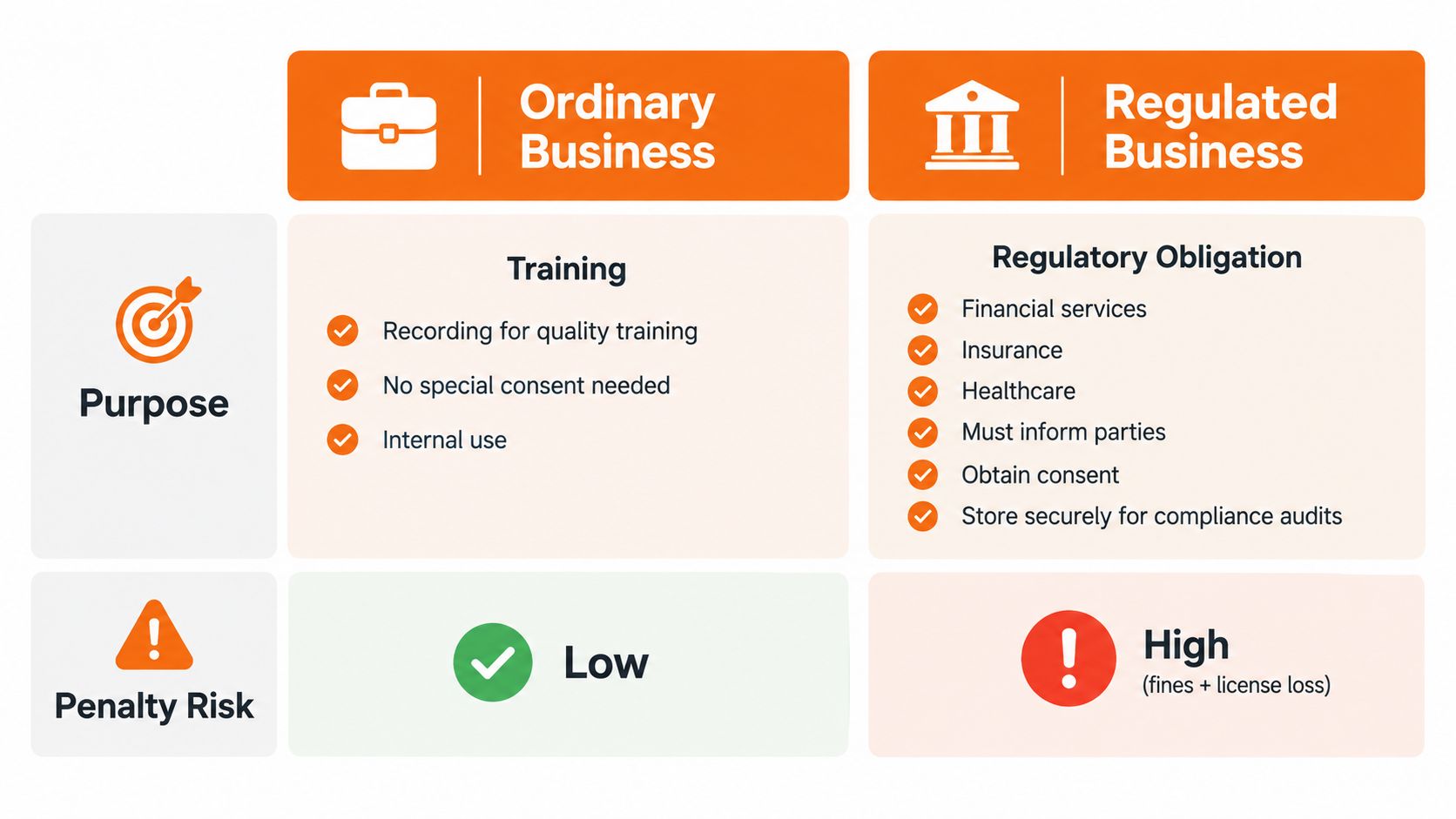
An ordinary business usually records calls for service reviews, complaint handling, staff training, or checking what was agreed. A regulated firm records for those reasons too, but the recording also has to stand up as evidence. In financial services, that means the system and process must support retention, retrieval, and oversight in line with FCA record-keeping expectations under SYSC 9.
For regulated firms, especially FCA-regulated businesses, a recording is part of the control environment. You may need to produce, index, redact, and retain it on demand. If your platform records audio but cannot do those things reliably, it is not suitable for regulated use.
What ordinary business use looks like
A typical SME outside formal sector regulation still needs discipline. The standard is simpler, but it is not casual.
The process should cover four points:
- Notice: callers know the call is being recorded.
- Access control: only people with a clear reason can listen.
- Retention: recordings are kept for a defined period, then deleted.
- Searchability: staff can locate a recording if a complaint, subject access request, or dispute appears.
That is the baseline. If you cannot search by date, agent, number, or case reference, you will struggle even in a low-risk setting.
What regulated use adds
Regulated firms need evidential control, not just storage. You need a reliable way to tie a recording to a customer, transaction, adviser, and timeline. You need an audit trail showing who accessed it and when. You also need a practical method to export a call for an investigation or complaint file without losing context.
Redaction is often missed. It should not be. If a recording contains personal data about another individual, payment information, or material that should not be shared in full, your team needs a controlled way to remove or mask that content before disclosure. The UK GDPR right of access does not disappear because the information sits inside an audio file, and the ICO expects organisations to handle disclosure properly under the right of access guidance.
A folder full of audio files is not an FCA-ready archive.
Side-by-side difference
| Requirement area | Ordinary business | Regulated business |
|---|---|---|
| Main purpose | Training, QA, disputes, complaint handling | Regulatory evidence, complaint support, conduct oversight |
| Retention approach | Keep only for a defined business need | Retain under formal rules linked to regulatory obligations |
| Retrieval standard | Find the relevant call when an issue arises | Produce a specific call quickly, accurately, and with full context |
| Record handling | Basic access restriction and deletion | Indexed records, audit trail, controlled export, and redaction capability |
Legal and financial firms should pay close attention here. Sector rules differ, but the operational lesson is the same. If you cannot find the call, prove its chain of control, restrict access, and disclose it safely, your recording setup does not meet a regulated standard.
Many SMEs buy entry-level telephony that records calls but lacks useful metadata, structured retention, permission controls, and clean export options. That may be enough for occasional training reviews. It is the wrong setup for complaint evidence, FCA scrutiny, or any environment where you have to produce the right record on demand.
Implementation Checklist for Call Recording Compliance
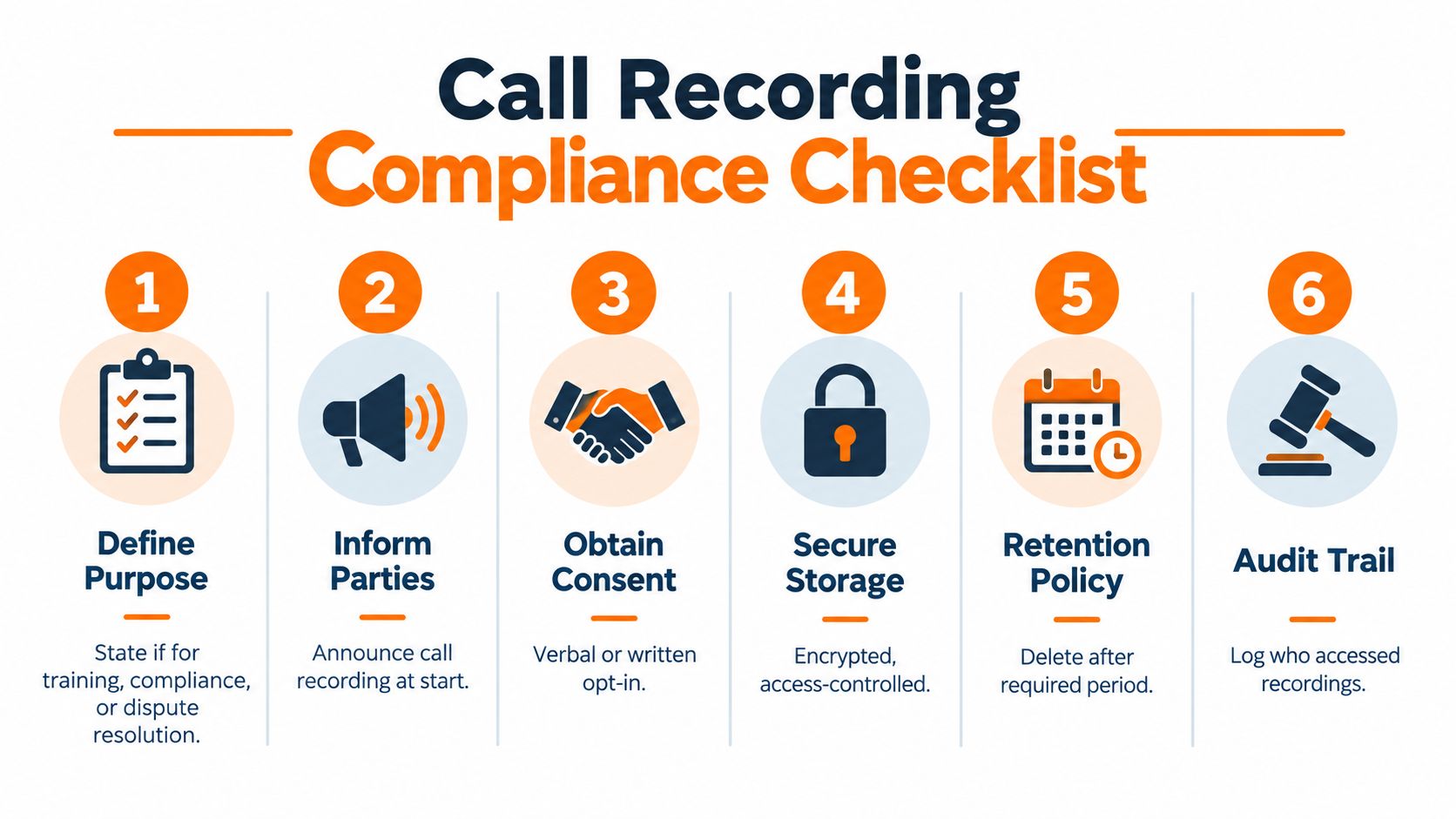
Most compliance failures come from vague ownership. Fix that by turning policy into a checklist that operations, IT, and compliance can run.
Start with decisions, not software
Define the purpose
State exactly why calls are recorded. Training, complaint handling, dispute resolution, and regulated compliance are different purposes. Don't lump them together unless they apply.Document the lawful basis
Record the legal basis used for each recording category. If you rely on legitimate interests, complete the assessment before switching recording on.Write the notice
Your inbound message, outbound script guidance, and privacy documentation must align. If the script says one thing and the policy says another, you've created your own audit finding.
Build the control layer
Restrict access by role
Not everyone needs access to recordings. Managers, compliance leads, and complaint handlers may need different levels of permission.Protect storage properly
Use encrypted storage, controlled administrator access, and access logging. If recordings live in a general file share or can be downloaded casually, the setup is wrong.Create retention rules in the platform
Manual deletion is a weak control. Use automation wherever possible so recordings are deleted at the end of the approved retention period.
A lot of this depends on choosing telephony that supports it. If you're still reviewing the basics of modern business telephony, this overview of what SIP trunks are helps clarify where call routing and recording capabilities sit in the wider stack.
Make the system auditable
Use this quick internal audit list:
- Can you evidence necessity: Someone should be able to show why each recording category exists.
- Can you retrieve specific calls: Search should work by user, date, line, customer identifier, or complaint reference.
- Can you prove deletion: The system should show retention settings and deletion outcomes.
- Can you answer a request: UK GDPR expectations include responding to subject access requests within one month, as explained in this UK compliance manual entry on call recording accountability.
Good call recording compliance is boring by design. Clear ownership, predictable controls, and an audit trail beat clever workarounds every time.
One practical note. If you're using a managed telephony service, ask whether the provider supports searchable and exportable recordings stored in secure cloud infrastructure. Blowfish Technology, for example, offers call recording within its managed telephony services for compliance or training use, with secure cloud-based storage and search/export capability. That matters because retrieval is often the first place poor systems fail.
Common Compliance Failures and Risk Scenarios
The most common compliance failures are not dramatic. They are routine. A team turns on recording, leaves the default settings alone, and assumes the job is done.

The business that can't find the call
A customer raises a complaint about what was said during a phone sale. The company knows the call was recorded. The problem is that nobody can identify which file is the right one without listening to dozens of recordings.
That is not a minor inconvenience. It shows the organisation treated recordings as raw audio, not as formal records. In a regulated context, that failure is worse because the expectation is not merely to retain calls, but to produce the right one promptly.
The business that never deletes anything
Another common failure is indefinite retention. The logic sounds harmless: storage is cheap, so keep everything. From a compliance perspective, that is poor discipline.
When businesses rely on manual clean-up, deletion usually slips. Staff leave, folders move, systems migrate, and recordings remain in place without a clear purpose. Privacy risk increases, and the business loses the ability to prove that retention is limited and controlled.
The business with open access
This one appears in SMEs more often than people admit. Supervisors, admins, team leaders, and sometimes general office staff can all access recordings because nobody tightened permissions after deployment.
Too much access is a compliance failure, not a convenience.
Sensitive personal data, complaint details, financial discussions, and legal instructions should not be casually available across the organisation. If role-based access is missing, your risk sits with every unnecessary click.
The warning signs to watch
Look for these red flags:
- Generic retention with no rationale: The same period applied to every call category without explanation.
- No indexing or metadata discipline: Recordings are stored, but not organised in a searchable way.
- No deletion evidence: Staff say recordings are deleted, but nobody can prove when or how.
- No staff guidance: Front-line teams don't know what to say if a caller asks about recording.
- No complaint retrieval process: There is no tested route for finding and exporting a relevant call.
These failures all come from the same mindset. The business treats call recording as a one-time telecoms feature instead of an ongoing governance control. That mindset is what needs fixing first.
Choosing VoIP and Hosted Telephony Providers
Provider choice matters more than most SMEs expect. If the platform can't support compliance properly, your policy won't save you.
Non-negotiable questions for providers
Ask direct questions during procurement:
- How are recordings indexed: Can you search by user, date, extension, or case reference?
- What access controls exist: Can permissions be restricted by role and reviewed easily?
- How does retention work: Can you automate deletion by policy rather than relying on staff?
- What export options exist: Can you provide recordings quickly for complaints or legal review?
- Can sensitive data be managed: Is there a practical route for redaction or controlled disclosure?
If a provider gives fuzzy answers, move on.
Match the platform to your risk profile
A small service business may need reliable notice, secure cloud storage, retention settings, and basic retrieval. A financial or legal practice needs much more. Searchability, auditability, and controlled production become central buying criteria.
That's why telephony decisions should sit alongside wider communications planning. If your business is comparing broader platforms, this enterprise communications solution guide gives useful context on how voice, collaboration, and governance should fit together rather than being purchased in isolation.
A similar point applies when reviewing hosted voice architecture. This guide to cloud unified communications is worth reading if your current estate mixes legacy telephony, remote users, and compliance-sensitive call flows.
Avoid the expensive retrofit
The worst buying decision is choosing a cheap platform and then trying to bolt compliance onto it later. That usually means separate storage, awkward exports, clumsy permission workarounds, and inconsistent retention handling.
Use a short decision table internally:
| Question | If the answer is no |
|---|---|
| Can we locate the right recording quickly? | Complaint handling will be weak |
| Can we limit access by role? | Privacy risk stays high |
| Can we automate retention? | Deletion control will drift |
| Can we export evidence cleanly? | Regulatory response will be slow |
Choose the provider that supports your actual obligations, not the one that advertises “call recording” as a feature alone.
Building a Sustainable Compliance Strategy
The strongest businesses stop treating call recording as a telephony setting and start treating it as part of operational governance. That's the shift that makes the rest work.
A sustainable approach has three parts. First, the organisation defines where recording is necessary and where it is not. Second, it applies platform controls that match those decisions. Third, it reviews those controls regularly as services, staff, and regulation change.
Put ownership in the right place
Ownership should never sit with telecoms alone. Compliance, operations, IT, and whoever handles complaints all need defined responsibilities. Someone should own policy, someone should own system control, and someone should verify that retrieval and deletion work.
Staff training matters too. People on the phones need practical instructions, not policy PDFs they'll never read. Managers need to understand access limits. Administrators need to know that convenience is not a lawful reason for broad permissions. Broader staff awareness is part of the same discipline covered in GDPR training for staff.
Review the system like a control, not a tool
Use periodic checks to test whether:
- Your notices still match reality
- Retention rules still fit business purpose
- Permissions still reflect current roles
- Complaint retrieval still works under pressure
- Suppliers still support your compliance needs
Strong call recording compliance is visible in the audit trail, not in the welcome message.
That's the practical standard UK SMEs should aim for. Not perfection. Control. If you can justify the recording, govern access, delete on schedule, and produce what matters when asked, you are operating like a mature business. If you can only say “the system records calls”, you are still exposed.
If your current setup records calls but doesn't give you confidence on access control, retention, retrieval, or regulated evidence handling, it's time to fix the gap. Blowfish Technology helps UK SMEs align telephony, cloud services, and compliance controls so call recording supports governance instead of undermining it. Speak to them if you need a practical review of your current platform or a better-fit hosted telephony solution.
