
If you're responsible for an SME, this probably sounds familiar. Someone asks whether your staff have had GDPR training, and the honest answer is, "Yes, sort of." New starters got an induction slide deck. A few people clicked through an online module. HR and finance know the data is sensitive, but they haven't had training built around the actual decisions they make each day.
That's where most programmes fall down. The problem usually isn't that a business ignores data protection. It's that training sits off to one side of the everyday work. It isn't tied to your systems, your teams, your incident process, or the way staff now use Microsoft 365, collaboration tools, and AI features in daily operations.
Good GDPR training for staff has to do two jobs at once. It needs to be defensible if the ICO ever asks how you train people, and it needs to reduce avoidable mistakes in practical application. Those are not separate goals. For a UK SME, they are the same programme.
Table of Contents
- Aligning Your Training with UK GDPR Requirements
- Designing a Role-Based GDPR Training Curriculum
- Choosing Effective Training Delivery Methods
- Assessing Understanding and Maintaining Compliance Records
- Integrating GDPR into Your Security Awareness Culture
- Conclusion From Compliance Chore to Business Advantage
Aligning Your Training with UK GDPR Requirements
Start with accountability, not course content
UK GDPR training for staff isn't optional housekeeping. The regime applies from 25 May 2018, and organisations are expected to build awareness into compliance controls, with the DPO's tasks including awareness-raising and training of staff involved in processing operations. Guidance also says management must provide initial and refresher training on confidentiality and accountability, and that people with permanent or regular access to personal data need relevant training, as outlined in GDPR staff training guidance.

That changes the starting point. Don't begin by asking which off-the-shelf course to buy. Begin by asking what evidence you'd need if a regulator, client, insurer, or auditor wanted to see how staff are trained, how often, and why different roles receive different content.
A workable baseline usually includes:
- Documented objectives tied to your business activities, not generic privacy theory.
- Role coverage for teams that handle personal data regularly, including HR, finance, sales, customer service and IT.
- Refresh cycles that update staff when policies, systems or processing practices change.
- Proof of completion and proof that staff understood what they completed.
Practical rule: If your training records only show that someone watched a video, you have evidence of attendance, not evidence of compliance.
Directors often underestimate the regulator's view of accountability. The issue isn't whether you can say staff were "made aware". The issue is whether you can show your training matches the risks in your environment.
If you're in a regulated or document-heavy sector, the bar is higher in practice. A firm managing case files, financial records, engineering documentation or employee data should align training with the systems and workflows those teams use. For example, legal practices handling client records need privacy training that reflects operational reality, not a generic e-learning package. That overlaps with wider controls discussed in IT support for legal firms, where support, access control and compliance evidence all interact.
Define what good looks like in your business
A defensible programme usually starts with four decisions.
Identify where personal data sits
Your CRM, finance platform, Microsoft 365 tenancy, payroll system, ticketing system, HR files, mobile devices, archived mailboxes and shared folders all matter.List who touches that data
Not just department heads. Include administrators, temporary staff, managers approving exports, and anyone with regular access.Tie training to specific risks
HR may need deeper handling rules around employee records. Sales may need clarity on lawful basis, marketing preferences and data sharing. Managers need to know escalation duties when staff report issues.Set evidence standards
Decide in advance what you will retain. Completion logs, quiz scores, policy acknowledgement, module version, retraining date and exceptions all belong in scope.
Many businesses also benefit from reviewing practical examples of implementing GDPR staff training best practices before building their own framework. The useful part isn't the theory. It's seeing how training can be structured as an operational control rather than an annual admin exercise.
Designing a Role-Based GDPR Training Curriculum
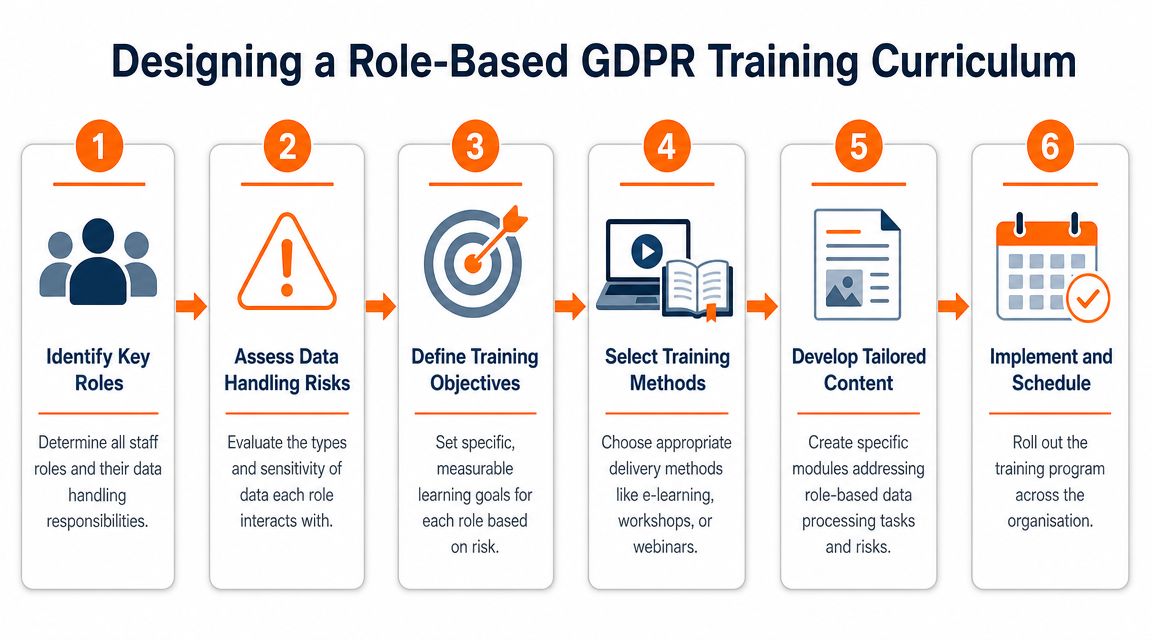
A generic privacy module may satisfy procurement, but it rarely changes behaviour. The curriculum should be built around decisions people make in their jobs, not around headings copied from the regulation.
Build the curriculum from your data map
A strong benchmark from the ICO indicates that UK organisations delivering role-specific GDPR training report around 35 to 40 per cent fewer category-2 and category-3 data breaches than those relying on generic awareness sessions, according to role-based GDPR training requirements. That aligns with what works on the ground. Staff retain more when the examples match the systems, documents and approval paths they use every day.
The cleanest way to build this is to start with your processing register or equivalent data map, then turn it into a role matrix.
Use a simple process:
- Map processing activities against departments. Include collection, storage, sharing, retention and deletion.
- Mark legal and operational risk. Some teams need more than awareness because they work with sensitive, regulated or high-volume data.
- Assign core modules that everyone must complete, such as confidentiality, incident escalation, secure handling and data subject rights awareness.
- Add specialist modules by role. The programme then becomes useful rather than decorative.
One common mistake is assuming access rights tell you everything. They don't. A manager may have limited system access but still approve subject access responses, exports to third parties, or retention decisions. Training has to reflect decision authority as well as data access.
A practical side benefit is that this review often exposes stale access, shared credentials or old accounts that should have been removed. That links directly to access hygiene and the risks covered in old logins for ex-staff.
What different teams actually need to learn
The curriculum shouldn't be equal in length. It should be equal in relevance.
For a quick visual overview of how role-based training can be introduced, this short explainer is useful:
Here is the kind of distinction most SMEs need to make:
| Role | Training focus |
|---|---|
| HR and payroll | Employment data handling, confidentiality, special category data awareness, retention, internal sharing limits, subject access coordination |
| Finance | Supplier and customer data, invoice and payment data handling, email verification, secure transfers, retention rules, fraud-linked disclosure risk |
| Sales and marketing | Consent handling, lawful basis awareness, contact preferences, CRM hygiene, list imports, third-party platform use |
| Customer service | Identity checks, request handling, secure disclosures, escalation routes, note-taking discipline |
| IT and system admins | Access control, least privilege, logging, secure configuration, back-up handling, processor oversight |
| Managers | Escalation, policy enforcement, decision-making records, approving access, handling reported concerns |
Training works when staff can recognise their own inbox, folders, systems and mistakes inside the lesson.
This is also where scenario design matters. HR doesn't need a long lecture on every GDPR article. It needs practical modules such as, "A manager asks for sickness details by email. What can you share, and through which channel?" Marketing needs, "Can this legacy contact list be uploaded into the campaign platform?" Customer service needs, "A caller asks for account changes and knows partial details. What verification steps apply?"
If you want one planning principle, use this: train on tasks, not departments. Within finance, payroll staff may need different content from credit control. Within sales, account managers may need different content from lead generation teams.
Choosing Effective Training Delivery Methods
The delivery method changes the result. A good curriculum pushed through the wrong format becomes background noise.
What works and what tends to fail
Simulation-driven GDPR training such as mock DSARs and phishing-style drills can improve median incident-reporting time by 50 to 60 per cent within six months, while annual marathon training can reduce retention by up to 60 per cent compared with monthly 10 to 15-minute sessions, according to simulation-led GDPR employee training analysis. For SMEs, that supports a simple conclusion. Shorter, repeated training beats one overloaded annual event.
That doesn't mean face-to-face workshops are obsolete. They are often the best option for senior management, HR, finance and teams dealing with high-risk scenarios. People ask better questions live. Ambiguities surface faster. Policies make more sense when discussed against real workflows.
But workshops alone don't scale well. If you rely only on classroom sessions, refreshers slip, records become messy, and remote or shift-based staff fall through the gaps.
Comparison of GDPR Training Delivery Methods
| Method | Engagement | Scalability | Tracking & Reporting | Best For |
|---|---|---|---|---|
| Face-to-face workshops | High when the trainer uses real scenarios and allows discussion | Limited across multi-site or fast-growing teams | Manual unless paired with a learning platform | Leadership teams, HR, finance, regulated departments |
| LMS or e-learning platform | Moderate to good if content is role-based and concise | Strong for dispersed teams and repeatable onboarding | Strong, usually with completion logs and version control | Core induction, refresher training, audit evidence |
| Microlearning with simulations | High when modules are short and scenario-driven | Strong if automated and scheduled | Strong when linked to quizzes and campaign reporting | Continuous awareness, incident response habits, modern collaboration risk |
Annual training often feels efficient because it gets booked once. In practice, it usually pushes too much content into one sitting and produces weak recall.
A blended model is usually the most practical choice for SMEs:
- Use induction modules for everyone who joins and touches personal data.
- Run short monthly or periodic refreshers on one issue at a time.
- Add simulations for breach escalation, phishing-style disclosure risk and DSAR routing.
- Reserve workshops for high-risk roles, policy changes and management accountability.
If you already run cyber awareness campaigns, combine the programmes where it makes sense. Staff don't separate a privacy mistake from a security mistake. Sending a spreadsheet to the wrong recipient, oversharing in Teams, or clicking a fake link that exposes customer data are all people risks. A managed programme such as user awareness training can support that combined approach by giving you one place to schedule content, track completion and repeat key messages.
Assessing Understanding and Maintaining Compliance Records
A completion certificate is better than nothing, but it isn't enough on its own. The real question is whether staff understood what to do.

Since GDPR took effect on 25 May 2018, organisations have been expected to maintain records, run role-appropriate training and update staff whenever processing practices change. Failing to keep training current and documented can breach obligations on integrity and confidentiality, as noted in UK GDPR staff training record-keeping guidance.
Test judgement, not memory alone
The fastest way to weaken a programme is to assess only recall. Staff can memorise definitions and still mishandle a live request.
Better assessment methods include:
- Scenario questions that ask what the employee should do next.
- Decision trees for breaches, DSARs, sharing requests and retention actions.
- Short scored quizzes after modules so you can identify repeated weak spots.
- Manager sign-off where the role includes approval, escalation or supervisory duties.
A useful pattern is to assess in layers. Start with a short knowledge check after induction. Then test with a task-based scenario after a few weeks. After that, use periodic micro-assessments tied to actual risks, such as file sharing, consent handling or secure deletion.
Keep records you can actually produce
Training records should be easy to retrieve and easy to interpret. If someone asks for evidence, you shouldn't need three different spreadsheets and a search through old emails.
Keep, at minimum:
- Employee identity and role at the time of training
- Training module name and version
- Completion date
- Assessment result where relevant
- Policy acknowledgement if linked to the module
- Retraining or refresher dates
- Exceptions or overdue actions
When an organisation changes a process, system or supplier, training records should show who was updated and when. Otherwise the paper trail stops where the operational risk begins.
The practical goal isn't bureaucracy. It's accountability you can defend. If a member of staff causes or mishandles an incident, your records should show what they were trained on, whether they passed assessment, and whether the business refreshed that training when circumstances changed.
Integrating GDPR into Your Security Awareness Culture
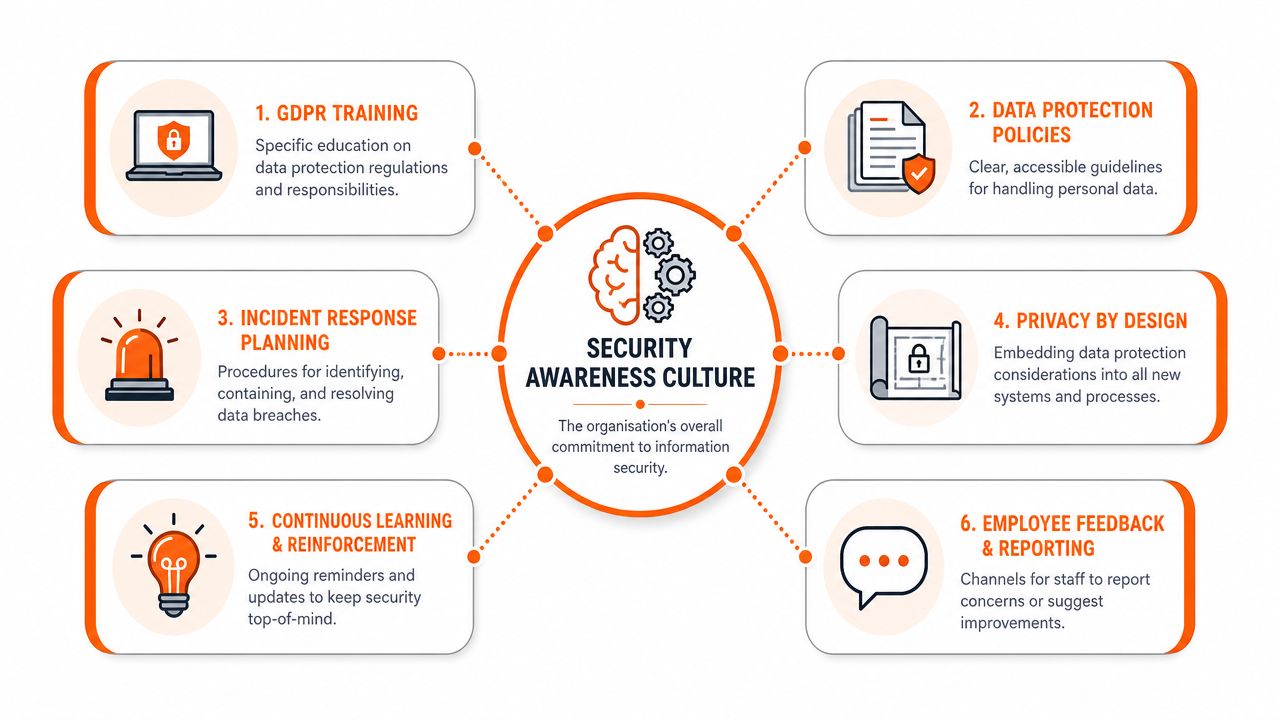
Privacy training on its own has limited value if your wider security habits are weak. Staff don't experience risks as separate categories. They experience emails, attachments, Teams chats, browser prompts, AI copilots, cloud links and pressure to move quickly.
Join privacy and security into one staff habit
Many UK SMEs can achieve their greatest improvement through GDPR training. GDPR training should sit inside a broader staff awareness culture that includes phishing, password hygiene, device security, reporting routes, access control discipline and safe data sharing.
Done properly, the overlap is obvious:
- Phishing awareness supports privacy because compromised accounts expose personal data.
- Password and MFA habits support privacy because weak identity controls lead to unauthorised access.
- File-sharing rules support privacy because convenience often drives oversharing.
- Incident reporting habits support privacy because delays turn small mistakes into reportable events.
When teams see these as one operating model, training becomes easier to sustain. The message stops being, "Remember the GDPR module," and becomes, "This is how we handle data and systems here."
That cultural piece matters because human error remains a major weakness in UK organisations, and generic awareness alone doesn't solve it. Staff need routes for asking questions, reporting near misses and checking uncertainty before they act. That's why many businesses also review practical ideas on how to secure company data for teams, especially when information moves across chat, shared documents and distributed devices.
Update training for AI, SaaS and collaboration risk
Recent privacy guidance has stressed that training must adapt as processing changes, yet many courses still focus only on classic topics and miss how staff should safely use AI tools, collaboration platforms and third-party SaaS vendors under UK GDPR, as discussed in GDPR training for newer workplace risks.
That gap is now one of the biggest weaknesses in staff training.
Teams need clear operational rules for issues such as:
AI prompts and pasted data
Staff should know whether personal data can be entered into AI tools at all, under what conditions, and which tools are approved.Unmanaged sharing links
Employees need straightforward rules on external sharing, guest access, expiry settings and when links must not be used.Third-party SaaS adoption
A team lead signing up for a useful platform can create a processor, transfer or retention problem without realising it.Collaboration platform sprawl
Data spreads quickly across Teams, SharePoint, email, mobiles and exported files. Training has to reflect that reality.Near-miss reporting
Staff should report "almost incidents" as well as confirmed ones. That's where process fixes often become obvious.
One practical model is to fold GDPR training into the same campaign calendar as cyber awareness. A monthly topic could cover safe sharing, then AI usage, then breach escalation, then data retention discipline. That works better than trying to force all modern risk into one annual slide deck.
For organisations that want a joined-up approach, this is also the point where managed support can help. Blowfish Technology offers security awareness training for teams as part of broader cyber and compliance services, which can be useful when you need delivery, reporting and operational controls to line up rather than running as separate workstreams. The wider people-risk challenge is also well captured in whether your employees are your security's weakest link, because privacy failures and security failures often start with the same staff behaviour.
Conclusion From Compliance Chore to Business Advantage
The businesses that get value from GDPR training for staff don't treat it as an isolated compliance event. They turn it into an operating discipline. Staff know what applies to their role, managers know what they must evidence, and the business can show how training connects to real controls.
That matters because a common pitfall for UK SMEs is treating training as a checkbox without operationalising it. Many guides say training should be role-based, but they don't answer the practical question of what finance, HR and frontline teams should each learn, or how to prove it worked, as discussed in practical GDPR training guidance for SMEs. That's exactly where human error continues to thrive.
The strongest programmes are simple in structure and disciplined in execution. They start with risk, not generic content. They train by role, not by assumption. They use short refreshers, realistic scenarios and measurable assessments. They keep records that can withstand scrutiny. And they sit alongside broader security awareness so staff see one set of habits, not five disconnected campaigns.
If your current approach is an induction module and a hope that common sense will fill the gaps, it probably won't. A defensible programme is more deliberate than that. It also gives you something valuable beyond compliance. Better judgement at the point where people handle data.
If you'd like help building a GDPR training programme that fits your systems, roles and wider security controls, Blowfish Technology can help you turn staff training into a practical, managed process rather than a once-a-year exercise.

The Blowfish Technology team. Managed IT, cloud services, software development and connectivity for North West businesses since 1999.