
A prospective client asks for your supplier questionnaire. Halfway down the page, there it is: Are you Cyber Essentials certified? If you're bidding for work, renewing a contract, or trying to reassure a customer that you take data security seriously, that question can stop things cold.
For many UK SMEs, uncertainty often arises at this stage. You may already have Microsoft 365, antivirus, a firewall from your internet provider, and someone handling IT support. You may still be unsure whether that counts, what Cyber Essentials involves, or whether it's just another compliance box to tick. If you're at that point, a practical small business cyber security guide helps frame the bigger picture.
Cyber Essentials matters because it turns vague good intentions into a recognised standard. It gives customers, insurers, and your own leadership team something concrete, but its true value lies in pushing the business to put a baseline of sensible controls in place, which is where many avoidable security problems begin and end.
Table of Contents
- Introduction A Crucial Question for Your Business
- What Is Cyber Essentials Really
- Why Cyber Essentials Matters for Your Business
- Cyber Essentials vs Cyber Essentials Plus
- The Certification Process Costs and Timelines
- Common Pitfalls and How to Avoid Them
- How Blowfish Technology Simplifies Your Certification
Introduction A Crucial Question for Your Business
A manufacturer is asked for Cyber Essentials before a customer will onboard them. A law firm sees it in a tender pack. A growing services company finds that a larger client won't share data until basic security assurance is in place. Those situations are common now, and they usually arrive before the business has had time to prepare.
That's why the question matters. It isn't only about passing an assessment. It's about whether your business can show, in a recognised and practical way, that you've put the basics in order.
For non-technical owners, the phrase itself can sound more complicated than it is. Cyber Essentials is not an enterprise-only framework built for large banks and government departments. It's a UK scheme designed to set a baseline that organisations of all sizes can understand and maintain.
Good Cyber Essentials projects start with business reality. Who uses what devices, where they work, how they access data, and what would actually disrupt operations if something went wrong.
If you've been wondering what is Cyber Essentials certification, the useful answer is simple. It's a structured way to prove that your business has covered the core controls that stop many common attacks from succeeding.
Want to see where you stand before you start? Our free Cyber Essentials readiness checker takes about two minutes and shows which of the five controls need work.
What Is Cyber Essentials Really
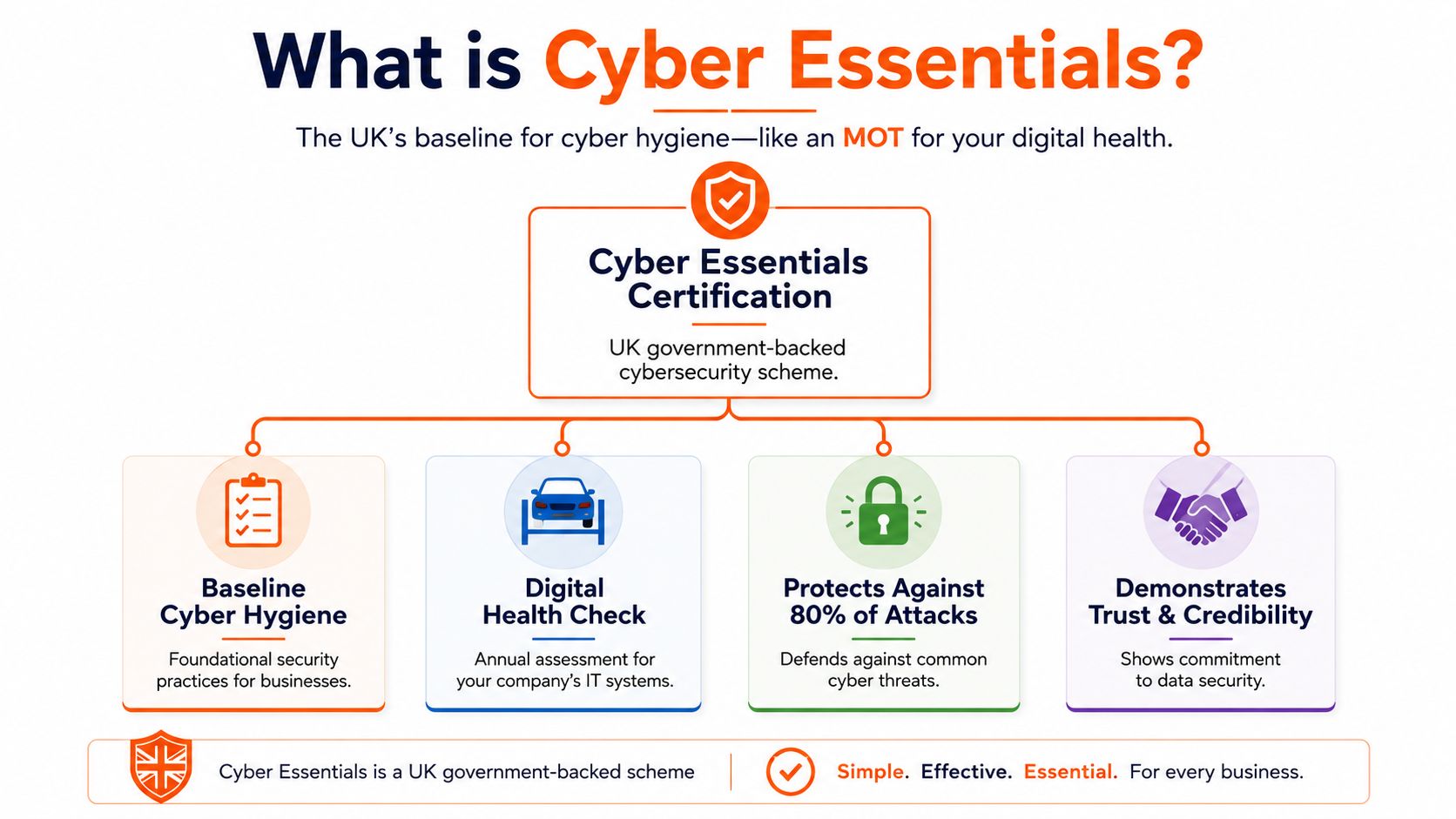
Cyber Essentials is a defined UK certification scheme that checks whether your business has the core security controls attackers routinely test first. In practical terms, it asks a simple question. Are your everyday systems set up well enough to stop the common, avoidable problems that lead to real business disruption?
A baseline, not a fortress
Cyber Essentials sets a floor for security, not a guarantee against every threat. That distinction matters for SMEs. A certificate shows you have the fundamentals under control. It does not replace monitoring, backups, staff awareness, or a plan for responding when something goes wrong.
That is also why the scheme is useful. Many security incidents do not start with advanced intrusion techniques. They start with shared admin accounts, unsupported software, weak device setup, or missing patches on laptops used outside the office. Cyber Essentials brings those basics into scope and forces consistency across the business.
Government guidance for UK suppliers says implementing the five core controls can protect against 80% of common cyber security threats, because those controls reduce the weaknesses attackers most often exploit, as outlined in the GCA guidance for SMEs and suppliers.
For a business owner, that translates into fewer preventable problems, less operational downtime, and stronger answers when a client asks how you protect their data.
If you want to understand how these baseline controls fit into broader security practice, technical training resources such as study materials for CISSP certification can be useful for seeing where access control, patching, and defensive layers sit in the wider picture.
The five controls in plain English
Each control exists for a business reason, not to create paperwork.
- Firewalls control which connections can reach your systems. Done properly, they reduce unnecessary exposure to the internet and lower the chance of opportunistic attacks finding an easy way in.
- Secure configuration removes risky default settings on devices and software. That means fewer open services, fewer unused accounts, and less convenience-led setup that creates avoidable risk later.
- User access control limits who can reach what. If every member of staff has broad privileges, one compromised account can interrupt far more of the business than it should.
- Malware protection helps stop malicious files and software from running on business devices. For some SMEs that means managed antivirus. For others, it can include more advanced endpoint controls.
- Security update management keeps supported systems patched within an acceptable timeframe, so known weaknesses are not left open for attackers to exploit.
In client environments, the gap is rarely a complete lack of controls. The usual issue is uneven coverage. Office desktops may be well managed while remote laptops, old user accounts, and small one-off systems sit outside the same standard. That is where certification becomes useful as an operating discipline, not just a badge.
It also gives SMEs a solid base to build on. Once the basics are consistent, it becomes much easier to assess whether you also need stronger measures such as endpoint detection and response for business devices.
Practical rule: Cyber Essentials works best when every device used for business is included in the same standard, whether it sits in the office, at home, or in a director's bag.
Why Cyber Essentials Matters for Your Business
A common SME scenario looks like this. A promising client sends over a supplier questionnaire, asks whether you hold Cyber Essentials, and wants an answer before they move your bid forward. At that point, certification stops being an IT task and becomes a business decision tied to revenue, trust, and how easily your company can win work.
It helps you win and keep work
For many small and mid-sized firms, Cyber Essentials matters because buyers increasingly expect proof, not reassurance. Saying your business takes security seriously carries far less weight than showing that a recognised scheme has checked your baseline.
That has a direct commercial effect. It can shorten supplier due diligence, reduce back-and-forth with procurement teams, and remove one of the reasons a cautious client might delay a decision. In competitive tenders, that matters. If two suppliers are close on price and capability, the one with clear security assurance often feels lower risk to appoint.
It also opens doors in parts of the market where baseline assurance is becoming standard. Public sector work is the obvious example, but we also see it in professional services, manufacturing, outsourced support, and any supply chain where customer data or system access is involved. If a client is already asking whether you have Cyber Essentials, the certificate is no longer just about compliance. It is part of your sales process.
Some businesses also use certification as a stepping stone to stronger assurance, especially if larger customers want evidence that controls have been independently tested through Cyber Essentials Plus certification.
It reduces avoidable business disruption
The practical value goes well beyond winning contracts.
Cyber Essentials pushes a business to tighten the everyday weaknesses that cause a high share of avoidable incidents. Old accounts stay live for too long. Laptops fall outside patching. Staff keep broad admin rights because no one has reviewed them. Home and office devices end up managed to different standards. None of that feels dramatic until a compromised account, unpatched machine, or poorly controlled device interrupts normal work.
For an owner, the risk is not abstract. It is lost time, missed orders, frozen inboxes, invoice fraud, or a team that cannot access the systems they need on a Monday morning.
A good certification project helps fix that by forcing clear operational decisions:
- Ownership: Someone is accountable for updates, device checks, and user access reviews.
- Consistency: The same security standard applies across office devices, remote laptops, and director-owned machines used for work.
- Access control: Staff get the access they need, not broad permissions that create unnecessary exposure.
- Repeatability: Security stops depending on memory and starts following a defined process.
That discipline is often where the return sits. The certificate matters, but the bigger benefit is running a tighter business with fewer weak spots and fewer unpleasant surprises.
It gives clients and insurers more confidence
Trust is easier to build when you can explain your security position in plain English. Cyber Essentials gives SMEs a straightforward way to do that. Instead of vague claims, you can point to a recognised standard and explain that core protections are in place across the business.
That can help with customer confidence, insurer conversations, and board-level discussions about risk. It also gives internal teams a clearer benchmark. Security becomes easier to discuss because the business is working from a defined baseline rather than a mix of assumptions.
From a practical MSP perspective, that is why certification works best when it is treated as part of normal business operations. It supports sales, reduces friction, improves resilience, and gives a smaller business a more credible position in front of larger, more demanding clients.
Cyber Essentials vs Cyber Essentials Plus
A common SME scenario looks like this. A client asks whether your business is Cyber Essentials certified, then follows up with a harder question. Do you have Cyber Essentials Plus?
For a business owner, that is usually the point where the choice becomes commercial, not just technical. Both certifications are useful. The right one depends on how much assurance your customers expect, how exposed your systems are, and whether you want a basic declaration or independent testing.
The simple difference
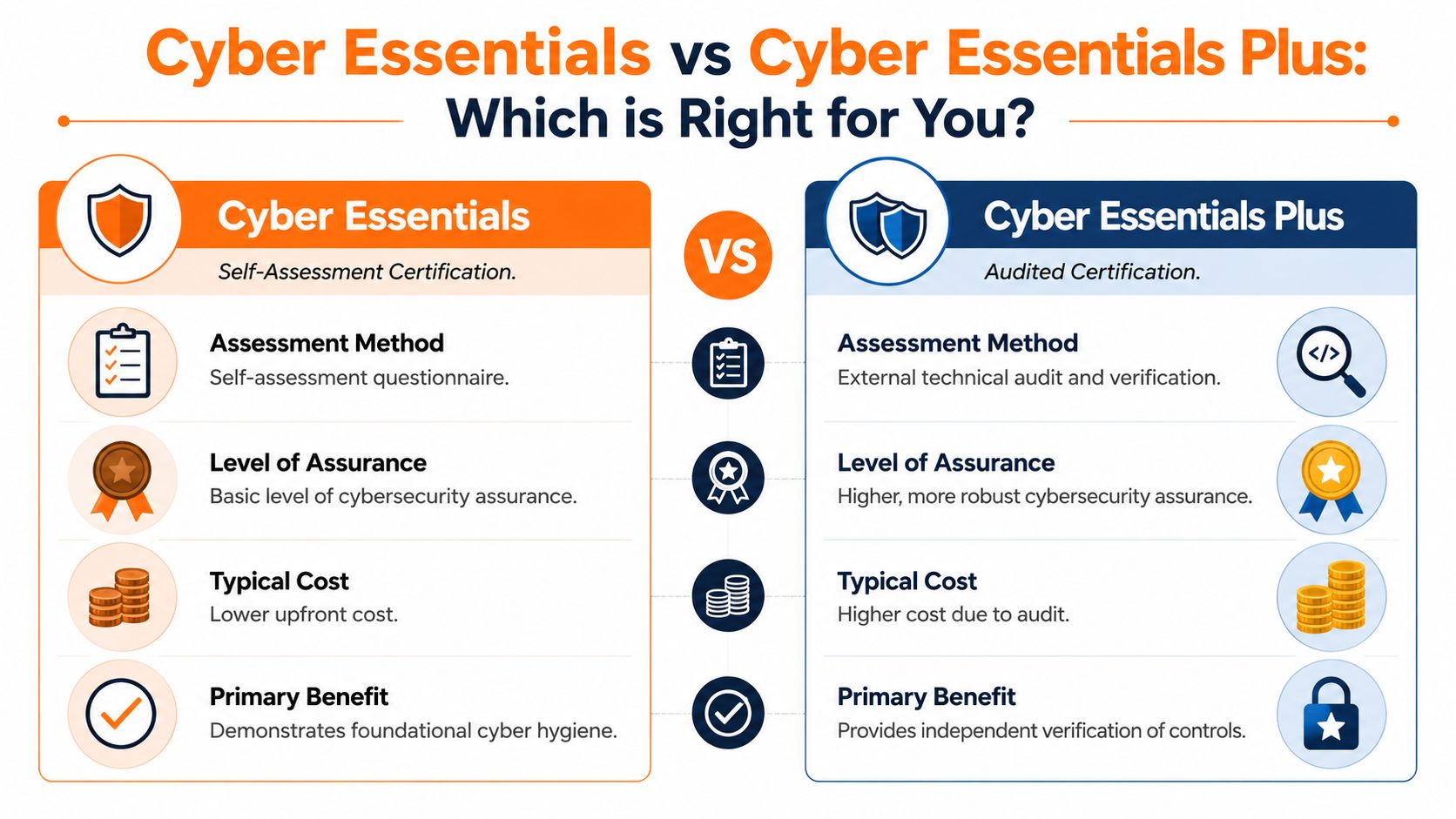
Cyber Essentials is a verified self-assessment. Your organisation completes the scheme questionnaire, confirms that the required controls are in place, and submits that information to a certification body for review.
Cyber Essentials Plus adds hands-on technical verification. An assessor checks whether those controls are working across the environment. That changes the conversation with customers. You are no longer only stating that security measures exist. You are showing they have stood up to external testing.
For many SMEs, that extra assurance can influence buying decisions. We see this regularly with firms that sell into larger organisations, handle sensitive client information, or sit inside supply chains where security checks are part of supplier onboarding.
Cyber Essentials vs Cyber Essentials Plus at a Glance
| Feature | Cyber Essentials (CE) | Cyber Essentials Plus (CE Plus) |
|---|---|---|
| Assessment method | Verified self-assessment questionnaire | External technical audit and testing |
| Level of assurance | Baseline assurance | Higher assurance through independent verification |
| Evidence style | Your organisation declares controls are in place | Assessor validates that controls operate effectively |
| Preparation effort | Usually lighter if your environment is already tidy | Usually higher because tested weaknesses must be fixed |
| Best fit | Businesses needing a recognised baseline quickly | Businesses facing stricter client demands or higher scrutiny |
A practical guide to Cyber Essentials Plus certification explains what that testing usually involves and where businesses tend to get caught out.
Who should choose which
Standard Cyber Essentials is often the right starting point for SMEs. It suits businesses that need a recognised baseline, want to meet common procurement requirements, or want to formalise security without taking on a full technical assessment straight away.
Cyber Essentials Plus makes more sense where the commercial stakes are higher.
- Your customers want independent proof. This is common in regulated sectors and in supply chains where buyers need confidence before sharing data or system access.
- You are bidding for contracts where trust affects conversion. Plus can help remove friction in sales conversations because the security checks have already been tested by an external assessor.
- Your IT estate has grown quickly. If laptops, user accounts, remote access, and cloud services have been added over time, Plus gives leadership a clearer picture of what is working and what needs fixing.
- You want certification to support a wider resilience plan. Plus is still a baseline standard, but it does a better job of exposing gaps between written policy and day-to-day reality.
There is a trade-off. Plus gives stronger assurance, but it also asks more of the business. Weaknesses that might stay hidden during a self-assessment are more likely to surface under testing, which means more remediation work before you pass.
That is not a reason to avoid it. It is a reason to choose it for the right business case.
If you are unsure, start with three questions. What are clients asking for today? What level of security confidence does the business need? And if an assessor tested your devices and accounts tomorrow, how comfortable would you be with the result?
The Certification Process Costs and Timelines
A typical SME starts this process with one question: how long will this take, and what will it really cost us? The honest answer is that the certificate fee is only the visible part. Time and cost usually depend on how tidy your systems already are.
For well-managed businesses, Cyber Essentials can move quickly. For businesses that have grown fast, changed IT suppliers, or adopted cloud tools without much standardisation, the work usually sits in preparation. Old laptops resurface. User accounts do not match reality. Update policies exist on paper but not across every device. That is where timelines stretch.
What the journey usually looks like
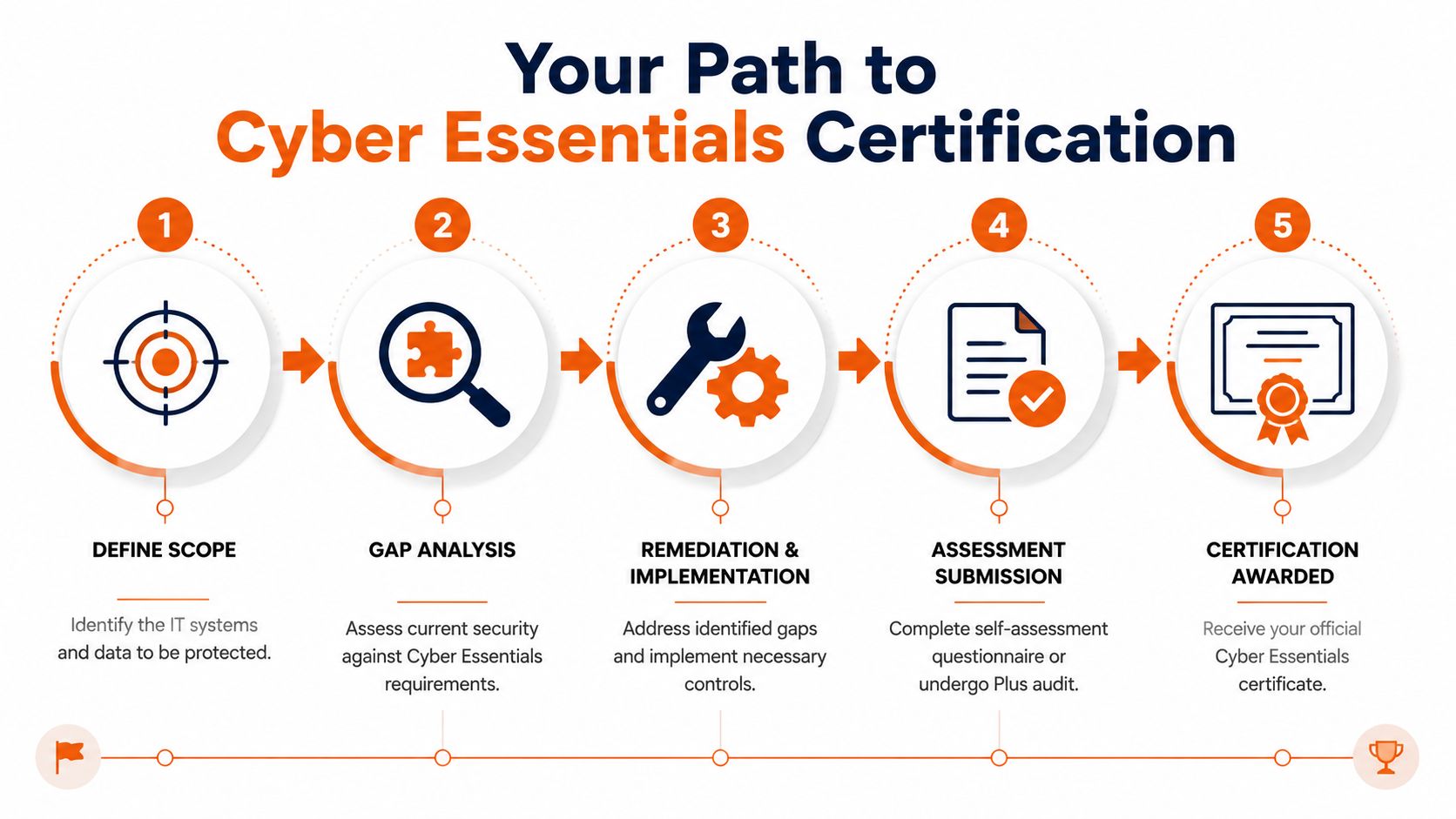
A practical project usually follows five stages.
Define scope
Confirm which users, devices, cloud services, and office or home-working setups are included. If the scope is wrong, everything after that becomes harder.Run a gap review
Check your current setup against the scheme requirements. Review endpoint protection, patching, admin rights, firewalls, and secure configuration across real devices, not just written policies.Fix the gaps
This often means removing unnecessary admin access, replacing unsupported software, tightening Microsoft 365 controls, standardising security tools, and bringing update management under control.Submit the assessment or prepare for testing
Cyber Essentials is based on a verified self-assessment. Cyber Essentials Plus adds hands-on technical testing, so the environment needs to stand up to external scrutiny.Keep the controls in place
Certification lasts for 12 months, so renewal needs to be part of normal IT management rather than a once-a-year rush.
A short explainer can help owners visualise the sequence before they commit to the work:
Where time and cost really go
The direct fee is predictable. Remediation is the moving part.
In practice, I find that SMEs rarely struggle with the form itself. They struggle with the clean-up behind it. A business with supported devices, centralised updates, controlled user permissions, and clear ownership can often move through the process without much disruption. A business carrying legacy software, inconsistent laptop builds, shared accounts, or unclear remote access arrangements will spend more time fixing the basics first.
Typical cost drivers include:
- Remediation work: Updating unsupported systems, standardising antivirus or endpoint protection, removing local admin rights, and correcting firewall or access settings.
- Internal input: Someone in the business needs to confirm which users, devices, services, and working practices are in scope.
- Operational disruption: Some fixes affect day-to-day habits. Staff may lose admin access, older devices may need replacing, and unmanaged applications may need approval or removal.
- Testing readiness for Plus: Controls need to be applied consistently across the environment, not just to a few sample devices.
- Ongoing maintenance: Settings drift over time if nobody owns them, which creates repeat work at renewal.
A realistic timeline depends less on headcount and more on consistency. Ten users with clean systems can be easier than five users with years of ad hoc changes.
That is why the business case matters. Cyber Essentials is not just a compliance task to get through. For many SMEs, it becomes a useful forcing point to tidy IT, reduce avoidable risk, and remove friction in sales conversations where buyers ask how security is being managed. With the right support, the process is usually straightforward. The problems start when businesses underestimate scope, postpone remediation, or treat certification as paperwork instead of an operating standard.
Common Pitfalls and How to Avoid Them
A business can answer the questionnaire, submit on time, and still fail because the day-to-day reality does not match the paperwork. That is the pattern behind many Cyber Essentials delays. The problem is rarely a lack of security tools. It is usually a gap between how the business believes it operates and what is happening across devices, users, and remote access.

Where businesses go wrong
The first issue is scope drift. A company lists office PCs but leaves out directors' laptops, home workers, personal devices used for email, or the machine someone uses to connect into the office. If a device can reach company data or systems, it needs to be considered properly. Missing it can invalidate the answer set and create awkward questions later.
Another common problem is mistaking existing IT for compliant IT. A firewall, antivirus, and Microsoft 365 tenancy do not automatically mean the controls are set correctly. Local admin rights may still be too broad. Patching may depend on users clicking reminders. Old accounts may still exist. One department may follow the rules while another has exceptions nobody has reviewed.
Then there is last-minute preparation. Businesses often leave Cyber Essentials until a tender, insurance renewal, or customer request forces the issue. That creates pressure, and pressure leads to weak scoping, rushed fixes, and answers based on assumption rather than evidence.
How to avoid those mistakes
Start with a plain view of how the business works. Who works from home, who uses mobile devices, which systems hold client data, who has admin access, and how new starters and leavers are handled. That sounds simple, but it is where many assessments are won or lost.
Assign ownership early. One internal person or an external provider should be responsible for checking settings, reviewing access, and keeping records straight. Without that, standards slip after certification and the next renewal becomes the same exercise again. For SMEs that do not want that burden sitting with one busy office manager or director, managed IT security support gives those controls a clear owner.
A separate mistake is expecting Cyber Essentials to cover all of cyber security. It does not. It sets a baseline against common online threats. It does not replace backups, incident response, security monitoring, staff awareness training, or recovery planning. For a small business, that trade-off matters. Certification can help win work and reassure customers, but it should sit inside a wider plan to keep the business running when something still goes wrong.
A practical way to stay out of trouble is:
- Keep scope honest: Include remote working, mobile devices, and real access routes, not just the equipment in the office.
- Review privileged access: Remove admin rights where they are not needed and check who still has administrative access.
- Deal with exceptions properly: If an old system cannot meet the standard, record it, contain the risk, and decide whether to replace it.
- Treat certification as an operating standard: Build routine checks for patching, account reviews, and endpoint protection into normal IT management.
- Use it commercially: Once the controls are in place, use the certification in sales conversations, supplier onboarding, and tender responses as evidence that security is being handled sensibly.
Passing the assessment matters. Keeping the controls in place matters more.
Handled properly, Cyber Essentials does more than satisfy a questionnaire. It helps an SME reduce avoidable risk, answer customer due diligence with confidence, and show that security is being managed in a disciplined, credible way.
How Blowfish Technology Simplifies Your Certification
For most SMEs, the hardest part isn't understanding what Cyber Essentials asks for. It's translating the wording into the systems, devices, users, and routines they already have. That's where hands-on support makes a real difference.
Practical support from scoping to submission
A useful engagement starts with a gap analysis against the five controls. That means checking how the business really operates, not how it assumes it operates. Which laptops are in use, who has privileged permissions, how remote workers connect, whether Microsoft 365 is configured sensibly, and whether unsupported software is still hanging around.
From there, the work is remediation. That may involve tightening firewall rules, standardising endpoint protection, improving patch management, reducing admin rights, and cleaning up user access. The point isn't to layer on unnecessary technology. It's to align day-to-day operations with the baseline the scheme expects.
For businesses that want outside support, managed IT security services can cover that preparation and ongoing control maintenance so the certificate reflects reality, not a temporary sprint.
Blowfish Technology provides support for Cyber Essentials and Cyber Essentials Plus through gap analysis, remediation, and submission support for SMEs that want practical help rather than a checklist to interpret alone. That's especially relevant in engineering, manufacturing, legal, and financial environments where legacy systems, multiple sites, and mixed working patterns can complicate scope.
The strongest outcome is not just getting the certificate. It's ending up with a cleaner, more controlled IT estate that's easier to support, easier to explain to customers, and less exposed to routine mistakes.
If you want a clear route to Cyber Essentials without guessing what's in scope or where your gaps are, speak to Blowfish Technology. A no-obligation conversation can map the practical steps, identify likely remediation work, and help you decide whether Cyber Essentials or Cyber Essentials Plus fits your business best.

The Blowfish Technology team. Managed IT, cloud services, software development and connectivity for North West businesses since 1999.