
Your support inbox is full, a sales lead is waiting for a response, and a client in a regulated sector has just asked for proof that last month's issue was handled properly. The engineer who usually answers is on site, the legal team is chasing a document trail, and finance wants reassurance that sensitive data hasn't been exposed. In moments like that, customer experience service stops being a vague idea and becomes the thing that protects trust, revenue, and compliance at the same time.
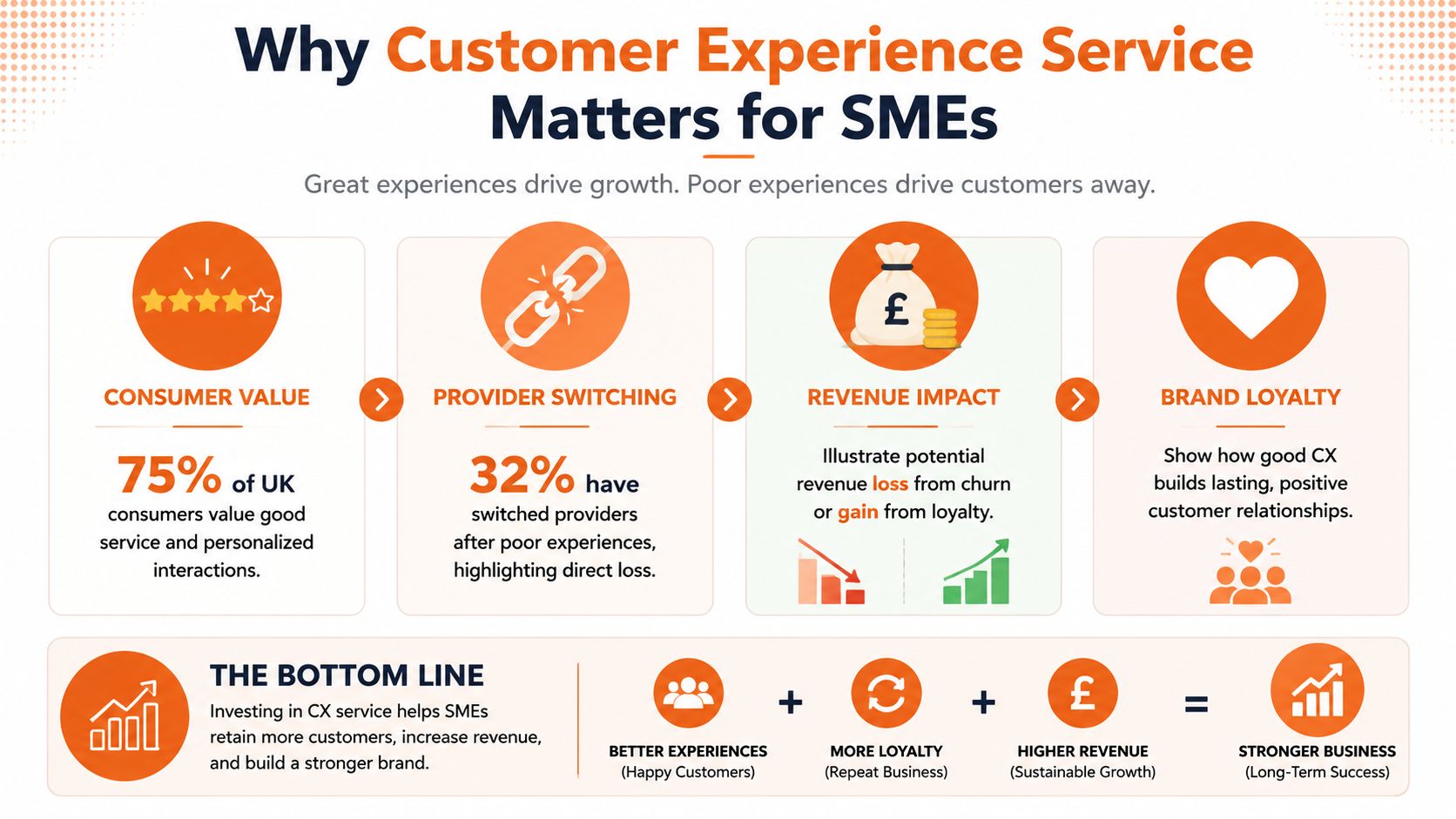
For UK SMEs, that shift matters because service quality now shapes buying decisions as much as the product itself. The Competition and Markets Authority's consumer research found that 75% of UK consumers considered good customer service important when choosing a provider, while 32% said they had switched supplier after a poor customer service experience in the previous 12 months, a reminder that service failure can turn into lost business fast (UK customer experience statistics). If you're trying to improve retention, lower support friction, and keep an auditable trail for regulators, managed IT services in the UK can be part of the operational backbone, but the strategy starts with how experience is designed.
Table of Contents
- Introduction
- Understanding Customer Experience Service Concepts
- Why Customer Experience Service Matters for SMEs
- Key Metrics for Customer Experience Service
- Designing Customer Experience Service with Technology
- Real-World Customer Experience Service Examples for Engineering Legal and Finance
- Checklist and Roadmap for Improving Customer Experience Service
- Conclusion and Next Steps for Customer Experience Service
Introduction
A growing SME often notices the problem only when it starts costing time. A customer emails support, then calls because nobody replied, then sends a message through a different channel, and each person who picks it up sees a slightly different story. If that business also works in engineering, legal, or financial services, the confusion isn't just frustrating, it can create weak records, slow decisions, and avoidable compliance risk.
That's why customer experience service needs to be treated as an operational discipline, not a soft layer on top of IT or account management. In UK service markets, complaint handling, response speed, and clarity of communication all shape whether a customer stays or leaves, and regulators have reinforced the expectation that service quality should be visible and measurable, not assumed (Ofcom complaint reporting context). The practical question isn't whether service matters. It's how to make it consistent, measurable, and defensible.
For SMEs, the answer sits where people, process, and technology meet. Good service should reduce repeat contacts, shorten resolution time, and create records that stand up to internal review. Bad service does the opposite, it multiplies effort, burns goodwill, and leaves managers guessing which part failed.
Understanding Customer Experience Service Concepts
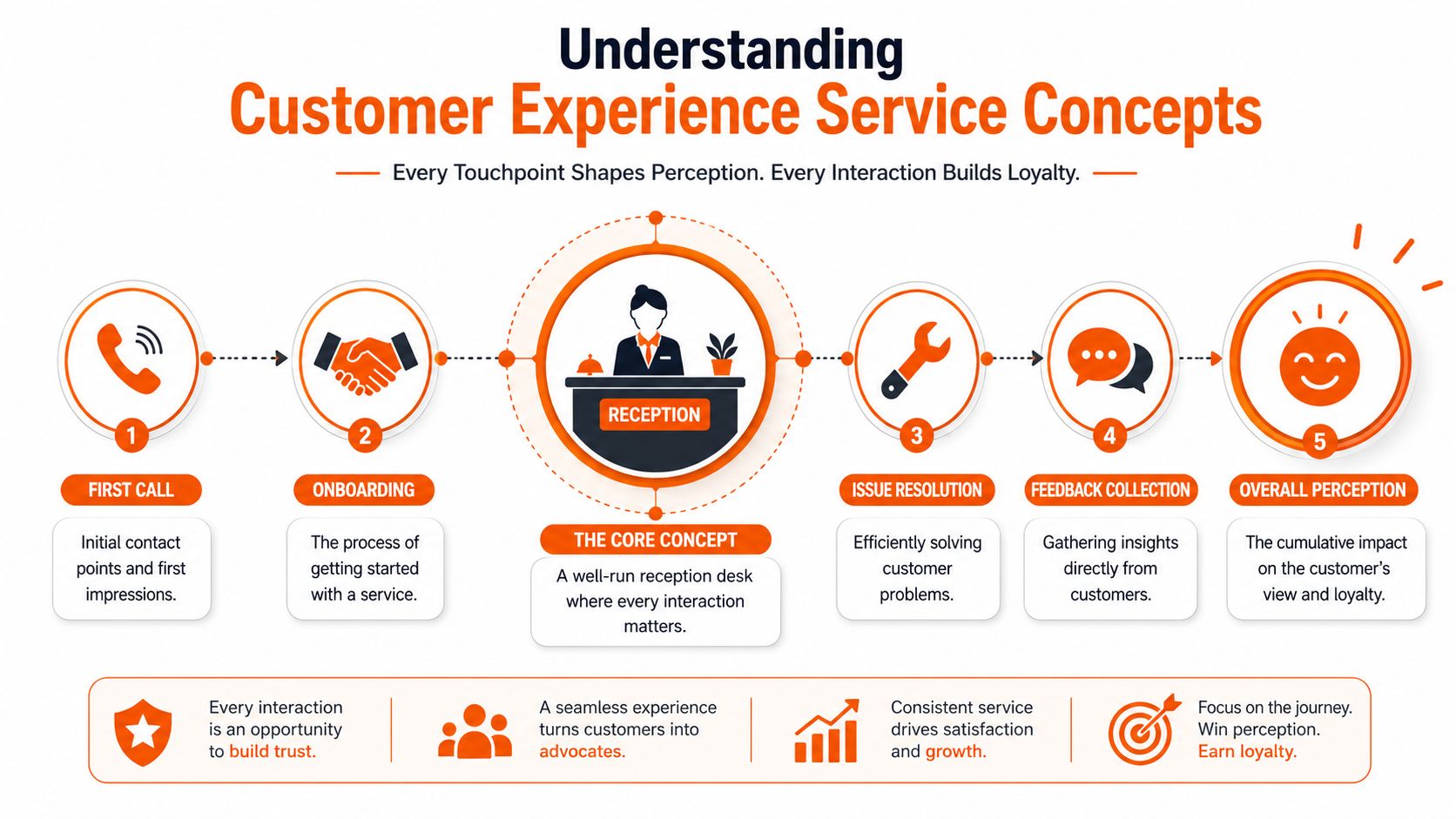
Think of customer experience service like a well-run reception desk in a busy office. The receptionist doesn't just answer the phone. They greet visitors, route requests, confirm details, and make sure the right person gets the right information without forcing everyone to repeat themselves. When that desk works well, people trust the whole organisation a little more. When it's chaotic, every department feels harder to deal with.
Service touchpoints shape the whole journey
A customer journey is bigger than a single interaction. A first call can create confidence, onboarding can remove friction, issue resolution can either strengthen trust or damage it, and feedback collection can show whether the relationship is improving. Each step changes how the customer interprets the last one.
That's why a service team can't rely on one good phone call to save a broken process. If the email follow-up is slow, the handoff is unclear, or the fix never gets documented, the experience still feels fragmented. Good customer experience service joins the dots so the customer doesn't have to.
Customer service is part of CX, not the whole thing
Basic customer service answers questions. A broader CX service strategy looks at why those questions are arriving in the first place, whether customers are contacting you through the right channel, and whether the experience is easy enough to repeat. That distinction matters because a fast reply to a confusing process still leaves friction behind.
Practical rule: if customers keep asking the same thing, the issue may sit in the process, not the person answering the phone.
For SMEs, the shift is from reacting to individual tickets to designing the entire service journey. That means aligning the front line, the back office, and the tools that connect them. It also means treating every interaction, from first call to final resolution, as part of one service system, not a series of separate chores.
Why Customer Experience Service Matters for SMEs
The business case is straightforward once you connect service quality to customer choice. UK consumers have already signalled that service is part of the buying decision, not an optional extra, and the CMA research shows how quickly poor service can push people away (UK customer experience statistics). For SMEs, that means every support interaction can either protect future revenue or put it at risk.
Retention is cheaper than rebuilding trust
When a customer leaves because service was poor, the loss is rarely just one contract. The sales team may need to re-open pipeline, account managers lose momentum, and the support team inherits a more sceptical customer next time around. Good service reduces that churn pressure by making the customer feel that the business is reliable when things go wrong.
The same logic applies to upsell and cross-sell opportunities. A customer who feels looked after is easier to expand, because they already trust the team handling their questions. That's especially true in professional services and regulated industries, where buyers often value continuity and accountability as much as price.
Compliance depends on service records as much as service tone
In legal and financial firms, or engineering businesses with strict service agreements, a friendly answer isn't enough. You need evidence of what was requested, when it was acknowledged, who handled it, and how it was resolved. That audit trail turns customer experience into a compliance tool, because it helps you show that the organisation acted consistently and responsibly.
A useful example is lead qualification. If sales and service teams don't separate serious enquiries from casual ones, the response model becomes noisy and slow. A resource like how to qualify sales leads effectively is helpful because it shows why clear triage protects time and improves follow-up quality. The same principle applies to service requests, the better the routing, the better the experience.
Fast service doesn't just feel better. It reduces waste, lowers repeat contact, and gives managers cleaner records to work with.
If you're modernising the stack that supports that work, digital transformation services only pay off when they improve the customer's path, not just the internal system map. The commercial value comes from better retention, lower friction, and fewer preventable escalations.
Key Metrics for Customer Experience Service
The easiest way to miss what's broken is to track the wrong thing. A team can celebrate a high number of closed tickets while customers still feel ignored, or quote a good satisfaction score while repeated contacts are steadily piling up. That's why service metrics need to work together, not sit in isolation.
The metrics that show friction, not just activity
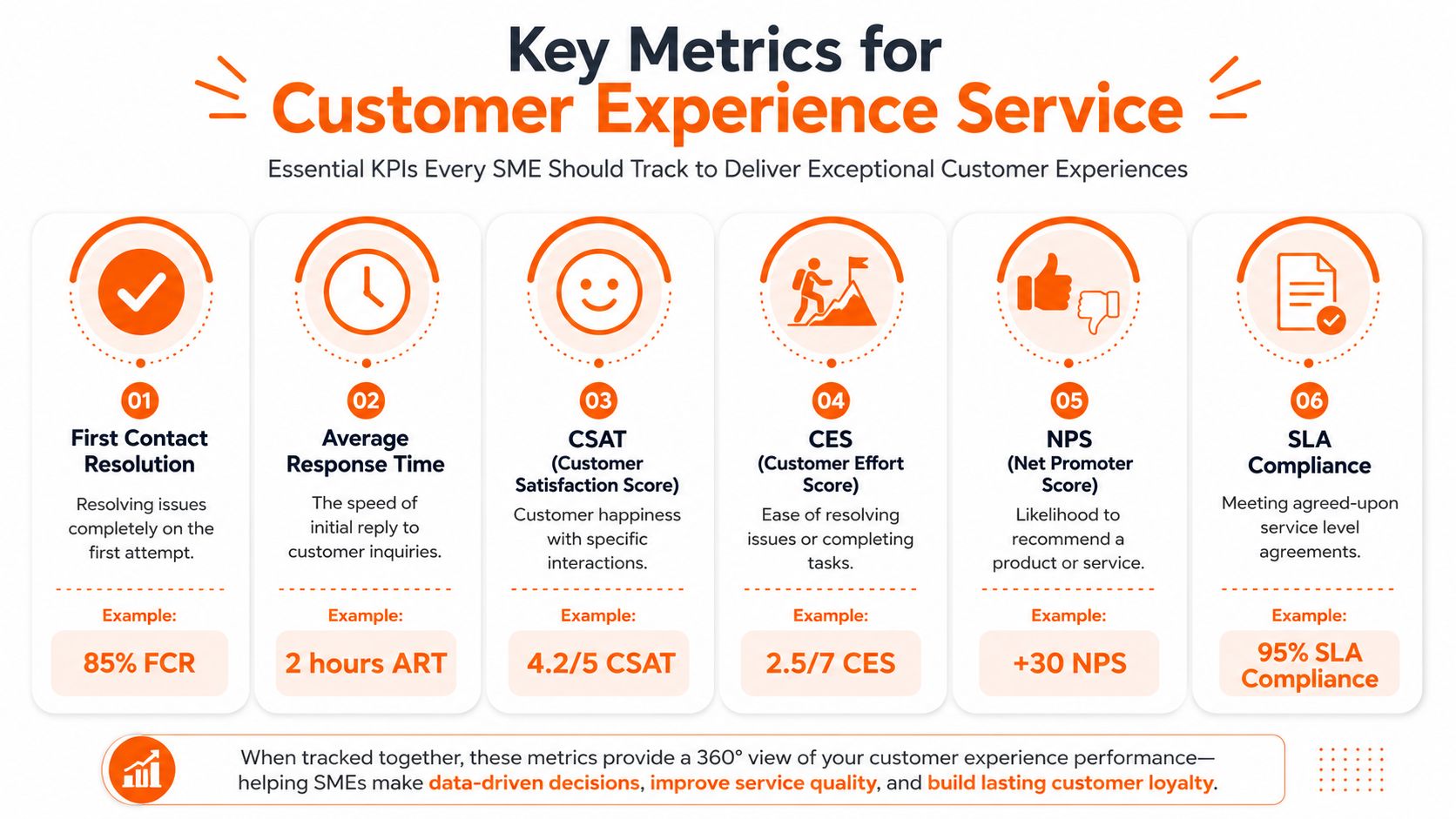
For UK service operations, first contact resolution and average response time are especially useful because they capture queue friction and repeat-contact load (Qualtrics service metrics). If a customer gets a quick answer but still has to come back twice, the team hasn't solved the underlying issue. If the response is slow but the first reply fully resolves the problem, that's still a service weakness, just in a different place.
The other metrics give the fuller picture:
- CSAT, or customer satisfaction, shows how a specific interaction landed with the customer.
- CES, or customer effort score, shows how hard it was for the customer to get something done.
- NPS reflects broader willingness to recommend.
- SLA compliance shows whether the service team is meeting agreed commitments.
Use metrics as a diagnostic set
The trick is to read them together. A high CSAT with poor FCR often means customers like the agent but not the process. A decent NPS with weak response time may mean customers still trust the brand but are getting impatient with support. SLA compliance helps you separate performance problems from expectation problems, because it shows whether the team met the target that was promised.
A simple dashboard should split results by channel and issue type. Email, phone, and chat behave differently, and billing queries won't act like technical faults. Segmenting the data helps you spot where the primary bottleneck sits instead of making broad assumptions.
| Metric | What it tells you | What to do next |
|---|---|---|
| FCR | Whether issues are solved properly the first time | Fix knowledge gaps, routing, and escalation rules |
| ART | How quickly customers get an initial reply | Adjust staffing, triage, and queue design |
| CSAT | How customers felt after the interaction | Review tone, clarity, and resolution quality |
| CES | How hard the process felt | Remove steps, handoffs, and repeated form filling |
| NPS | Whether the wider relationship is healthy | Look at loyalty drivers across the journey |
| SLA compliance | Whether commitments were met | Compare promised times against actual handling |
Track the reason for contact, not just the outcome. The reason often explains the experience better than the final status.
Designing Customer Experience Service with Technology
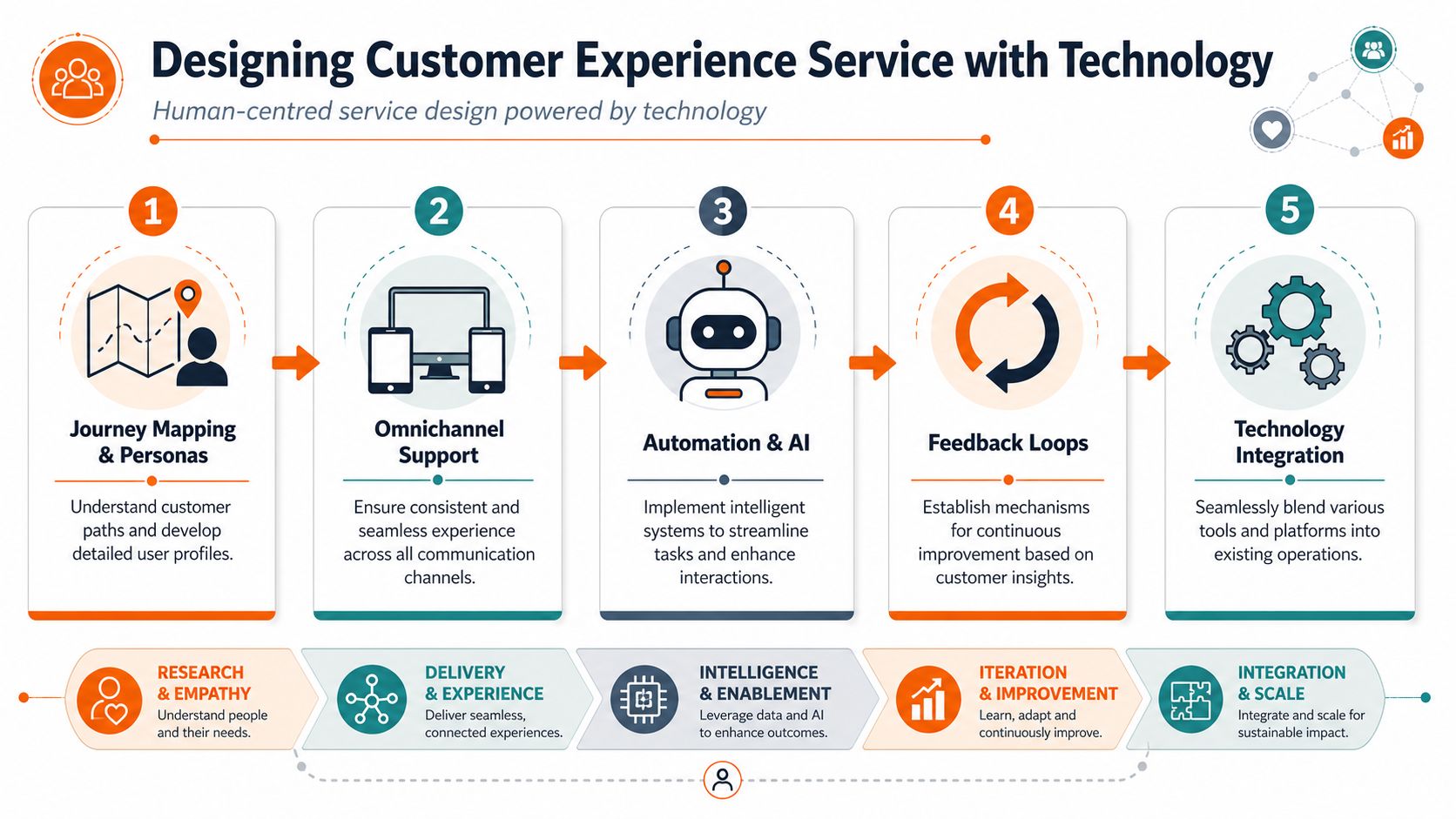
A strong CX stack starts with the customer's path, not the software list. First map the journey, then decide where people need judgement, where automation can help, and where records must be created for traceability. That order matters, because technology should support the service design, not force the design around the tool.
Start with journey mapping and personas
A journey map shows the path customers take, not the path the business hopes they'll take. For an engineering firm, that might mean a site engineer logging an issue from a mobile device, then office staff following up later by email. For a legal practice, it may mean a client contacting reception, then a fee earner, then compliance. Each path needs different handling.
Personas help teams avoid designing for an imaginary average customer. A finance director, a site manager, and an office administrator all care about service quality, but they don't need the same channel, tone, or level of detail. Good personas make those differences visible before service standards are written.
Build an omnichannel service layer
Customers don't want to repeat themselves across phone, email, and chat. They want one conversation that continues across channels. That's where omnichannel support matters, because it keeps context attached to the case and prevents rework.
Internal handoff quality is just as important as customer-facing speed. When a ticket moves from first line to second line, or from support to compliance, the next person should see the same notes, the same history, and the same deadline. That's where tools like Microsoft 365, secure helpdesk workflows, and shared collaboration spaces help teams work as one service unit rather than as separate silos.
Add automation without losing judgement
Automation should remove repetitive admin, not remove accountability. Use it for triage, status updates, knowledge-base suggestions, and routing. Keep a human in the loop for sensitive cases, unusual requests, or anything involving regulated advice, because those moments need judgement and context.
A data-integration approach matters here. A strong UK CX stack should combine feedback, behavioural data, transaction history, and operational service data into one unified view (Monday.com customer data integration). That unified view lets you see not just what customers said, but what they did before the complaint arrived.
Build accessibility and security into the design
Inclusive service design isn't a side issue. UK public guidance on customer service accessibility stresses adapting communication, checking understanding, and using reasonable adjustments for disabled customers (customer service standards and community outreach). For SMEs, that means making sure channels are usable, language is clear, and customers can get help without unnecessary barriers.
Security and privacy need the same attention. If customers are sharing sensitive information, your service process must preserve confidentiality, limit access, and keep the right logs. That's especially important when teams are handling regulated data across multiple systems.
If a tool makes it faster to answer but harder to audit, it's the wrong tool for a regulated service model.
Real-World Customer Experience Service Examples for Engineering Legal and Finance
The hardest part of CX work is seeing how abstract principles behave in a real business. An engineering firm, a legal practice, and a financial services SME all need responsiveness, but they don't need the same kind of response. The right model depends on risk, context, and how much evidence the customer will later need.
Engineering firms need speed and clarity on operational issues
An engineering firm usually cares about downtime, site continuity, and clear escalation. If an asset fails or a system stalls, the customer wants to know who owns the issue, how quickly it will be handled, and whether the fix is documented for future work. A service model built around SLA-driven routing and secure remote assistance can keep that loop tight.
The lesson is simple. When the helpdesk can see the issue history, the engineering team spends less time re-explaining the problem. That means better continuity, cleaner handovers, and fewer repeat interventions. It also helps the customer feel that the supplier understands the operational impact, not just the ticket number.
Legal practices need auditable handling and controlled collaboration
Legal firms face a different pressure. Clients expect confidentiality, accurate records, and consistent communication across the team. If a matter moves between receptionist, fee earner, and support staff, the service process has to preserve detail without exposing more than necessary.
A secure collaboration model, supported by structured logs and clear permissions, helps legal teams prove what happened and when. That makes the service function part of the firm's control environment, not just an administrative overhead. A useful route into that design is help desk for IT support, because the same structured workflow principles apply when the information is sensitive and the record must be reliable.
Financial services need trust, escalation, and restraint in automation
Financial SMEs often want faster support, but they can't afford to sacrifice trust. AI-assisted chat can handle routine questions, but anything sensitive should move quickly to a human who can confirm context and explain the next step clearly. That balance matters because automated service feels efficient only when customers believe it's safe and accurate.
A frequent gap in CX service content is how UK businesses should redesign support around AI-assisted tools without losing trust and compliance, especially in regulated sectors (CX gaps in plain sight). The practical lesson is to use AI for speed, then design a human escalation path that protects judgement where it matters most.
Across all three sectors, the pattern is the same. Service gets better when the team captures context once, routes it correctly, and keeps a defensible record of the outcome.
Checklist and Roadmap for Improving Customer Experience Service
Improving CX service works best as a phased project. If you try to fix everything at once, the team loses focus and the evidence gets muddy. If you sequence the work, each stage can prove value and earn the next step.
Use a phased plan instead of a vague ambition
Start with assessment. Review response times, repeat contacts, SLA misses, and the most common reasons customers get in touch. Then ask where the biggest friction sits, not where the loudest complaints are.
Move to vendor selection once the problem is clear. Look for responsiveness, security, scalability, and integration capabilities. If a platform can't support Microsoft 365 workflows, secure access, or auditable ticket handling, it's probably not fit for a regulated SME.
Test before you roll out
A pilot should be small enough to manage and large enough to teach you something. Pick one team, one workflow, or one issue type, then monitor how the new process affects response time, escalation quality, and customer effort. The point is to validate the design before it touches the whole business.
During the full rollout, train staff on the process, the handoffs, and the expectations for logging information. A service model only works when people use it consistently, because inconsistency breaks the data as well as the experience.
Keep monitoring after go-live
The final stage is continuous monitoring. Metrics should be reviewed regularly, but so should the shape of the work itself. If a new issue type appears, or if customers start choosing one channel over another, the service design needs to adjust.
A practical checklist helps keep the work honest:
- Assessment phase: identify gaps in response speed, resolution quality, accessibility, and record keeping.
- Vendor selection: confirm security controls, integration fit, scalability, and responsiveness.
- Pilot design: test one use case, one team, or one customer segment before scaling.
- Full rollout: document the workflow, train users, and lock in ownership.
- Continuous monitoring: review metrics, customer comments, and case trends together.
Choose tools that make service easier to evidence, not just easier to describe.
Conclusion and Next Steps for Customer Experience Service
Customer experience service is no longer a support-side nice-to-have. It's a commercial lever, a retention tool, and, for regulated SMEs, a way to create auditable service records that stand up to scrutiny. The businesses that win are the ones that measure what's happening, design for clarity, and keep humans in control where judgement matters.
The simplest next move is to audit your current service flow this week. Look at response times, repeat contacts, and where customers have to explain themselves more than once. Then run a small pilot that proves the change is real before you scale it across the business.
A CTA for Blowfish Technology. If you're ready to turn your service process into a measurable growth lever, assess your current CX setup this week and ask for a pilot plan that covers response speed, secure records, accessibility, and SLA tracking.

The Blowfish Technology team. Managed IT, cloud services, software development and connectivity for North West businesses since 1999.