
Modern businesses face unprecedented technological challenges. From cybersecurity threats to infrastructure management, the complexity of maintaining robust IT systems has grown exponentially. Managed IT services and support have emerged as the solution for organisations seeking to optimise their technology investments whilst focusing on core business objectives. By partnering with experienced providers, companies across the UK gain access to enterprise-level capabilities without the overhead of building extensive in-house teams.
Understanding Managed IT Services and Support
Managed IT services and support represent a comprehensive approach to technology management where external providers assume responsibility for your organisation's IT infrastructure. Rather than simply responding to problems, managed service providers deliver proactive monitoring, maintenance, and strategic guidance that keeps systems running optimally.
The fundamental shift from traditional IT support models centres on prevention rather than reaction. Businesses no longer wait for systems to fail before taking action. Instead, managed IT services and support create a continuous improvement cycle where potential issues are identified and resolved before they impact operations.
Core Components of Modern Managed Services
Today's managed IT services and support encompass far more than basic helpdesk functions. They integrate multiple technology disciplines into cohesive solutions:
- Infrastructure monitoring and management across on-premises and cloud environments
- Cybersecurity services including threat detection, response, and compliance management
- Cloud migration and optimisation for platforms like Office 365 and Azure
- Disaster recovery and business continuity planning to ensure operational resilience
- Strategic IT consultancy aligned with business growth objectives
The comprehensive nature of managed services allows organisations to access expertise across specialised domains without hiring multiple internal staff members. This approach proves particularly valuable for businesses in the North West seeking to compete with larger national enterprises.

Benefits Driving Managed IT Services Adoption
Organisations across manufacturing, professional services, healthcare, and retail sectors increasingly recognise the strategic advantages of managed IT services and support. The business case extends well beyond cost considerations.
Predictable Operational Costs
Traditional IT departments operate with variable expenses. Equipment failures, emergency support calls, and unplanned projects create budgeting uncertainty. Managed IT services and support transform these unpredictable costs into fixed monthly investments.
| Cost Model | Traditional IT | Managed Services |
|---|---|---|
| Monthly predictability | Low | High |
| Emergency expenses | Frequent | Rare |
| Capital requirements | High | Low |
| Scaling flexibility | Limited | Extensive |
This financial predictability enables better strategic planning. Finance directors appreciate the ability to forecast technology spending accurately, whilst operations teams benefit from guaranteed service levels regardless of demand fluctuations.
Access to Specialist Expertise
The technology landscape evolves rapidly. Maintaining in-house expertise across networking, security, cloud platforms, and emerging technologies requires substantial investment. Managed IT services and support provide access to teams with diverse specialisations.
When businesses partner with experienced providers like Blowfish Technology, they gain immediate access to professionals certified across Microsoft, Cisco, VMware, and security frameworks. This breadth of knowledge proves impossible for most organisations to replicate internally.
Enhanced Security Posture
Cybersecurity represents one of the most compelling reasons for adopting managed IT services and support. The threat landscape grows more sophisticated daily, with ransomware, phishing, and data breaches targeting businesses of all sizes.
Professional managed service providers implement multi-layered security strategies:
- Continuous monitoring of network traffic and system behaviour
- Patch management ensuring vulnerabilities are addressed promptly
- Security awareness training for employees
- Incident response protocols minimising breach impact
- Compliance management for GDPR, ISO 27001, and industry standards
Organisations in sectors handling sensitive data particularly benefit from robust cyber security frameworks that managed IT services and support providers implement as standard practice.
Selecting the Right Managed Services Provider
Choosing a managed IT services and support partner represents a critical business decision. The relationship extends beyond vendor selection to become a strategic partnership influencing operational capabilities.
Essential Evaluation Criteria
Geographic proximity matters. Whilst remote support handles many scenarios effectively, having providers with local presence in the North West ensures rapid response for hardware issues and on-site requirements. Businesses in areas like Alderley Edge, Congleton, or Bramhall benefit from providers understanding regional business contexts.
Service breadth determines flexibility. Comprehensive managed IT services and support should address current needs whilst accommodating future growth. Evaluate whether providers offer cloud services, telecommunications, connectivity solutions, and specialised security services under integrated frameworks.
Track record speaks volumes. Request case studies demonstrating provider experience with organisations similar to yours. Understanding how managed IT services and support have solved comparable challenges provides confidence in their capabilities.
Service Level Agreements That Matter
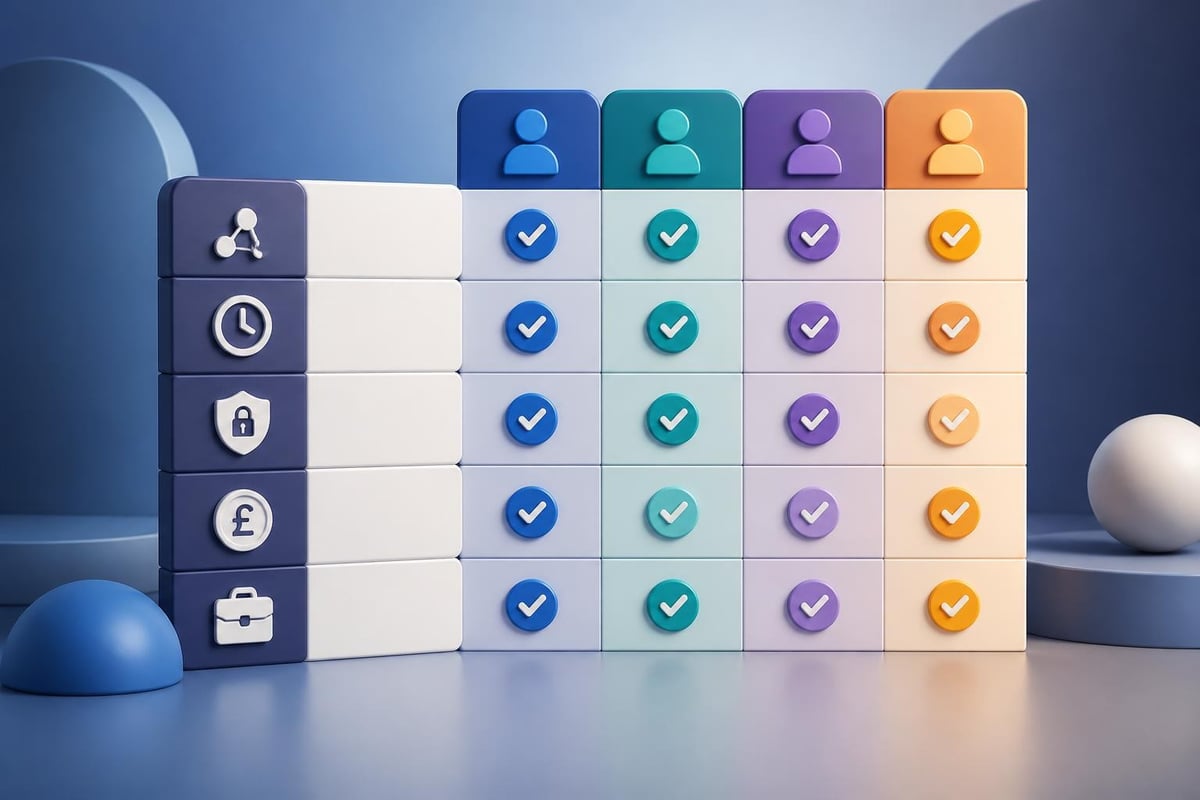
Service Level Agreements (SLAs) define the relationship between businesses and their managed IT services and support providers. Research demonstrates that well-structured SLAs incorporating ITIL processes significantly improve service quality and operational outcomes.
Critical SLA components include:
- Response time guarantees for different severity levels
- Resolution timeframes with escalation procedures
- Availability targets for critical systems and applications
- Performance metrics measuring provider effectiveness
- Reporting requirements ensuring transparency
Avoid providers offering vague commitments. Managed IT services and support agreements should specify measurable outcomes with consequences for non-performance. This accountability ensures your technology receives the attention business operations demand.
Implementation and Transition Strategies
Migrating to managed IT services and support requires careful planning. Rushed transitions create disruption, whilst methodical approaches ensure continuity throughout the change process.
The Phased Approach
Most successful implementations follow staged progressions rather than abrupt cutover events:
- Assessment phase documenting current infrastructure, applications, and pain points
- Pilot programme testing managed services on non-critical systems
- Incremental migration bringing additional systems under management progressively
- Full integration completing the transition whilst maintaining operational stability
- Optimisation cycle refining services based on performance data
This methodology minimises risk whilst demonstrating value early in the relationship. Businesses maintain control throughout the transition, adjusting approaches based on real-world results.
Managing Internal Team Dynamics
Existing IT staff often express concern about managed IT services and support implementations. Address these dynamics proactively to ensure successful outcomes.
Position managed services as augmentation rather than replacement. Internal teams gain access to specialist knowledge, reducing pressure whilst expanding capabilities. Many organisations redeploy internal staff toward strategic projects after routine management transfers to external providers.
Establish clear role definitions. Document which responsibilities transfer to managed IT services and support providers versus those remaining internal. This clarity prevents confusion and ensures accountability across both teams.
Create collaborative workflows. The most effective arrangements integrate managed service providers with internal stakeholders. Regular communication, joint planning sessions, and shared tools foster partnerships delivering superior results.
Service Models and Delivery Approaches
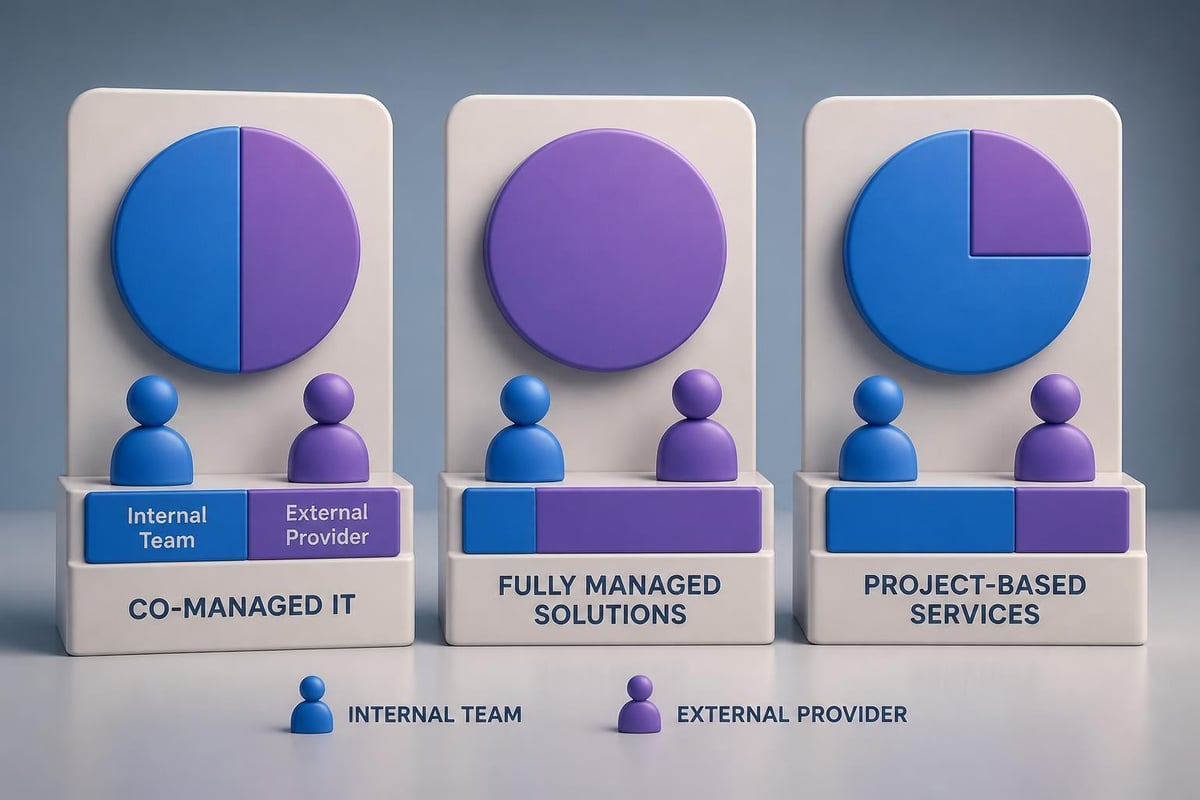
Managed IT services and support providers offer various engagement models tailored to different organisational needs. Understanding these options helps match services to specific requirements.
Co-Managed IT Services
Some businesses maintain internal IT capabilities whilst augmenting them with managed IT services and support. This hybrid approach allows organisations to:
- Retain control over strategic technology decisions
- Supplement internal expertise in specialised areas
- Scale support capacity during peak periods
- Access 24/7 monitoring without hiring night shift staff
Co-managed arrangements suit organisations with established IT departments seeking to enhance rather than replace existing capabilities. Understanding how managed services complement internal teams proves essential for successful implementations.
Fully Managed Solutions
Organisations without dedicated IT staff often opt for comprehensive managed IT services and support covering all technology aspects. Providers assume complete responsibility for:
| Service Area | Provider Responsibility |
|---|---|
| Help desk | All user support requests |
| Infrastructure | Server, network, storage management |
| Security | Monitoring, response, compliance |
| Cloud services | Migration, optimisation, management |
| Planning | Strategic roadmap development |
This model converts technology from a management burden into a predictable operational expense. Businesses focus entirely on core competencies whilst providers handle technical complexities.
Project-Based Managed Services
Some managed IT services and support engagements target specific initiatives rather than ongoing operations. Common project scenarios include:
- Cloud migration programmes transitioning infrastructure from on-premises to Azure or AWS
- Office 365 implementations replacing legacy collaboration systems
- Network infrastructure upgrades supporting business expansion
- Disaster recovery solution deployments ensuring business continuity
Project engagements often transition into ongoing managed IT services and support relationships as organisations recognise the value of continuous professional management.
Technology Platforms and Integration
Modern managed IT services and support rely on sophisticated platforms enabling proactive management, rapid response, and strategic insight. Understanding these technologies helps evaluate provider capabilities.
Remote Monitoring and Management
Remote Monitoring and Management (RMM) platforms form the foundation of effective managed IT services and support. These systems continuously assess infrastructure health, identifying issues before they escalate.
Advanced RMM implementations monitor:
- Server performance metrics including CPU, memory, and disk utilisation
- Network traffic patterns detecting anomalies suggesting security incidents
- Application availability ensuring business-critical systems remain accessible
- Backup completion status verifying data protection processes
- Security patch status across all managed endpoints
The data collected through RMM platforms enables strategic decision-making around infrastructure optimisation and capacity planning. Businesses gain visibility previously unavailable even with dedicated internal IT teams.
Ticketing and Workflow Automation
Professional managed IT services and support providers implement structured ticketing systems ensuring consistent service delivery. These platforms track every request from submission through resolution, creating accountability and enabling continuous improvement.
Modern ticketing solutions integrate with communication tools, documentation systems, and automated workflows. When users report issues, systems automatically:
- Create tickets with relevant context and priority levels
- Route requests to appropriate technical specialists
- Escalate unresolved issues according to SLA timeframes
- Document resolution steps for knowledge base population
- Generate satisfaction surveys measuring service quality
This systematic approach eliminates the inconsistency often plaguing traditional IT support models.
Measuring Success and ROI
Quantifying the value delivered by managed IT services and support requires establishing meaningful metrics aligned with business objectives. Effective measurement frameworks track both technical and business outcomes.
Technical Performance Indicators
System uptime represents the most fundamental metric. Managed IT services and support should demonstrably improve infrastructure availability compared to previous arrangements. Track uptime percentages for critical applications, comparing results against baseline measurements.
Mean time to resolution (MTTR) measures how quickly issues are addressed once identified. Professional providers typically achieve significantly faster resolution than internal teams managing multiple competing priorities.
Security incident frequency indicates whether managed IT services and support effectively reduce threat exposure. Monitor metrics including malware detections, blocked intrusion attempts, and successful phishing attacks.
Business Impact Metrics
Technical improvements should translate into tangible business benefits:
- Productivity gains from reduced downtime and faster issue resolution
- Cost avoidance through prevented security breaches and system failures
- Strategic capacity as internal resources redirect toward innovation projects
- Compliance achievements meeting regulatory requirements without dedicated staff
- Customer satisfaction improvements resulting from reliable technology
| Metric | Before Managed Services | After Implementation | Improvement |
|---|---|---|---|
| Monthly downtime | 8 hours | 45 minutes | 89% reduction |
| Security incidents | 12 per quarter | 2 per quarter | 83% reduction |
| IT support costs | £8,500/month | £6,200/month | 27% reduction |
| Help desk tickets | 180/month | 95/month | 47% reduction |
Regular business reviews with managed IT services and support providers should examine these metrics, identifying optimisation opportunities and ensuring continuous value delivery.
Future Trends in Managed Services
The managed IT services and support landscape continues evolving rapidly. Understanding emerging trends helps organisations make informed decisions about provider selection and service scope.
Artificial Intelligence Integration
AI-powered tools increasingly augment managed IT services and support capabilities. Machine learning algorithms analyse system behaviour, predicting failures before they occur and automating routine remediation tasks.
Predictive analytics enable truly proactive management. Rather than responding to threshold alerts, managed service providers identify subtle patterns indicating developing issues. Systems automatically implement corrective actions, often resolving problems before users notice any impact.
Security-First Service Design
Cybersecurity considerations now permeate every aspect of managed IT services and support. Providers integrate security controls into infrastructure design, application deployment, and user provisioning processes rather than treating security as an aftermarket addition.
This shift reflects the escalating threat landscape. Organisations require comprehensive security frameworks protecting against sophisticated adversaries targeting businesses of all sizes. Managed IT services and support incorporating security-by-design principles provide superior protection compared to traditional reactive approaches.
Edge Computing and Distributed Infrastructure
As businesses adopt IoT devices, remote offices, and distributed workforces, managed IT services and support must address increasingly complex network topologies. Edge computing architectures process data closer to generation points, requiring new management approaches.
Progressive managed service providers develop capabilities supporting these distributed environments. Services extend beyond central datacentres to encompass branch offices, remote workers, and connected devices whilst maintaining consistent security and performance standards.
Common Challenges and Solutions
Whilst managed IT services and support deliver substantial benefits, implementations sometimes encounter obstacles. Recognising potential challenges enables proactive mitigation.
Communication and Expectations
Challenge: Misalignment between expected and delivered services creates friction. Businesses may anticipate immediate response for non-critical issues, whilst providers prioritise based on SLA severity definitions.
Solution: Establish clear communication protocols during onboarding. Document escalation procedures, define severity criteria unambiguously, and conduct regular expectation reviews. Managed IT services and support relationships thrive on transparency.
Legacy System Integration
Challenge: Older infrastructure may resist integration with modern management platforms. Proprietary systems, discontinued products, and custom applications complicate managed IT services and support implementations.
Solution: Conduct thorough discovery during assessment phases. Identify legacy components requiring special handling and develop migration strategies addressing these systems. Professional providers bring experience managing diverse technology estates including legacy platforms.
Data Sovereignty Concerns
Challenge: Organisations handling sensitive data require assurance that managed IT services and support arrangements comply with regulatory requirements. Questions arise regarding data location, access controls, and third-party risk.
Solution: Select providers demonstrating robust compliance frameworks. Verify certifications, review security policies, and establish contractual protections addressing data handling. UK-based managed IT services and support providers familiar with GDPR requirements offer advantages for organisations with strict compliance obligations.
Change Management Resistance
Challenge: Staff accustomed to existing IT support arrangements may resist transitions to managed IT services and support. Concerns about job security, process changes, and unfamiliarity create hesitation.
Solution: Invest in change management activities communicating benefits clearly. Involve affected stakeholders early in planning, address concerns directly, and demonstrate quick wins proving value. Successful managed IT services and support implementations treat cultural change as seriously as technical transitions.
Cost Structures and Budget Planning
Understanding managed IT services and support pricing enables accurate budget forecasting and ensures arrangements deliver value commensurate with investment.
Common Pricing Models
Per-user pricing charges monthly fees for each supported employee. This straightforward approach scales automatically as organisations grow, though it may disadvantage businesses with many light technology users.
Per-device pricing bases fees on managed endpoints including servers, workstations, and network equipment. This model suits organisations with varied user-to-device ratios, though complex environments with many devices face higher costs.
Tiered service packages offer predefined bundles at different price points. Bronze, silver, and gold tiers typically include progressively more services and faster response times. Businesses select packages matching their requirements and budget constraints.
Consumption-based pricing charges for actual resource usage, particularly relevant for cloud-based managed IT services and support. This flexible approach aligns costs directly with business activity levels.
Hidden Costs to Consider
Beyond monthly fees, evaluate total managed IT services and support costs including:
- Onboarding and migration expenses transitioning to new providers
- Training requirements familiarising staff with new processes
- Contract exit costs if arrangements prove unsatisfactory
- Upgrade fees when expanding service scope
- Premium charges for after-hours support or emergency response
Transparent providers discuss these factors upfront, enabling accurate total cost of ownership calculations. Comprehensive service descriptions prevent unexpected charges undermining budgets.
Industry-Specific Considerations
Different sectors face unique technology challenges. Effective managed IT services and support adapt to industry-specific requirements rather than applying generic approaches.
Healthcare and Medical Practices
Healthcare organisations require managed IT services and support addressing strict patient data protection regulations. GDPR compliance, clinical system integration, and medical device management demand specialised expertise.
Providers serving healthcare clients implement enhanced security controls, maintain detailed audit trails, and understand interoperability standards enabling electronic health record systems to communicate effectively. Downtime tolerance remains extremely low given potential patient care impacts.
Professional Services Firms
Law firms, accountancy practices, and consultancies depend heavily on secure document management and client communication systems. Managed IT services and support for professional services emphasise confidentiality, matter management integration, and mobile working capabilities.
These organisations often require hybrid infrastructure balancing on-premises servers for sensitive data with cloud collaboration tools supporting flexible working arrangements. Email archiving, secure file sharing, and client portal management feature prominently in service requirements.
Manufacturing and Distribution
Manufacturing businesses need managed IT services and support integrating office IT with operational technology. Production system monitoring, supply chain integration, and warehouse management systems extend beyond traditional IT scopes.
Industrial control systems, machinery connectivity, and real-time data analytics demand providers comfortable with both information and operational technology domains. Downtime directly impacts production capacity, making reliability paramount.
Managed IT services and support have transformed from luxury offerings to essential business utilities enabling competitive advantage through technology excellence. By partnering with experienced providers, organisations across the UK gain enterprise capabilities, enhanced security posture, and strategic technology guidance without the overhead of extensive internal teams. Blowfish Technology delivers comprehensive managed IT services and support tailored to businesses throughout the North West, combining proactive monitoring, cybersecurity expertise, and cloud solutions that keep your operations running smoothly whilst you focus on growth.

The Blowfish Technology team. Managed IT, cloud services, software development and connectivity for North West businesses since 1999.