
Monday morning at a 45-person accountancy firm rarely starts with a tidy queue of prioritised work. Two engineers may chase the same fault, a production change may have no record, and the finance director may still be asking why last week's outage took six hours to resolve. The problem isn't usually technical competence. It's the absence of a shared operating method.
Processes in ITIL give small UK teams that method without requiring an enterprise bureaucracy. Used properly, they clarify who owns an incident, which requests should follow a standard route, how live changes are assessed, and when a recurring fault deserves deeper investigation. Used badly, they create forms nobody reads and meetings nobody needs.
This guide takes the practical view. You'll see which ITIL processes deliver control for SMEs, which measurements are worth keeping, how ITIL evolved from a UK public-sector framework, and how to introduce a workable model without interrupting daily support.
Table of Contents
- Why ITIL Processes Matter for Modern UK IT Teams
- How ITIL Processes Evolved from a 1980s UK Framework
- The Core Day-to-Day ITIL Processes Explained
- Mapping ITIL v3 Lifecycle Processes to ITIL 4 Practices
- Real-World ITIL Process Examples for UK SMEs
- Common Misconceptions About ITIL Process Overhead
- A Practical Roadmap for Adopting ITIL Processes
- Next Steps and Frequently Asked Questions About ITIL
Why ITIL Processes Matter for Modern UK IT Teams
At a small UK firm, informal support works until the IT lead is away, a supplier owns part of the service, or several users report faults at once. Then personal knowledge becomes a single point of failure. Tickets lack consistent priorities, changes go undocumented, and managers cannot tell whether the team is resolving service issues or reacting to whoever asks loudest.
A lightweight ITIL-style operating model gives the team a shared way to make those decisions. Keep only the controls that improve ownership, communication, or risk:
- Incidents: Restore a disrupted service and keep affected users informed.
- Service requests: Fulfil routine, pre-approved work through a repeatable route.
- Changes: Assess the risk of altering a live service before implementation.
- Problems: Investigate recurring or serious faults instead of repeatedly treating symptoms.
The benefit is operational clarity. Engineers can distinguish an urgent restoration from a standard request, a technical escalation, or a change requiring approval. Service desk leads can review what happened from ticket records rather than reconstructing events from emails and Teams messages.
Practical rule: If a process does not help someone decide what to do next, simplify it or remove it.
Who gains from a lightweight model
The in-house IT lead usually sees the benefit first. Named ownership, consistent tickets, and easier handovers reduce interruptions and prevent routine work from disappearing behind urgent requests. Directors gain a record of how the organisation handled disruption and production changes, supporting internal control reviews and Cyber Essentials discussions.
Operations managers can also assess an internal team or supplier using shared evidence. They can review incident volumes, severity categories, resolution times, and SLA performance instead of debating whether support merely feels busy. UK public-sector guidance treats incidents as unplanned service events affecting more than one organisation and expects providers to establish whether the fault lies within their architecture or elsewhere. That makes incident management useful for defining responsibility between suppliers and customers.
A small team does not need a process manager for every practice. One person can coordinate incidents and requests, while another approves normal changes and reviews recurring faults. Start with a shared ticketing tool, a clear priority matrix, and a short change log. Add formality only when missed handovers, repeated outages, audit requirements, or supplier disputes justify it.
Teams that need help operating these controls can also review managed IT support rather than building every capability internally.
How ITIL Processes Evolved from a 1980s UK Framework
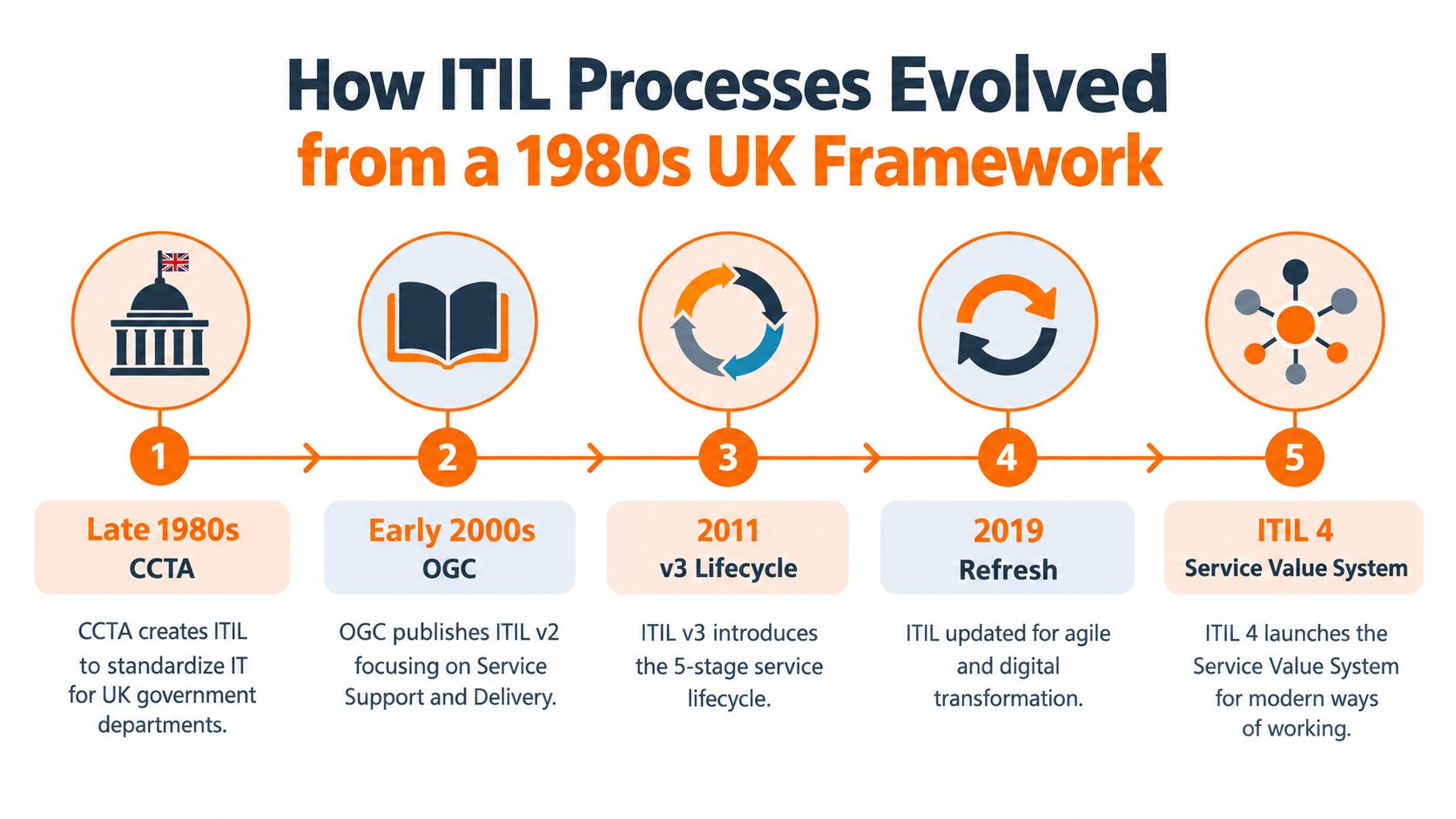
ITIL's history matters because it explains why the framework still appears in UK service teams. It wasn't imported as a foreign management fashion. The Central Computer and Telecommunications Agency, a UK government body, was commissioned to improve the quality and financial control of government IT services. ITIL originated in the UK during the 1980s and was formally released in 1989, creating a British public-sector foundation for what became a global service management model. The ITIL history overview records that development path.
The early framework focused on making IT more controlled and repeatable. By 2001, ITIL Version 2 had been released. Version 3, released in 2007, expanded the model into 26 processes and functions organised around a service lifecycle. For many UK practitioners, that lifecycle became the vocabulary used in service reviews, supplier contracts, and operational improvement plans.
The v3 lifecycle in operational terms
The v3 model grouped work into five stages:
- Service Strategy: Service portfolio management, financial management, demand management, and business relationship management connected IT services to business needs.
- Service Design: Service level management, capacity management, availability management, information security management, supplier management, and continuity management shaped services before launch.
- Service Transition: Change management, release and deployment management, service asset and configuration management, service validation and testing, knowledge management, and transition planning prepared services for live operation.
- Service Operation: Incident management, problem management, event management, request fulfilment, access management, and the service desk supported users and restored services.
- Continual Service Improvement: Measurement, review, and improvement activities used evidence to improve value over time.
The 2019 refresh and ITIL 4 moved away from treating those activities as rigid, sequential procedures. ITIL 4 describes 34 practices and places them within a Service Value System, allowing teams to combine practices around a particular value stream. That change recognised cloud services, Agile delivery, Lean improvement, and DevOps automation.
For a small business, the lesson is straightforward. Learn the old process names if your suppliers or contracts use them, but design today's workflow around the result you need. A service desk should restore access quickly, a change should be safe enough for its risk, and a request should be easy to fulfil repeatedly. Teams seeking broader historical context can also review Blowfish Technology's 25 years of experience in supporting UK organisations.
The Core Day-to-Day ITIL Processes Explained
A small UK IT team can lose a morning to a locked-out user, a recurring VPN fault, or a rushed firewall change. A lightweight ITIL operating model keeps those jobs visible and repeatable without turning the service desk into a paperwork function. Start with four processes that handle most day-to-day work: incidents, problems, changes, and service requests.
Incident Management
Incident Management restores normal service quickly. Engineers do not need to find the permanent cause before helping the user. If staff cannot access Microsoft 365, confirm the scope, communicate the impact, apply a workaround or fix, and record the result.
Use a priority matrix based on business impact and urgency. A finance system unavailable to a whole department should take precedence over a single-user printer issue, even if the printer ticket arrived first. Track total incidents, severity-based counts, average resolution time by severity, and the percentage resolved within SLA. Define the incident-resolution rate as incidents resolved within SLA divided by total incidents reported, using the same calculation across each review period.
Problem Management
Problem Management investigates why incidents recur. If a VPN drops every Friday or new starters repeatedly lose access to a business application, create a problem record instead of closing each incident separately.
Keep the record practical. Link the related tickets, state the suspected cause, document the workaround, and assign an owner for permanent remediation. A one-off, low-impact fault does not justify a lengthy investigation. Use this process when recurrence, business impact, or technical risk makes the additional work worthwhile.
Change Enablement
Change Enablement controls modifications to live services. A standard laptop replacement may need only a pre-approved template. A firewall rule, identity policy, or backup configuration requires a risk assessment, implementation plan, test evidence, and rollback approach.
Three categories work well for many SMEs: standard, normal, and emergency. Standard changes follow an approved pattern. Normal changes receive peer review and scheduling. Emergency changes move quickly, while still requiring retrospective recording. This level of control protects live services without creating an enterprise-scale approval board.
Service Request Management
Service Request Management handles predictable, user-initiated work. New starter accounts, leaver access removal, software installation, laptop builds, and shared mailbox requests should use structured forms or catalogue entries instead of free-text emails.
A service catalogue should specify the information the requester must provide, the required approver, and the next step. If ownership is unclear, document a support ticket escalation process that records affected users, start time, previous troubleshooting, recent changes, and available workarounds.
| Process | Purpose | Typical Activity | Suggested Owner | Starter KPI |
|---|---|---|---|---|
| Incident Management | Restore service | Triage, prioritise, resolve, communicate | Service desk lead | Resolution within SLA |
| Problem Management | Reduce recurring disruption | Root-cause analysis and remediation | Technical lead | Open recurring problems |
| Change Enablement | Reduce change risk | Assess, approve, implement, review | Change owner | Change success rate |
| Service Request Management | Fulfil routine work | Approve and complete catalogue items | Service desk lead | Request completion time |
For a team of three to five people, combine roles where necessary. Begin with one shared ticket log, one priority model, one change register, and a weekly review of unresolved or recurring work. Add formal meetings only when a decision needs several people. That keeps process effort tied to service risk rather than ceremony.
Mapping ITIL v3 Lifecycle Processes to ITIL 4 Practices
The practical shift from v3 to ITIL 4 is less about deleting useful work and more about changing how teams organise it. ITIL v3 presented 26 processes and functions across five lifecycle phases. ITIL 4 describes 34 practices within a Service Value System, giving organisations more freedom to assemble the controls needed for a particular service.
That distinction matters to SMEs. A v3 process often suggested a defined sequence and documentation set. An ITIL 4 practice describes the capabilities, roles, information, and activities needed to achieve an outcome. A team can therefore use a lightweight workflow without pretending it operates an enterprise-scale stage gate.
| ITIL v3 Process | ITIL 4 Practice |
|---|---|
| Incident Management | Incident Management |
| Problem Management | Problem Management |
| Change Management | Change Enablement |
| Request Fulfilment | Service Request Management |
| Service Level Management | Service Level Management, supported by Relationship Management |
| Event Management | Monitoring and Event Management |
| Service Desk function | Service Desk |
| Service Asset and Configuration Management | Service Configuration Management and IT Asset Management |
| Release and Deployment Management | Release Management and Deployment Management |
| Knowledge Management | Knowledge Management |
| Information Security Management | Information Security Management |
| Continual Service Improvement | Continual Improvement |
The names reveal the design intent. Change Management became Change Enablement, which places emphasis on enabling useful change while controlling risk. Request Fulfilment became Service Request Management, aligning routine user work with a broader service catalogue. Service level work remains important, but ITIL 4 connects it more explicitly with relationships, value, and stakeholder expectations.
What changes for a UK SME
A small business should avoid mapping every legacy process to a separate owner. Incident, problem, and change work may sit with the same technical lead, while service request and service desk responsibilities sit together. The workflow should reflect risk, not the number of boxes in a framework diagram.
Asset and configuration information still matters, particularly when a supplier needs to understand endpoints, licences, identities, and dependencies. A practical guide to secure IT asset management tips can help teams strengthen that control without building a complicated configuration database. For a more UK SME-focused view, use an IT asset lifecycle management guide to connect procurement, deployment, support, and disposal.
Real-World ITIL Process Examples for UK SMEs
A process earns its place when it changes behaviour during pressure. Consider a 40-person accountancy firm facing a suspected ransomware incident. Staff report inaccessible files and unusual login prompts, so the service desk declares a major incident rather than handling each report independently.
The incident workflow establishes scope, identifies affected services, records communications, and brings the security and infrastructure contacts into one response. The immediate objective is containment and restoration. Problem Management then examines the evidence and traces the entry point to an unpatched VPN. That investigation produces a corrective change, not just another closed incident.
A controlled emergency change
The technical lead records the emergency patch, affected endpoints, test checks, implementation owner, and rollback position. A small virtual change authority, perhaps the IT lead and an authorised business representative, reviews the risk and approves the work. The team then applies the patch, monitors authentication and connectivity, and records the post-implementation result.
The useful measures are not decorative. Mean time to resolve shows how long the incident remained active. First-contact resolution indicates whether the service desk could handle reports without escalation. Change success rate shows whether emergency remediation introduced further disruption. The exact target depends on the agreed service and business risk, but the definitions must remain consistent.
Record the decision made under pressure, not every keystroke taken by the engineer.
Routine work across multiple sites
A multi-site retailer can use Service Request Management to standardise new laptop provisioning. The catalogue item captures the user, location, role, required applications, approval, delivery details, and handover confirmation. A leaver request follows a separate access-removal checklist, with identity, device, licence, and data-retention actions assigned to named owners.
This approach prevents routine work from competing invisibly with incidents. It also gives managers a clean view of demand. If one site repeatedly submits incomplete requests, the service desk can improve the form instead of blaming individual users.
An MSP can apply the same model across customers. It might track first-time fix, customer satisfaction, and SLA performance, then review recurring demand through Continual Improvement. The important point is not the sophistication of the dashboard. It's the connection between a recorded request, an accountable action, and a service outcome.
Common Misconceptions About ITIL Process Overhead
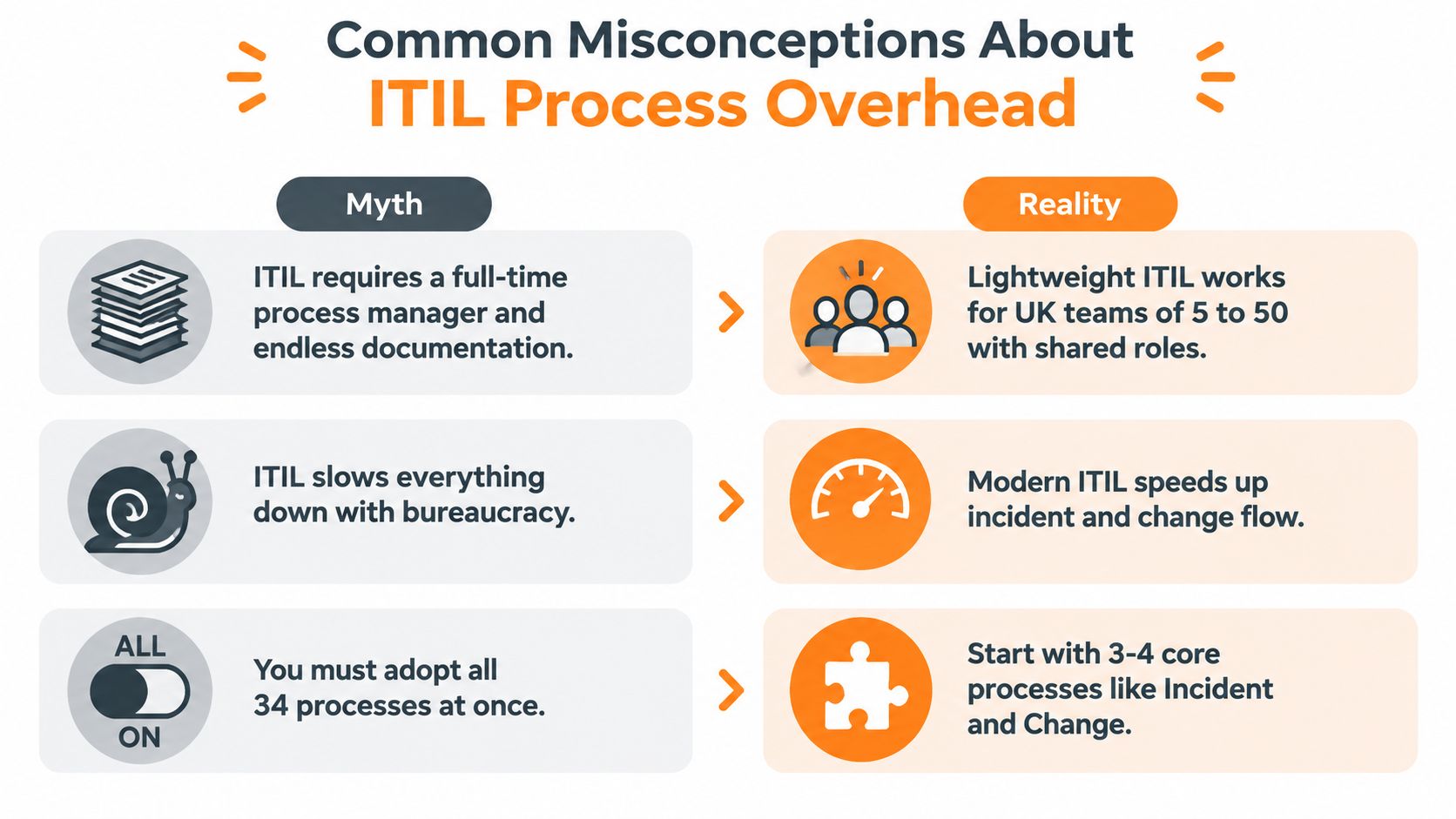
ITIL has earned its bureaucratic reputation. Many organisations copied the visible parts of the framework, such as approval boards, lengthy documents, and elaborate reports, without asking whether those controls matched operational risk. That doesn't mean the underlying practices are unsuitable for a UK team of five to fifty people.
Myth and reality
Myth: ITIL requires a full-time process owner.
Reality: A service desk lead can own incident and request workflows, while a technical lead owns problem and change decisions. Accountability matters more than dedicated headcount.
Myth: Every change needs a heavyweight CAB.
Reality: A two-person virtual change authority can review higher-risk work. Standard changes should use approved templates, not wait for a meeting.
Myth: Every ticket needs extensive documentation.
Reality: Capture the facts needed to restore service, explain the decision, and support follow-up. A short incident template beats a detailed form that engineers avoid.
Myth: Certification proves operational maturity.
Reality: Certification demonstrates knowledge of terminology and concepts. Maturity appears in consistent ownership, useful records, sensible escalation, and learning from failure.
Where teams create unnecessary work
KPI theatre is a common trap. A dashboard full of figures doesn't improve support if nobody acts on the results. Choose measures that trigger decisions, such as SLA performance, resolution time, repeat incidents, and failed changes.
Another mistake is treating ITIL 4 adoption as a full workflow rewrite. Keep the ticketing path that works, then tighten its weak points. Add a single-page service catalogue, a basic change log, and an incident priority matrix before introducing anything more elaborate.
A lean control that people use is stronger than a perfect control they bypass.
The right question isn't whether a process looks formally compliant. Ask whether it reduces ambiguity, prevents avoidable disruption, or makes performance visible. If it does none of those things, it's overhead.
A Practical Roadmap for Adopting ITIL Processes
A workable rollout should run alongside support, not demand that the team stop serving users. Use a 90-day path with a narrow first release, visible ownership, and measurements that help you adjust.
Phase one from days 1 to 30
Start with discovery. Review the current ticket flow from email, phone, Teams, and the service desk tool. Identify the top three recurring incident types, note where tickets stall, and establish a baseline for first-time fix, backlog, SLA performance, and resolution time.
Don't try to document every exception. Select the failure points that create the most operational noise. If engineers repeatedly wait for approval, fix the approval route. If requests arrive without business context, improve the request form.
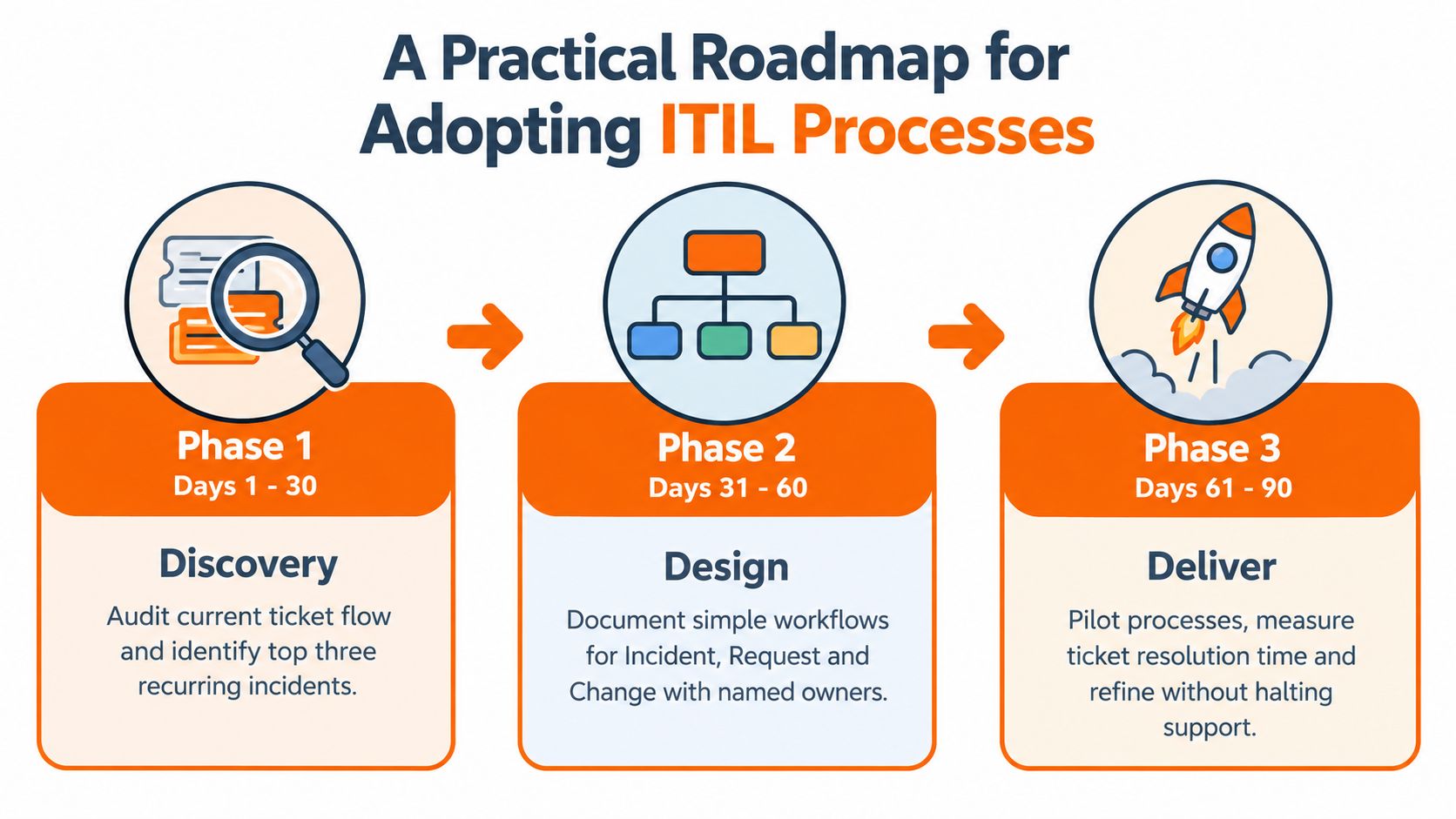
Phase two from days 31 to 60
Formalise Incident Management, Service Request Management, and Change Enablement in one shared tool. Write policies for the actual team, not an imagined enterprise. Define priority, escalation, approval, closure, and emergency handling in language engineers can apply during a busy morning.
A simple workflow should answer five questions:
- What happened?
- Who is affected?
- How urgent is it?
- Who decides the next action?
- What evidence closes the work?
Keep the service catalogue small. New user, leaver, access change, laptop build, software request, and shared mailbox work are sensible starting points.
Phase three from days 61 to 90
Pilot the workflows with real tickets, then introduce Problem Management for recurring faults and a basic change review. Track SLA hit rate, mean time to resolve, change failure rate, and first-contact resolution. Review the measures with the people doing the work, because they'll quickly identify whether a metric is useful or distorted.
Teams should consider a managed service provider when out-of-hours cover, security monitoring, or multi-site coordination exceeds internal capacity. If your organisation is also trying to reduce distractions with Fluidwave, keep that improvement work tied to named owners and measurable service outcomes.
The UK market still rewards practical incident capability. In the six months to 14 September 2026, UK job adverts cited incident management in 963 permanent roles, with a median annual salary of £55,000, and in 930 contract roles, with a median daily rate of £550. The figures are reported by IT Jobs Watch, and they reinforce a useful point for employers: operational process skill has tangible labour-market value.
Next Steps and Frequently Asked Questions About ITIL
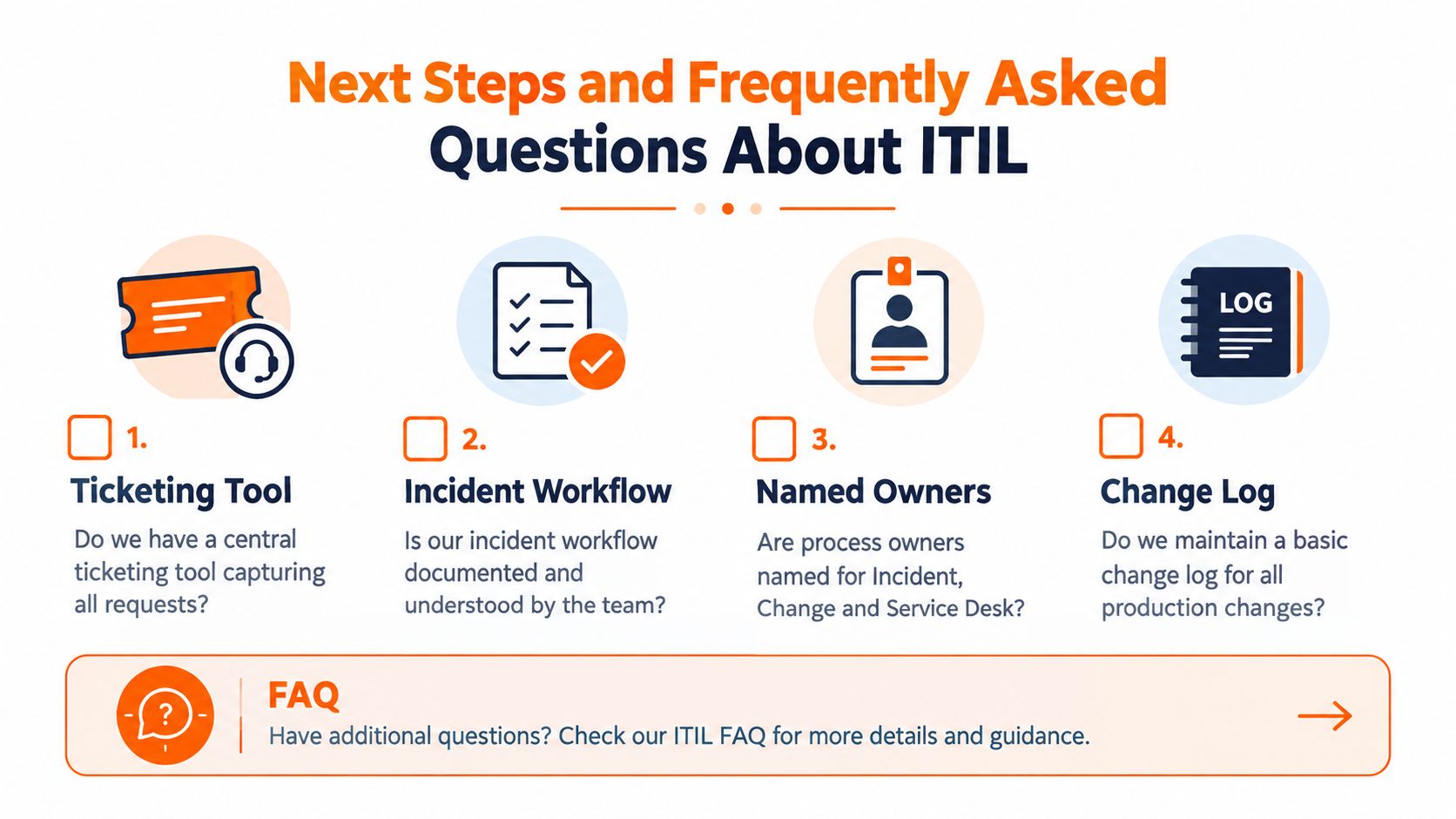
Run this readiness check before buying a new platform or commissioning a large consulting project:
- Ticketing tool: Does one system capture support requests and incidents?
- Incident workflow: Does the team know how to prioritise, escalate, communicate, and close an incident?
- Named owners: Does someone own Incident, Change, and Service Request Management?
- Change log: Do you record production changes, approvals, outcomes, and rollback decisions?
Frequently asked questions
Does ITIL 4 still use processes?
ITIL 4 uses the language of practices rather than presenting a fixed process catalogue. The operational work remains familiar, but teams can combine activities around value streams and business outcomes.
Is certification worthwhile for an SME owner?
Foundation-level study can be worthwhile if the owner approves IT spend, manages suppliers, or needs a shared service vocabulary. Certification shouldn't replace practical workflow design.
How long does adoption take?
A focused rollout can begin with discovery, workflow design, and pilot activity over a 90-day programme. The quality of the result depends on adoption and review, not on producing a large policy library.
What does skipping process cost?
The cost appears when an outage has no clear owner, a change has no rollback plan, or an incident record cannot explain what happened. You lose restoration time, confidence, evidence, and the ability to prevent recurrence.
Start this week by centralising tickets and recording every production change. If your team needs help applying ITIL principles without rebuilding an internal service function, Blowfish Technology provides managed IT support, cloud services, security controls, and measurable service management for UK SMEs. Visit Blowfish Technology to discuss a practical support model built around your business risks and capacity.
