
A provider boasting 25 years of experience is not automatically credible. In the UK, long tenure often does mean continuity, but continuity is not the same as current capability, and buyers who confuse the two end up paying for history instead of outcomes. The Office for National Statistics reported that in 2024 the median job tenure for employees aged 50 to 64 was 11.7 years, compared with 4.9 years for all employees, and 17.3% of employees aged 50 to 64 had been with their current employer for 20 years or more in the same data set, which tells you something important about seniority in the UK labour market, not just age in the calendar sense. ONS tenure data referenced in the brief
For SMEs, that matters because a long track record can signal institutional memory, but it can also hide stale methods, old assumptions, and inherited reputation. In cyber, cloud, and Microsoft 365 environments, the question is no longer whether someone has been around for a long time. The question is whether they still know how to operate in the current threat environment, under current compliance pressure, with current tooling.
Table of Contents
- Why Longevity Alone No Longer Wins the Conversation
- What 25 Years of IT Experience Really Means
- The Hard Credibility Signals Buyers Should Demand
- How the Value of Experience Shifts by Sector
- A Realistic UK SME Evaluation Scenario
- Common Pitfalls When Choosing an Experienced MSP
- Messaging 25 Years of Experience the Right Way
- Your Next MSP Conversation Starts Here
Why Longevity Alone No Longer Wins the Conversation
The old advice was lazy, “pick the firm with the most years behind it”. That's a comfort blanket, not a procurement strategy. A provider founded in 2001 may be excellent today, or it may still be selling the habits of 2001 with a modern logo on top.
Why buyers are sceptical now
UK buyers have stopped giving automatic credit for time served because the environment changed faster than supplier branding did. The 2025 Cyber Security Breaches Survey found that 50% of businesses and 32% of charities had experienced a cyber breach or attack in the previous 12 months, with ransomware and phishing still central threats, so the bar for trust has shifted from “established” to “adapted”. 2025 Cyber Security Breaches Survey
That's especially true for SMEs with mixed estates. A company running on-premises servers, Microsoft 365, remote access, and a few ageing line-of-business applications needs a partner who can explain the risks in plain English and act on them quickly. A long history helps only if the provider has modern answers.
Practical rule: tenure is a starting point, not evidence. If a supplier cannot show current controls, current processes, and current results, the years on the website are decoration.
What longevity has to prove
Longevity should prove three things. First, the provider has survived enough change to avoid panic-driven decision-making. Second, they've built enough operational discipline to keep clients stable over time. Third, they can translate older infrastructure knowledge into current support models, which matters in regulated, relationship-driven fields such as legal, financial, engineering, and manufacturing services.
If you want a provider that treats long service as part of a broader operating model, managed IT services in the UK should be presented as a current delivery discipline, not a heritage badge. That distinction is what separates real credibility from marketing fluff.
What 25 Years of IT Experience Really Means
A quarter century in IT is not one skill. It is a record of shifts in platforms, operating models, and bad assumptions that had to be corrected in production. The value is judgment, not nostalgia.
The technology generations matter
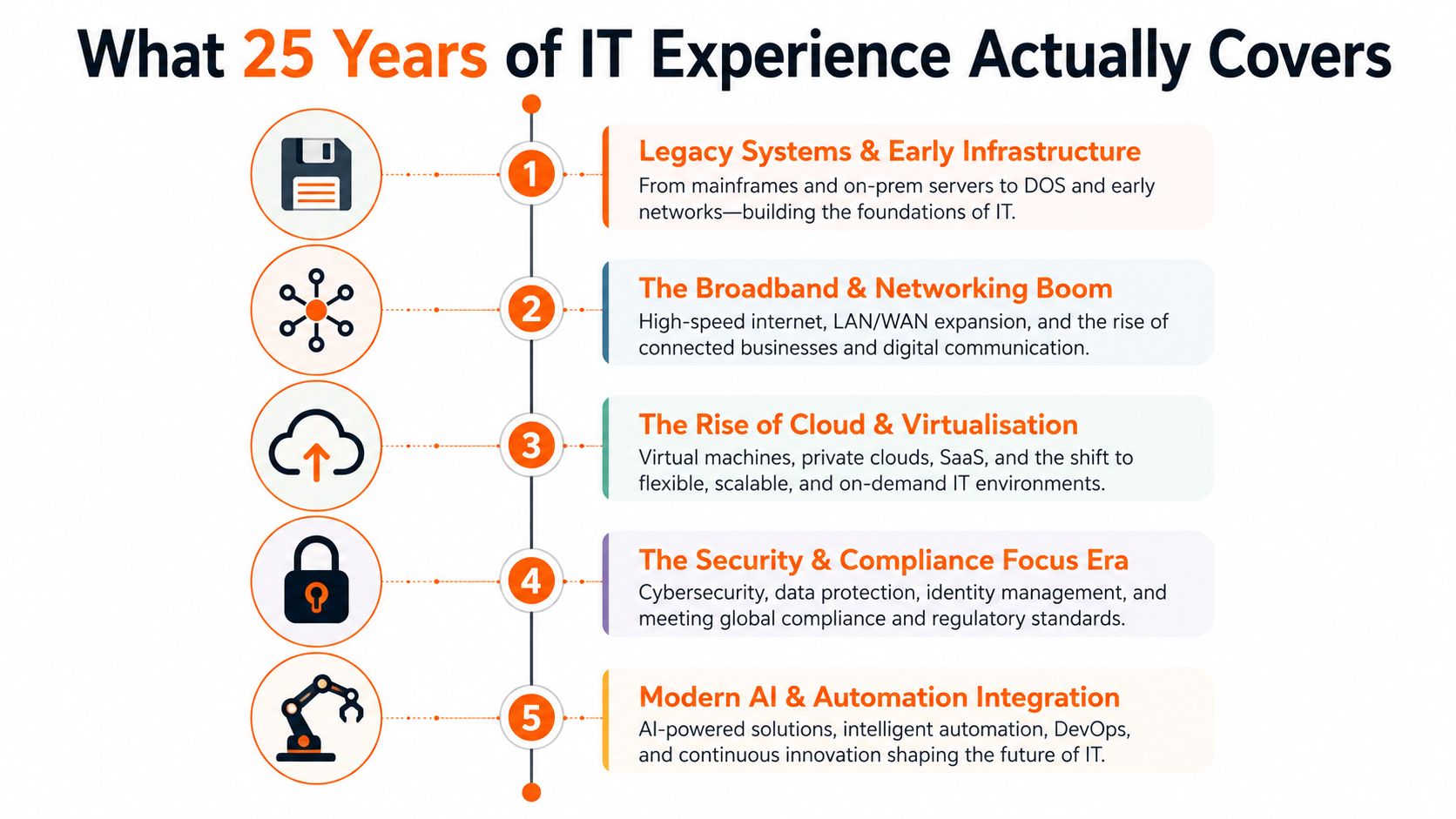
A provider with 25 years behind it has usually worked through legacy systems and early infrastructure, then the broadband and networking boom, then virtualisation, then the rise of cloud and hybrid estates, then the security and compliance era, and now modern automation and AI-assisted operations. That does not mean they are expert in every tool that ever existed. It means they have seen technology promises fail, scale, migrate, break, and recover.
That experience matters because old systems do not disappear cleanly. SMEs still carry the leftovers, an ageing file server, a line-of-business app tied to one workstation, a printer queue nobody wants to admit is critical. A team that has dealt with those realities before will not romanticise them. They will isolate risk, plan migration properly, and keep the business running while change happens.
Treat it like long-haul operations, not a fresh qualification
A junior engineer may know the latest feature set better than a veteran. The veteran knows what happens when the feature set meets production, users, poor documentation, and a deadline. That is why the better comparison for 25 years of IT experience is long-haul operations, not a classroom certificate. The classroom covers theory. Long-haul work covers weather, fuel, routing, fatigue, contingency, and how to land when the original plan falls apart.
That is also why what a managed service provider does should be understood in operational terms, not sales language. The job is not just to support IT. The job is to keep continuity intact across shifting platforms, suppliers, and risk profiles. A real MSP earns that label by running the day-to-day service well, not by repeating the same heritage claim in every proposal.
A long record only becomes valuable when it shows a provider can move from one generation of technology to the next without losing control of the business. Before signing anything, buyers should ask for proof of current delivery, not a wall of old milestones. If you want a partner who understands how credibility is judged, use trust signals advice from 3228 Digital UK as a reminder that reputation has to be earned in the present.
The Hard Credibility Signals Buyers Should Demand
A supplier that wants your business should be ready to prove it. Strip away the tenure claim and ask for evidence that still stands up today, because longevity without current delivery is just old branding.
Certifications are useful, but only if they're current
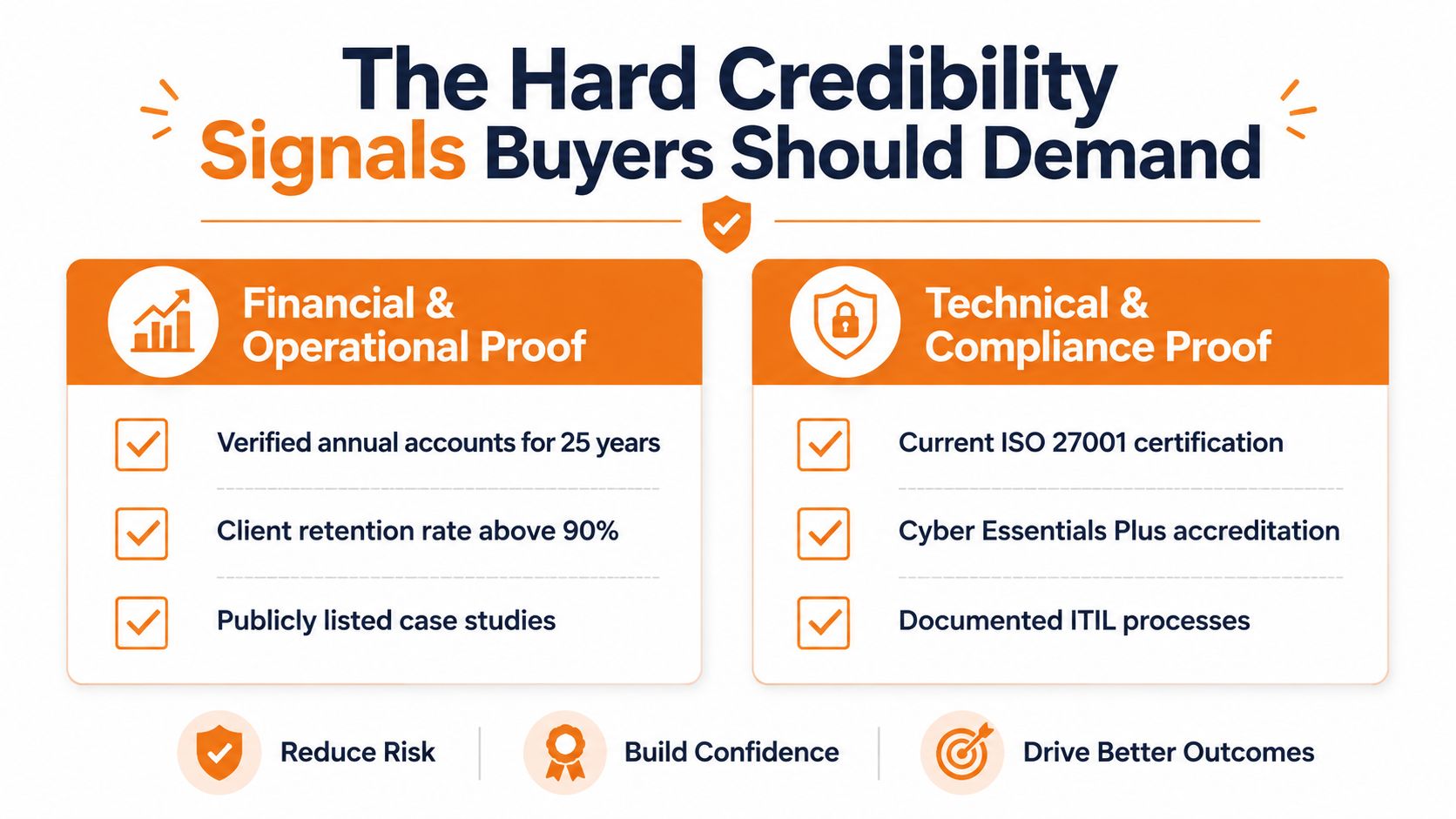
For UK SMEs, Cyber Essentials, Cyber Essentials Plus, and ISO 27001 still matter because they show documented controls, not just confidence in a sales meeting. Microsoft partner status can also matter if your business depends on Microsoft 365, Azure, or Modern Workplace tooling. Certification does not prove good service on its own. It proves the provider has cleared a formal bar, which is a starting point, not a verdict.
If you need a plain-English primer before you ask for evidence, this explanation of Cyber Essentials certification is the right kind of background reading, because it frames certification as a control baseline rather than a trophy.
Ask for operational proof, not slogans
Vendor talk gets vague very quickly. “Trusted by hundreds of businesses” tells you almost nothing. “We answer quickly” tells you less. Ask for service levels, response targets, and actual handling metrics. Blowfish Technology, for example, publicly positions its support around sub-20-second average call waits, 75% same-day ticket resolution, and 98% within SLA. That is the sort of evidence buyers should expect to see up front, not after the contract is signed.
For a broader view on how trust cues work in commercial buying, trust signals advice from 3228 Digital UK is useful because it reinforces a simple point, buyers want visible proof, not vague reassurance.
Case studies should be named and relevant
A credible provider should show named or at least clearly scoped examples from engineering, manufacturing, legal, or financial environments. The right case study is not the prettiest one. It is the one that matches your risk, your user base, and the pressure your team feels when something breaks.
A provider that claims long experience should also show how that experience survives contact with current demands. Ask for sample SLAs, engineer CVs, recent case studies, and proof of current certifications. Ask how they handle backup failure, account takeover, patching delays, and supplier outages. If they stall on any of it, they want you to trust memory instead of delivery.
How the Value of Experience Shifts by Sector
The same 25-year track record means different things depending on the buyer. A general SME wants stability. A regulated organisation wants evidence that the provider understands the consequences of failure.
General SME needs are operational, not ceremonial
For a typical North West SME, the value of long experience sits in predictable support, fewer surprises, and one accountable partner instead of a tangle of separate suppliers. You want a team that can keep email, endpoints, backup, connectivity, telephony, and remote access steady without turning every incident into a project.
That kind of buyer should care less about the age of the company and more about whether the provider can keep users working. If a long-established MSP can simplify the environment, reduce duplicated effort, and respond fast when something breaks, then the years matter. If not, they're just years.
Regulated sectors need current proof, not heritage
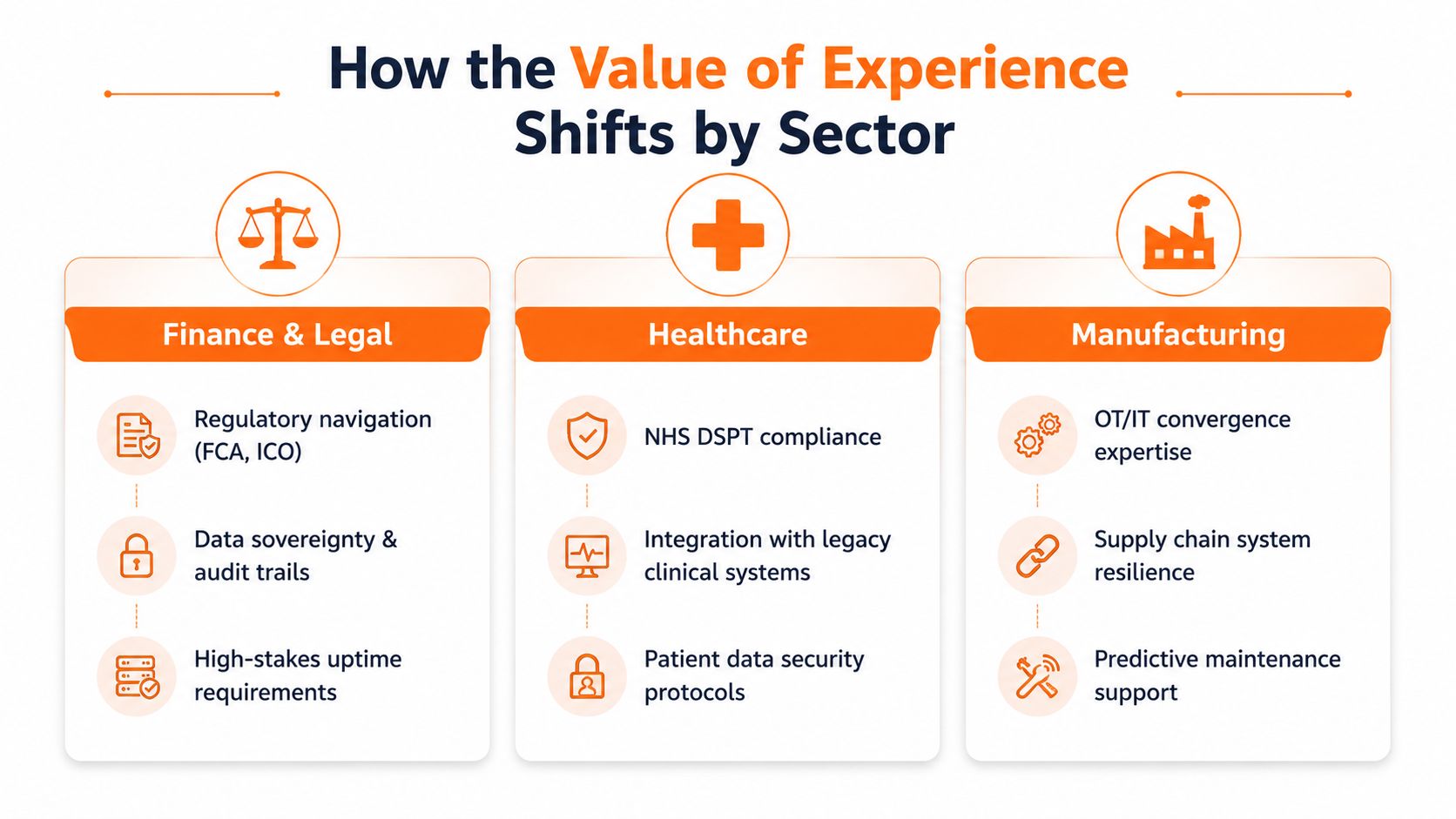
Legal, financial, engineering, and manufacturing buyers need something stricter. They need proof that the provider understands audit trails, recovery objectives, data handling, access controls, and sector-specific risk. IT support for financial services firms makes most sense when it is built around compliance, not generic desktop support.
Engineering and manufacturing also introduce different pressures. OT and IT have to coexist, recovery matters when production is interrupted, and support has to respect systems that can't be patched on a whim. A long-tenured MSP is valuable only if it has lived through those realities and can show how it protects them today.
| Buyer context | What 25 years should prove | What to ask for |
|---|---|---|
| General SME | Stability and accountable support | SLA evidence, helpdesk process, recent references |
| Legal and financial | Compliance awareness and audit discipline | Certification status, data handling controls, case studies |
| Engineering and manufacturing | Resilience across mixed infrastructure | Backup design, recovery process, environment-specific examples |
In other words, the sector decides what “experienced” is supposed to mean. Don't let a supplier define it for you.
A Realistic UK SME Evaluation Scenario
A 40-person engineering firm in the North West shortlists three MSPs. All three say they've been around a long time. One has the slickest website. One has the biggest name. One is the quietest. The buyer ignores all of that and starts asking hard questions.
First call, same questions to each supplier. Who answers the phone, who owns the account, what happens when a server, switch, or Microsoft 365 issue lands on a Friday afternoon, and how do you prove the engineer who will do the work has experience with environments like ours? The weak provider talks in broad terms. The strong one names the tools, the process, and the escalation route.
Documents requested before a second meeting
The buyer asks for three things before going any further, recent case studies, sample SLAs, and engineer CVs. That request flushes out the sales-led firms immediately. If a supplier cannot show how their support team works, what they commit to, and where they've done similar work, they're not ready for the contract.
One firm sends polished marketing material but no operational detail. They're out. Another sends a case study that sounds impressive but never names the environment or the outcome. They're out too. The third provides a sector-relevant example, clear service expectations, and evidence that its engineers have worked across modern Microsoft 365 and backup scenarios. That one makes the final round.
The buyer also calls two references and asks specific questions, not soft ones. Did the provider reduce friction? Did they respond quickly? Did the support model hold up when something broke outside office hours? That kind of reference check is more useful than any badge on a homepage.
Common Pitfalls When Choosing an Experienced MSP
Most bad buying decisions come from comfort, not stupidity. Buyers want to reduce risk, so they latch onto the thing that feels safest, lowest price, famous name, old brand, shiny website. None of those things proves the provider is right for your estate.
The usual traps are easy to spot
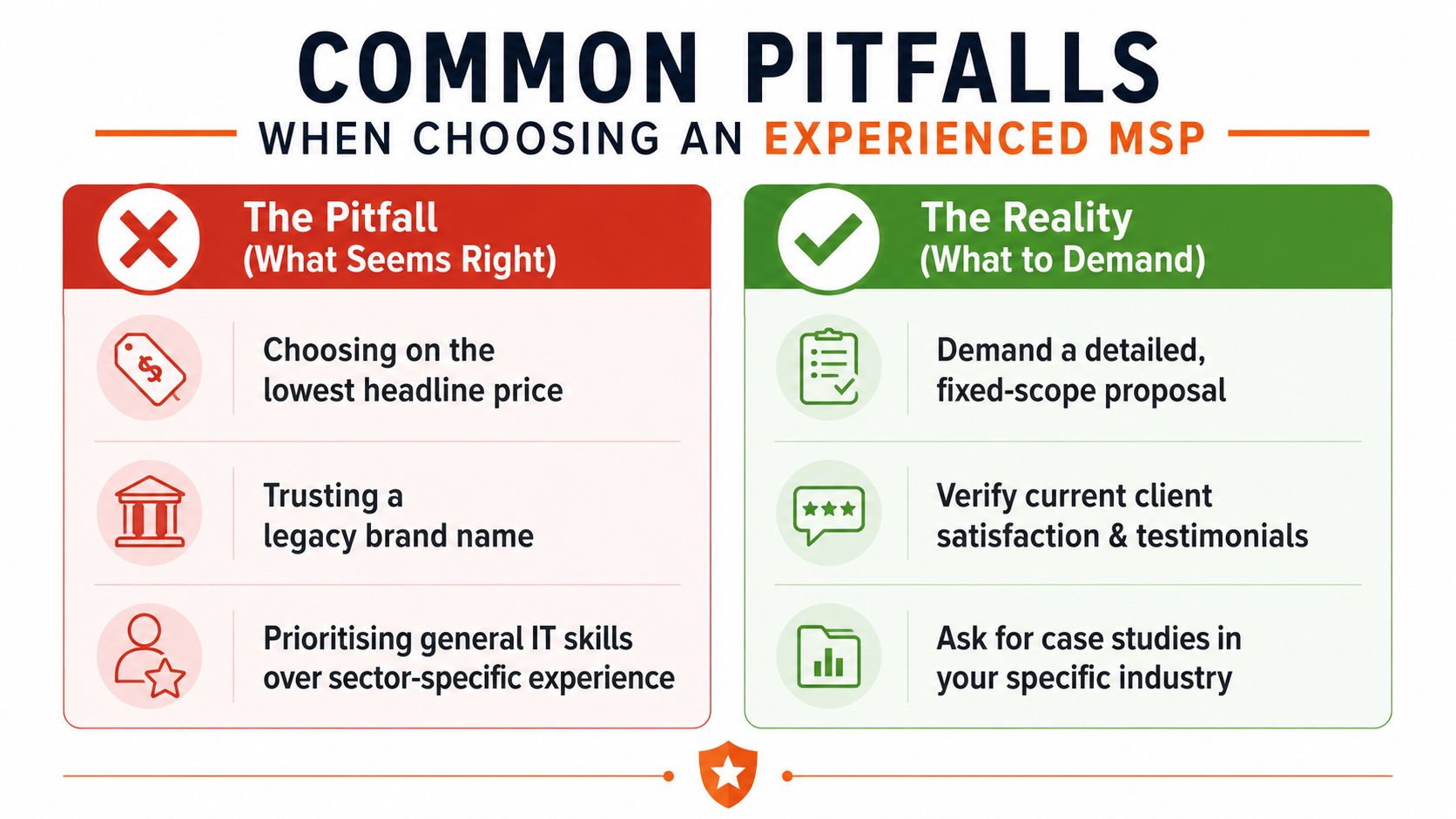
The first trap is headline price. Cheap support looks sensible until the first serious incident exposes the gaps. The right question is not “who is cheapest”, it's “what is included, how is it delivered, and what breaks when the first real issue arrives?”.
The second trap is brand recognition. A legacy name feels safer because it's familiar, not because it's current. The third trap is mistaking general IT competence for sector fit. A supplier can be good at laptops and still be weak on regulated workflows, recovery expectations, and the operational realities of a manufacturing site.
Ask the question that strips away the gloss
If the firm says it has 25 years of experience, ask what that proves in 2026. Do the founders still handle delivery? Are the engineers current on cyber resilience and Microsoft 365 Modern Workplace practices? Are the SLAs public and measurable, or hidden behind sales language? Have they got proof of current client satisfaction, not just old logos?
Strong providers welcome scrutiny. Weak ones try to move the conversation back to heritage, because heritage is easier to market than performance.
A 25-year provider that's worth hiring should look owner-managed, engineer-led, transparent on pricing, and specific about how it handles incidents, backups, security, and change. Anything less is just an old firm with a fresh coat of paint.
Messaging 25 Years of Experience the Right Way
If you sell IT services, stop leading with age as if it were the product. Buyers don't pay for birthdays. They pay for reduced risk, better support, and fewer avoidable mistakes.
Say what the experience has produced
The strongest way to present long tenure is to connect it to current proof. Name the industries you serve. Show the certifications you hold now. Show service levels in plain English. Mention the kind of environments you support, Microsoft 365, hosted desktops, backup, disaster recovery, connectivity, telephony, security tooling, and hybrid estates.
If you have engineers who have stayed with the business for a long time, that's useful, but only if they're still active and still current. Say who they are, what they work on, and how their knowledge helps clients today. Named people carry more weight than stock photography ever will.
Don't use claims that buyers can't test
Avoid empty badges like “over 25 years of excellence” unless you can back it up instantly. Avoid unverifiable client counts. Avoid pages full of generic promises and no operational detail. Buyers see through that quickly, especially in the UK SME market where recommendation culture is strong and patience for fluff is low.
A better sales conversation includes transparent pricing, a real discussion about roadmap and risk, and a willingness to talk about current security tooling rather than resting on the founder story. That is the difference between a credible MSP and a nostalgic one.
Your Next MSP Conversation Starts Here
The next time a supplier says they've got 25 years of experience, treat it as an opening statement, not a verdict. Ask five direct questions, what current certifications do you hold, what do your SLAs say, what industry case study can you show me, who does the delivery work, and what evidence do you have that your support model still works in modern Microsoft 365 and cloud environments.
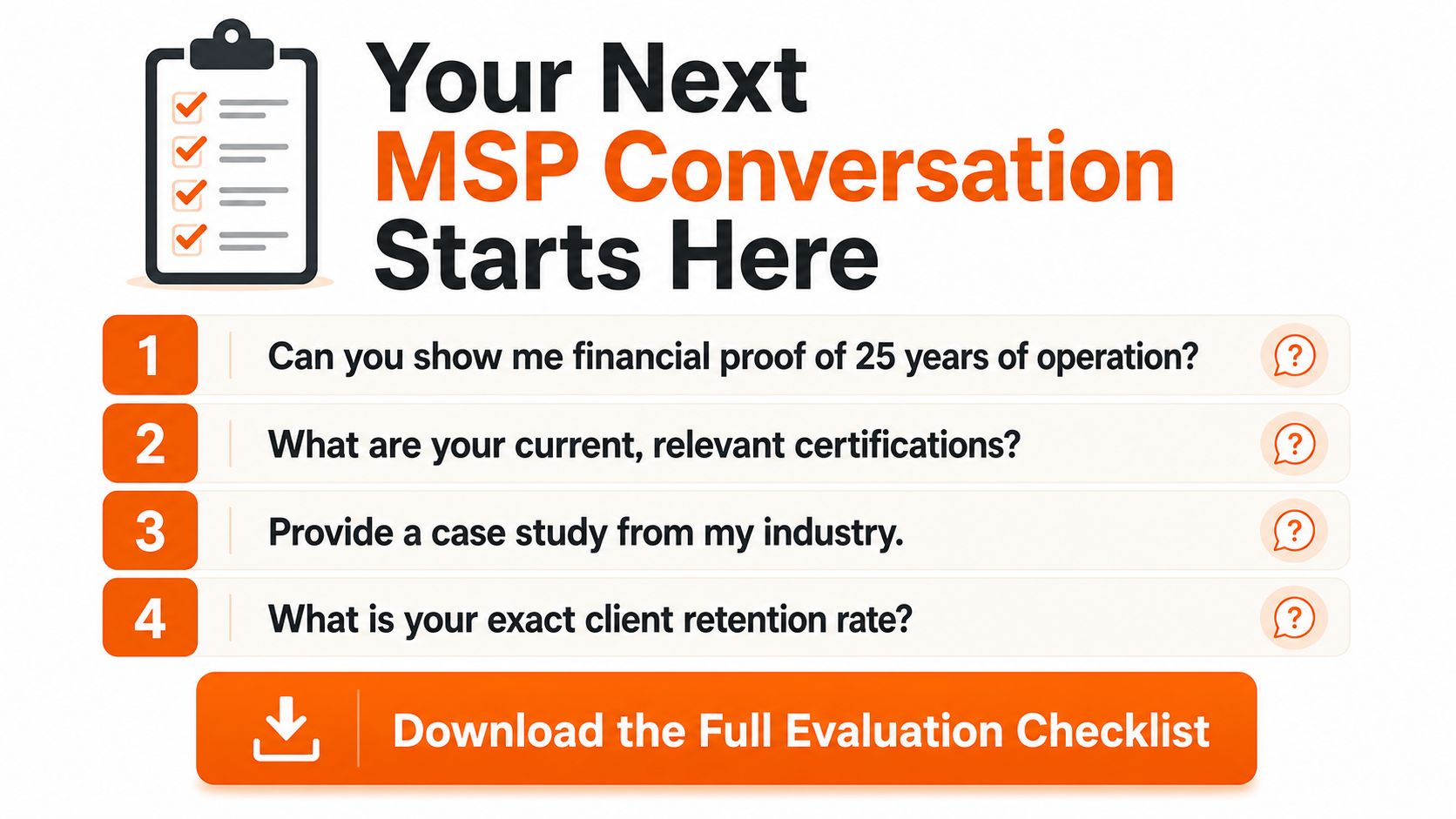
The documents that should arrive before meeting two
Before you go any further, ask for sample SLAs, a recent case study from your sector, proof of current certifications, and a clear account of how support is measured. If the provider cannot supply those without fuss, they're not ready for your business.
Use this checklist in every vendor conversation. If the answers are vague, defensive, or recycled from the website, walk away. Good providers make it easy to verify them because they know their value is in present-day delivery, not in the calendar.
Blowfish Technology works as a managed IT provider for UK SMEs that need support across security, cloud, connectivity, backup, and day-to-day operations. If you want a provider that treats 25 years of experience as a working standard rather than a slogan, visit Blowfish Technology and compare its service model against the questions in this article.

The Blowfish Technology team. Managed IT, cloud services, software development and connectivity for North West businesses since 1999.