
Headline price and star ratings still decide most UK hosting roundups. That ranking misses what a plan costs after the first invoice: renewal charges, restoration work, and the tasks left with the business.
An introductory discount says little about who acts when an enquiry form stops working. For an SME without an internal technical team, the useful question is what the subscription leaves you responsible for.
These web hosting UK reviews score providers on UK-specific criteria: data-centre location, data handling, latency evidence, support commitments, backups and security. Renewal terms and tier limits come before any recommendation, because promotional offers often hide both. The assessments use clear strengths, conditional strengths and unconfirmed details, rather than invented numerical scores or one overall winner that ignores different business needs.
No independent performance testing or incident-response testing is claimed here. Advertised features count as service promises, not proof of delivery. Review comments are useful only when they describe a specific operational experience.
Buying rule: Compare the cost of keeping your website operational, not just the cost of opening an account.
Switching needs its own budget and recovery plan. A hosting move can become a wider platform change affecting the shop's platform, integrations and checkout. The discussion of replatforming risk for established DTC brands is relevant in that case.
Table of Contents
- 1. Website Hosting
- 2. Krystal
- 3. 20i
- 4. Fasthosts
- 5. SiteGround
- 6. IONOS
- 7. Hostinger
- UK Hosting Providers at a Glance
- Shortlisting Your UK Host Next Steps
1. Website Hosting

Best fit: SMEs that want hosting looked after alongside their wider IT. Our Website Hosting service uses UK-based infrastructure and includes daily backups, SSL certificates, uptime monitoring and migration support. We also provide proactive monitoring, security scanning and managed updates.
That combination is relevant to businesses that don't want to coordinate a hosting company, web developer and IT helpdesk themselves. However, the available service description doesn't publish a plan-by-plan price list, resource allowances or website-specific restoration commitments. Its strongest case is managed responsibility, not a demonstrably lowest price.
What the managed approach changes
A hosting account and a maintained website aren't the same purchase. Updates, certificate management, security checks and investigation of availability problems all need an owner, even when the underlying server is running.
Our in-house developers build and look after websites, web applications and bespoke software. Each customer also has an account manager for reviews, renewals and planning, which provides a regular contact beyond individual support tickets.
- UK location: UK-based hosting is a confirmed strength, but location alone doesn't establish every aspect of a customer's compliance obligations.
- Recovery provision: Daily backups are included. Retention, restoration scope and recovery expectations should be recorded in the agreed service specification.
- Commercial transparency: Use our guide to UK website hosting costs to frame the comparison, then obtain a written quotation covering the actual website and support requirement.
- Performance fit: Specialist applications, busy shops and unusual integrations need a technical assessment rather than an assumption that standard hosting will suffice.
For a straightforward publishing site, WordPress blog setup basics can help separate initial configuration work from ongoing hosting responsibilities. For an established business, the migration scope should also cover forms, scheduled tasks, email routing and a rollback route.
Assessment: A credible shortlist choice for organisations seeking managed ownership and UK hosting. Price competitiveness, capacity and website-specific service commitments remain quotation-stage checks.
2. Krystal

Krystal's main attraction is the route beyond basic shared hosting. Its hosting portfolio includes standard web hosting, managed WordPress, business hosting, VPS and managed cloud services, making it worth considering when a business expects its infrastructure requirements to change.
Best fit: UK-focused businesses that want a local provider with several hosting architectures available. Standard web hosting uses cPanel, while the wider range offers alternatives for customers who need something beyond an entry-level account. Those alternatives shouldn't be treated as interchangeable levels of the same managed service.
Compare responsibility before capacity
A VPS gives a customer a different infrastructure arrangement, but that doesn't automatically mean the provider maintains the application, investigates plugin conflicts or administers everything inside the server. Read the management scope before treating an upgrade as a reduction in internal workload.
Krystal advertises PCI-compliant business-hosting options and says its data centres use renewable energy. For a shop, the useful follow-up is which service the compliance statement covers and what remains the merchant's responsibility.
- UK suitability: A UK-focused provider with a broad service range is a useful starting point. Record the location of the selected service, backups and relevant support access.
- Commercial check: Obtain the ongoing charge, billing commitment and upgrade terms for the exact plan, rather than comparing entry-level products with managed services.
- Operational check: Separate infrastructure support from WordPress maintenance, malware recovery and application troubleshooting.
Our explanation of managed IT hosting helps distinguish purchasing hosting capacity from delegating operational responsibility.
Assessment: A sensible growth-oriented shortlist option. The important comparison isn't shared hosting versus VPS, but who manages each layer after the move.
3. 20i
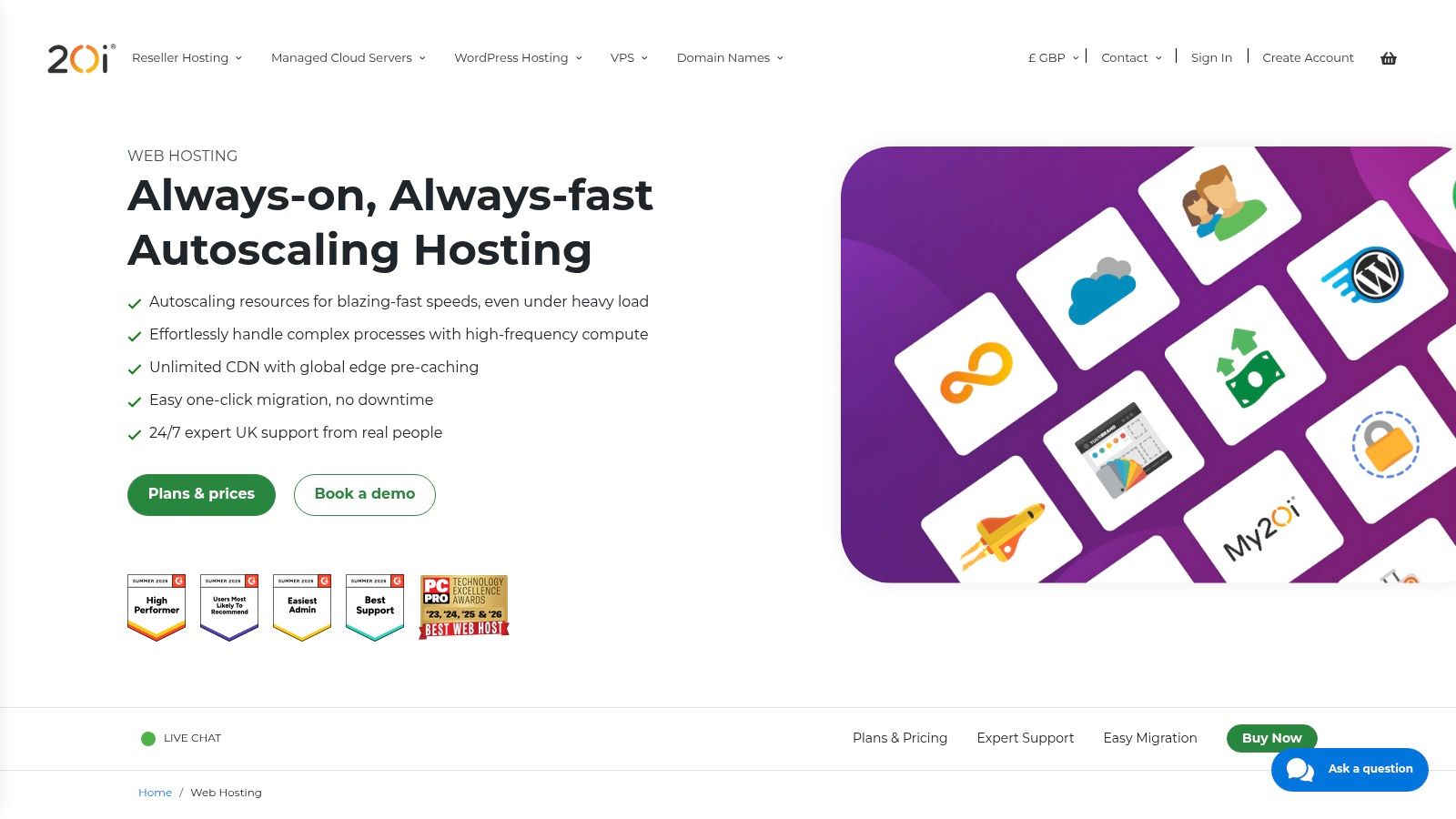
For an agency managing several client websites, migrations and account administration can matter as much as the hosting engine. 20i's web hosting brings together a London data-centre option, migration tooling, a global CDN and a broad set of security and backup features.
Its advertised provisions include SSL, daily backups, malware scanning and web application firewall features. Website, storage, bandwidth, mailbox and database allowances differ between tiers, so a long feature list isn't evidence that the cheapest tier fits the workload.
Best fit: developers, agencies and businesses that value integrated hosting tools. The range may be unnecessary for a simple brochure site, but useful when someone has the technical responsibility to operate multiple sites.
Support availability tells you when you can contact someone. It doesn't tell you when an engineer will restore your website.
The 20i customer review page on Trustpilot includes accounts of helpful technical support and migrations alongside complaints involving downtime, connectivity and prolonged investigations. That mix makes incident handling a more useful evaluation target than a headline rating.
- Support evidence: Look for descriptions of diagnosis, escalation and resolution, not praise for a friendly response.
- Recovery scope: Establish whether a restore includes files, databases and a check that the recovered site works.
- Tier exposure: Map each live site, mailbox and database to its allowance before selecting a package.
For a manufacturer, test the enquiry form and recruitment application process after migration. For an agency, verify who can authorise restores and how client accounts remain separated.
Assessment: Strong advertised tooling and a relevant UK location option. Support escalation, restoration outcomes and tier limits deserve more scrutiny than the breadth of the feature bundle.
4. Fasthosts
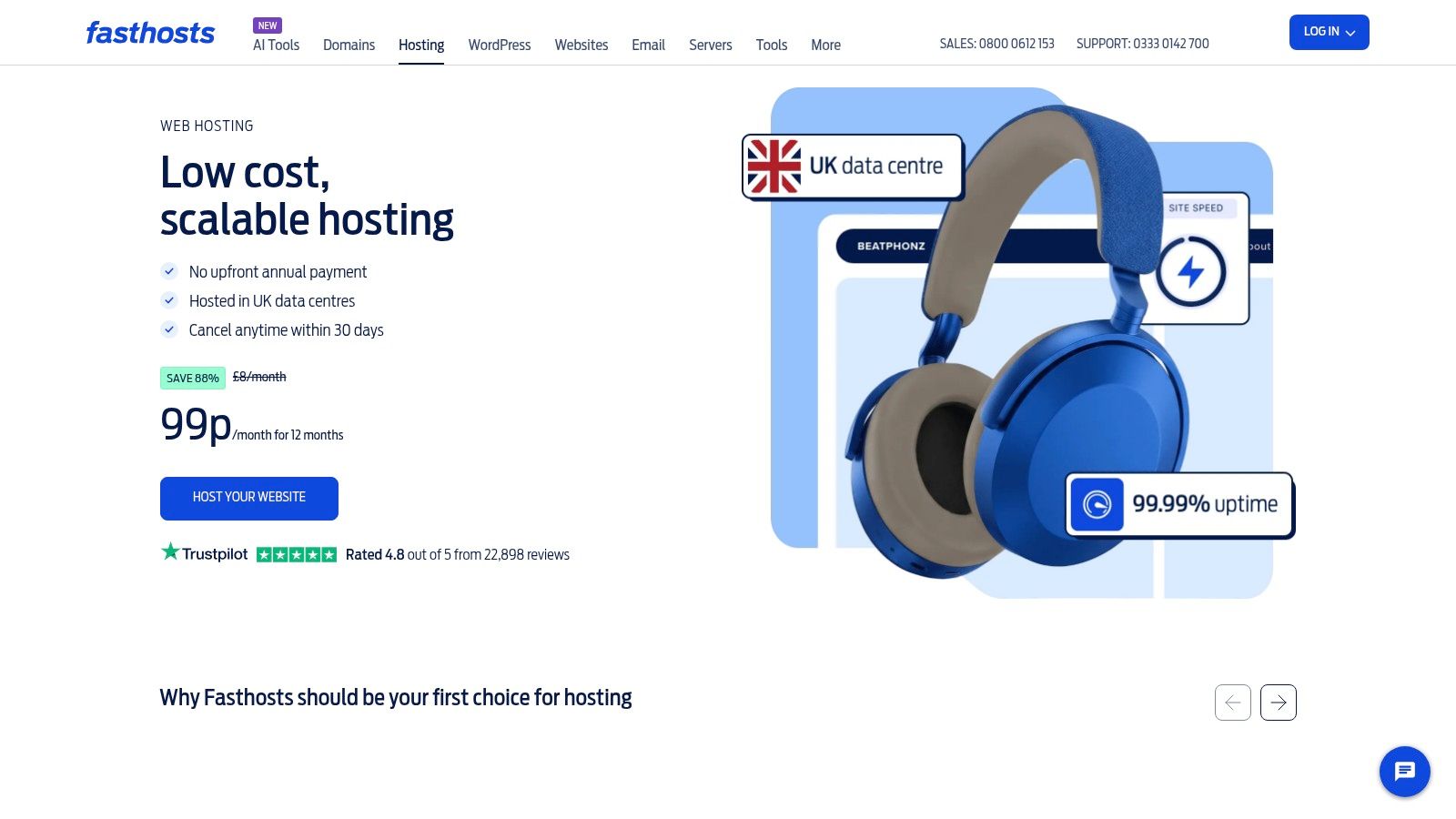
Consolidation is Fasthosts' clearest practical advantage. Its web hosting service sits alongside domains, email, cloud and server products, with UK data-centre operations and phone support available alongside online assistance.
For a small business, keeping services under one account can simplify administration. It can also concentrate responsibility, making account security, renewal ownership and access permissions particularly important.
Best fit: SMEs that want a broad UK provider and are comfortable with self-managed hosting administration. A control panel and app installer help customers operate a site, but they don't establish that application maintenance or hands-on incident recovery is included.
Convenience needs an exit plan
Before consolidating hosting, email and domains, document how each service could be moved independently. Keep the domain registrant details accurate, retain access to DNS records and identify which changes could interrupt email.
Nominet's account of its history explains that it was established in 1996 to operate the UK namespace, underlining why domain administration belongs in a hosting assessment rather than being treated as an incidental extra (Nominet).
- Location and support: UK operations and phone access are useful features, but neither establishes a contractual resolution commitment.
- Renewal exposure: Separate hosting renewal, domain renewal, email charges and optional services in the quotation.
- Resource limits: Check storage, databases and application constraints rather than relying on broad capacity language.
Our guide to the limits behind unlimited UK web hosting explains why capacity claims need translating into the resources a site uses.
Assessment: Convenient for account consolidation and customers who value telephone contact. The buying decision should turn on management scope, recovery arrangements and ongoing charges, not convenience alone.
5. SiteGround
SiteGround is easier to evaluate through its WordPress workflow than through introductory pricing. Its web hosting plans advertise site transfer, SSL, CDN, daily backups and WordPress management tools, with staging and on-demand backups appearing on higher tiers.
Best fit: WordPress businesses that want maintenance tools without commissioning a bespoke server environment. StartUp, GrowBig and GoGeek serve different workflows, so the relevant comparison is the plan that supports how the website is maintained.
A brochure site and a WooCommerce shop may both run WordPress, but their testing requirements differ. Before moving a shop, test checkout, payment callbacks, transactional email and scheduled jobs, rather than accepting a fast cached homepage as proof of readiness.
Buy the workflow you need
Staging is valuable when a developer needs to test changes away from the live site. On-demand backups serve a different purpose from scheduled backups because they let the operator create a recovery point before a planned change.
The WebAnts guide to UK WordPress performance highlights the importance of architecture, caching and test conditions when comparing hosting speed. For a useful assessment, test from UK locations and distinguish cached pages from uncached requests.
- Plan selection: Match staging, collaboration and support features to the people maintaining the website.
- Renewal check: Request the introductory and renewal totals on the same tax basis, with the billing period clearly stated.
- Capacity check: Unmetered traffic shouldn't be interpreted as unlimited processing capacity.
- Location check: Confirm the selected hosting location and the geography of backups and support access.
Assessment: A practical WordPress shortlist option where deployment and maintenance tools matter. Its value depends on the ongoing cost of the required tier, not the promotional price of the smallest plan.
6. IONOS
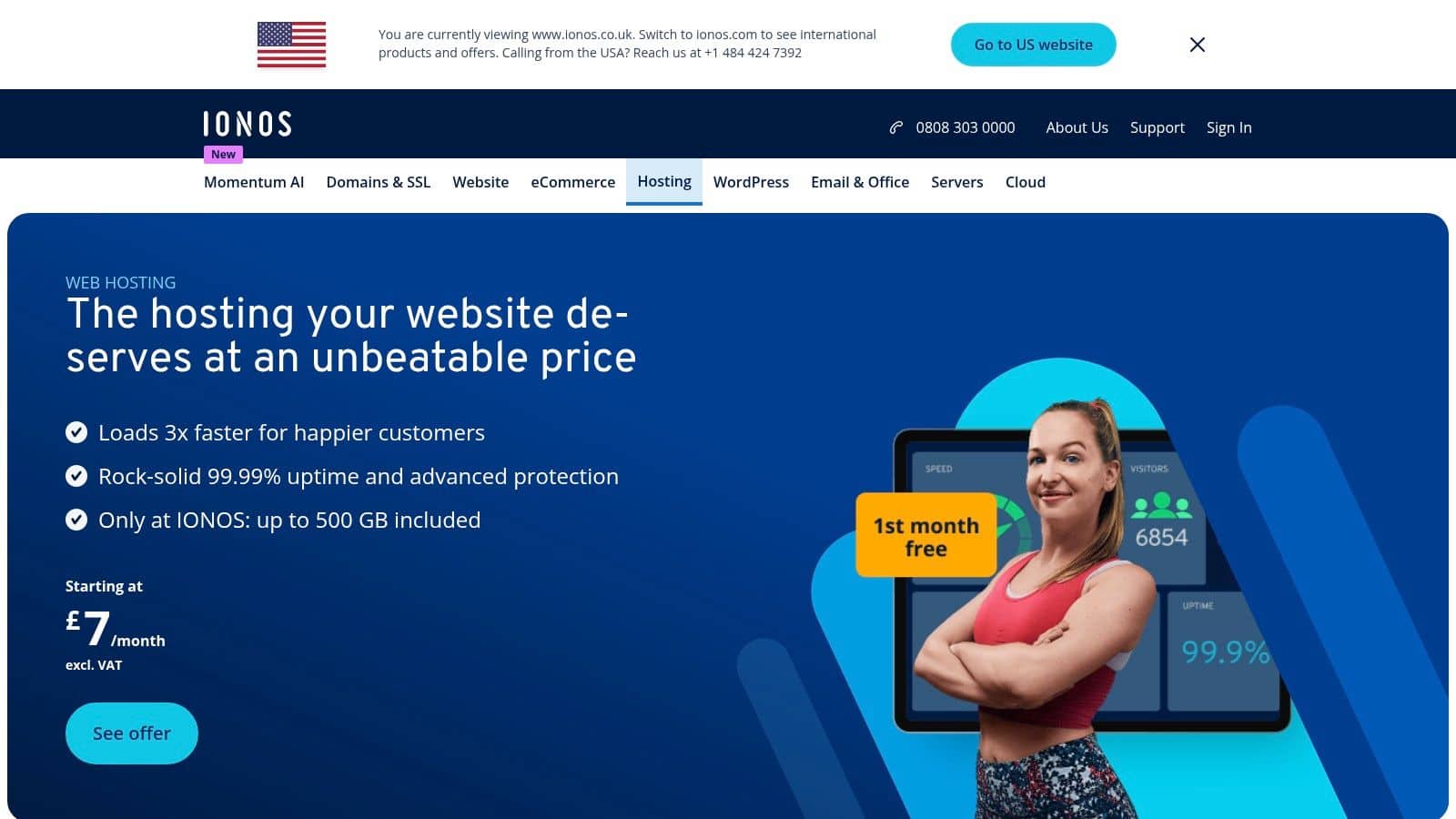
A UK-priced checkout isn't evidence of a wholly UK-based data flow. That distinction matters when assessing IONOS web hosting, whose shared-hosting range offers different capacity tiers alongside advertised NVMe storage, SSL, backup and malware-scanning provisions.
Best fit: businesses prepared to compare defined capacity tiers and administer a mainstream hosting account. The range provides options for different projects, but each inclusion needs reading at plan level.
For legal and financial practices, the location question extends beyond the live web server. Contact-form submissions, support attachments, logs and backup copies can all require separate consideration.
Compliance priority: Map where personal data is stored and who can access it before treating a UK hosting label as a compliance assurance.
The ContractorUK guide to website hosting location explains that UK law doesn't require a website to be hosted in Britain, while transfers of personal data to separate organisations abroad can require an appropriate transfer basis. Server geography therefore can't substitute for reviewing processors, contracts and access arrangements.
Our guide to data sovereignty and data security in the UK separates these considerations for businesses planning their hosting arrangements.
- Data handling: Obtain a service-specific description of hosting, backups, subprocessors and support access.
- Recovery: Clarify retention, restoration procedure and any charge for provider-assisted recovery.
- Commercial scope: Compare the continuing tier price with the security and support services included.
Assessment: A reasonable capacity-led comparison candidate. For confidentiality-sensitive work, data-flow transparency and written recovery commitments should carry more weight than a bundled domain or introductory promotion.
7. Hostinger

A business building its first website may prefer fewer purchasing decisions. Hostinger combines web hosting, managed WordPress, WooCommerce hosting, domains and a website builder, alongside migration tools and multilingual support.
Best fit: budget-conscious personal sites and straightforward small-business projects whose owners can manage routine administration. Its breadth is convenient, but a global product range shouldn't be confused with a local, engineer-led support relationship.
Subscription length is central to the comparison. Record the full upfront payment, the renewal basis and the cost of any services needed to reproduce the advertised package after its initial term.
Separate easy setup from ongoing operation
WordPress installation is only the beginning. Someone still needs to manage administrator accounts, assess plugin changes, verify forms and decide what happens when an update breaks the site.
The same distinction applies to migration. Moving files successfully doesn't establish that checkout, email delivery, redirects and scheduled tasks work correctly in the new environment.
- UK suitability: Confirm the actual data-centre selection for the purchased service rather than assuming a UK-facing website guarantees UK hosting.
- Security ownership: Identify which updates and security tasks the service performs and which remain with the customer.
- Support expectations: Establish the escalation route for business-critical incidents and whether the available channels suit your team.
- Budget control: Compare the required plan at renewal, including backup and recovery provisions, rather than selecting by the smallest advertised monthly equivalent.
For a low-risk publishing site, accepting more administrative responsibility may be a reasonable saving. For a customer portal or revenue-dependent shop, that responsibility needs an explicit owner.
Assessment: An accessible all-in-one candidate for simpler projects. It becomes less compelling when the requirement is dedicated resources, bespoke infrastructure management or a clearly defined local support relationship.
UK Hosting Providers at a Glance
A low first invoice is a poor way to rank a UK host. Renewal timing, whether the data centre is in the UK, and how much operation the plan includes change both cost and risk more than a star rating does.
| Provider | Data-centre position | Commercial shape | Best for |
|---|---|---|---|
| Website Hosting | UK | Managed UK hosting covering proactive monitoring, security scanning and updates, not a bare shared account | Businesses that want the host to run security and updates |
| Krystal | UK | Web hosting that can extend past shared plans; the entry rate depends on the package chosen | UK businesses that may outgrow shared hosting |
| 20i | London option | Feature-heavy hosting; the quoted Startup rate applies after the opening month | Businesses, developers and agencies |
| Fasthosts | UK | Price moves with the plan and the current promotion | Buyers who want hosting, domains and email from one provider |
| SiteGround | UK site not fixed in this comparison | StartUp is sold on an introductory term, so the renewal rate is the figure that matters | Small-business sites that want managed WordPress tools and migration help |
| IONOS | UK site not fixed in this comparison | A short introductory period, then a higher ongoing rate across capacity tiers | Projects comparing published capacity tiers |
| Hostinger | Multiple regions, not one UK site | Price changes with the plan and the length of the subscription | Budget builds for a small site or a first business site |
On that reading, the plans with the sharpest opening discounts are also the ones whose UK location or included upkeep is least clear. A UK facility plus managed monitoring is a different product from a cheap multi-region account, even when the first month looks similar.
Shortlisting Your UK Host Next Steps
A low headline price and a high star rating do not show what a failed form, a broken checkout or a down client portal costs. A personal blog, a manufacturer's enquiry site and a law firm's client service fail in different ways, so they should not share one score.
For a budget personal site, set Hostinger and other entry-level plans against the full billing term, including renewals, and against the administration you will handle yourself. For a UK SME that wants a local operator, place Blowfish Technology's managed hosting beside Krystal and Fasthosts. Score who owns monitoring, security scanning and updates. A UK address on its own is not that score.
WordPress and shop sites can weigh SiteGround and 20i on the workflow and migration tools those providers advertise, and Krystal where extra infrastructure routes matter. Regulated businesses should rank documented data handling, processor terms, recovery arrangements and written service commitments above whichever plan is easiest to order.
Turn the shortlist into a written specification
Put the same requirements in front of every supplier. Otherwise a low-cost self-managed account can look equivalent to a service that includes ongoing maintenance and operational support.
- List must-have criteria: Include hosting location, application support, security responsibilities, backup scope and named escalation routes.
- Compare total three-year cost: Include renewals, VAT treatment, domains, email, paid security features, migrations and restoration charges.
- Confirm recovery in writing: Record backup frequency, retention, restore procedure and any stated time for returning the website to service.
- Confirm support hours and commitments: Separate helpdesk access from guaranteed response, engineering escalation and resolution targets.
- Test before switching: Check forms, checkout, redirects, email routing and rollback before changing live DNS.
Do not award points for an unanswered question. A provider may still offer a suitable service without publishing every detail. Leave that gap open until the contract or a written specification closes it.
A free, no-obligation consultation can review your current setup and say whether Blowfish is the right fit. Book a free 30-minute call with Matt or Graham and bring renewal figures, website requirements and current support concerns so the discussion stays on a practical hosting decision.
Our UK-based website hosting includes proactive monitoring, security scanning and managed updates, and we can help you review whether your current hosting gives your business the support, security and recovery arrangements it needs. Visit Blowfish Technology to arrange that consultation.
