
You're probably already feeling this.
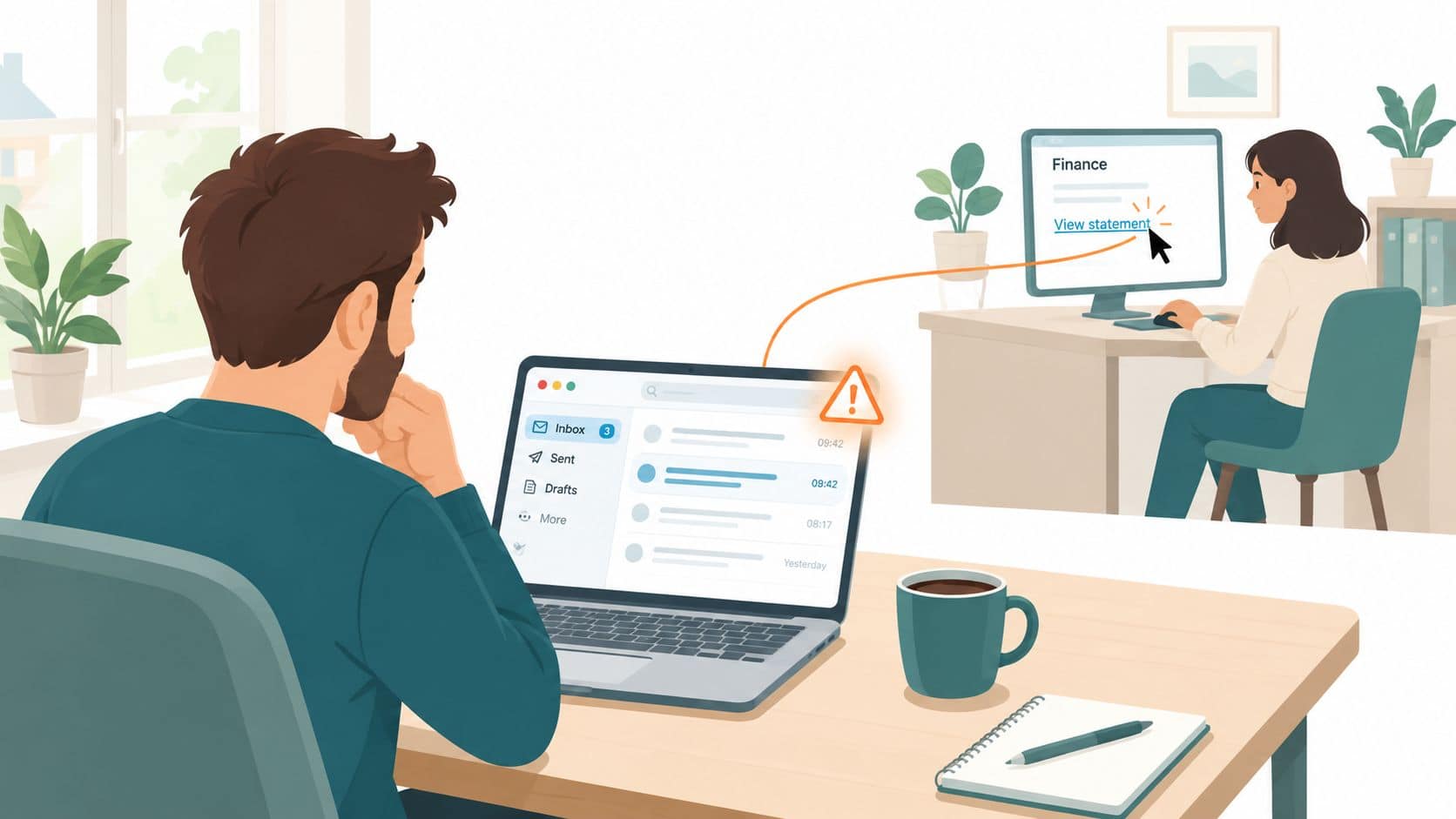
It's Monday morning. Finance has a supplier invoice open. The sender name looks right, the branding looks right, and the payment request fits the job that's already in motion. Then somebody spots a tiny change in the email address, or a link that doesn't go where it should, or a bank detail amendment that nobody expected. Suddenly the question isn't whether your anti-virus is up to date. The question is who's watching, who decides what happens next, and whether your business can prove its controls worked.
That's where most advice on cyber security management services falls apart. It gives you a shopping list. It doesn't tell you who owns the risk when a real incident lands.
Table of Contents
- The Monday Morning That Changes How You Think About Security
- What Cyber Security Management Services Actually Are
- Core Components an SME Should Expect Inside the Package
- UK Compliance Pathways and What Each One Demands
- The Accountability Question Most Buyer Guides Skip
- Treating Your Security Provider as a Critical Supplier
- Two North West Scenarios That Bring the Service to Life
- Choosing a Provider and How Blowfish Technology Fits
The Monday Morning That Changes How You Think About Security
For a lot of UK SMEs, security stops being abstract after one near miss.
A finance assistant gets an email that appears to come from a supplier. A project manager is chasing delivery dates. The owner is in a meeting. Someone clicks, someone hesitates, someone phones IT, and the whole business pauses while people try to work out whether it's a nuisance or the start of a serious incident.
That scenario isn't rare. The UK government's Cyber Security Breaches Survey 2025 technical report found that 43% of UK businesses experienced a cyber security breach or attack in the previous 12 months, and 3% of businesses reported a ransomware breach or attack. The survey used a sampling frame of 46,446 businesses, so this isn't a niche problem affecting only large enterprises.
What changes after a near miss
Owners usually make the same realisation at this point. Security can't sit in a folder called “IT stuff” until renewal season.
You need an operating model that answers basic questions fast:
- Who sees the alert first when a mailbox rule appears, a login looks suspicious, or a device starts behaving badly?
- Who has authority to act if a laptop needs isolating or an account needs locking?
- Who checks your backups restore instead of assuming they will?
- Who tells your leadership team what happened in plain English, without burying the problem in technical noise?
Buying tools without clear ownership gives you dashboards, not protection.
What a sensible SME should expect
Good cyber security management services exist to deal with the next call before it turns into downtime, fraud, or a regulatory headache. That means continuous monitoring, practical containment, identity protection, tested recovery, and users who've had enough training to stop the obvious traps.
It also means something many providers gloss over. Outsourcing security tooling doesn't outsource accountability. If your provider can't tell you, in writing, who does what when things go wrong, you haven't bought a managed service. You've bought hope.
What Cyber Security Management Services Actually Are
Most providers overcomplicate this. The plain-English version is simpler.
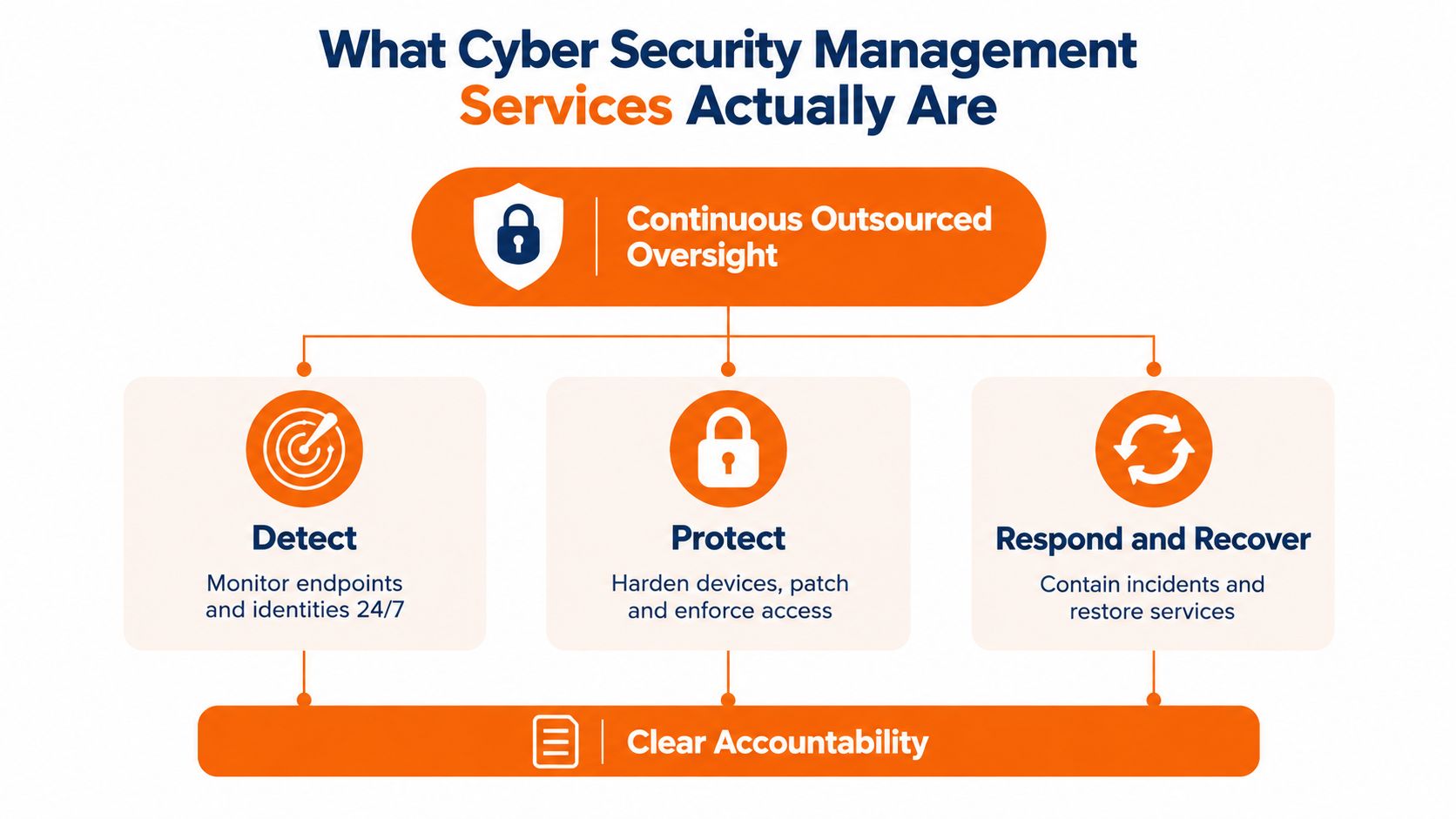
Cyber security management services are the continuous, accountable outsourcing of how your business is protected, monitored, and supported before, during, and after cyber incidents. Not just software licences. Not a one-off audit. Not break-fix support with a security badge on it.
The five things you are actually buying
A proper service should cover five building blocks.
Monitor
Somebody is watching endpoints, identities, email activity, and other key systems for signs that something's off.Protect
Devices are hardened, patching is managed, access is restricted, and weak habits are pushed out of daily operations.Detect
Suspicious behaviour is investigated. Good providers don't just forward noise from a tool and leave your team to guess what matters.Respond
There's a runbook for containment, escalation, communication, and decision-making when an incident is confirmed.Recover
Backups are managed, restore tests happen, and the business knows how it gets back to work.
What it is not
A lot of SMEs get sold the wrong thing because the language sounds reassuring.
| Model | What it really means | The problem |
|---|---|---|
| Licence resale | You pay for security tools through a provider | Tools may exist with little active management |
| Break-fix support | Help arrives when you report an issue | That's too late for many attacks |
| Managed service | Ongoing monitoring, action, reporting, and accountability | This is the one worth paying for |
Practical rule: If nobody can explain who's responsible at 02:00 on a Saturday, it isn't managed.
The evidence matters more than the bundle
A useful monthly service report should show whether controls worked. That means alert handling, patch status, MFA coverage, backup checks, restore evidence, incident records, and actions still open.
If you're comparing providers in procurement or public-sector style buying, it's also worth seeing how requirements are framed in live opportunities. A quick way to sharpen your checklist is to browse security services tenders and look at how buyers describe service outcomes rather than just product names.
A non-technical director should be able to say this in one sentence: we pay a provider to help prevent incidents, spot them quickly, act when they happen, and prove the controls are working. If your current supplier can't support that sentence, your contract is too vague.
Core Components an SME Should Expect Inside the Package
I hold firm opinions here. Some items are optional sequencing decisions. Others are essential.
If your business uses Microsoft 365, holds client data, or relies on staff logging in from multiple devices, you need a layered service. Not a single shiny tool.
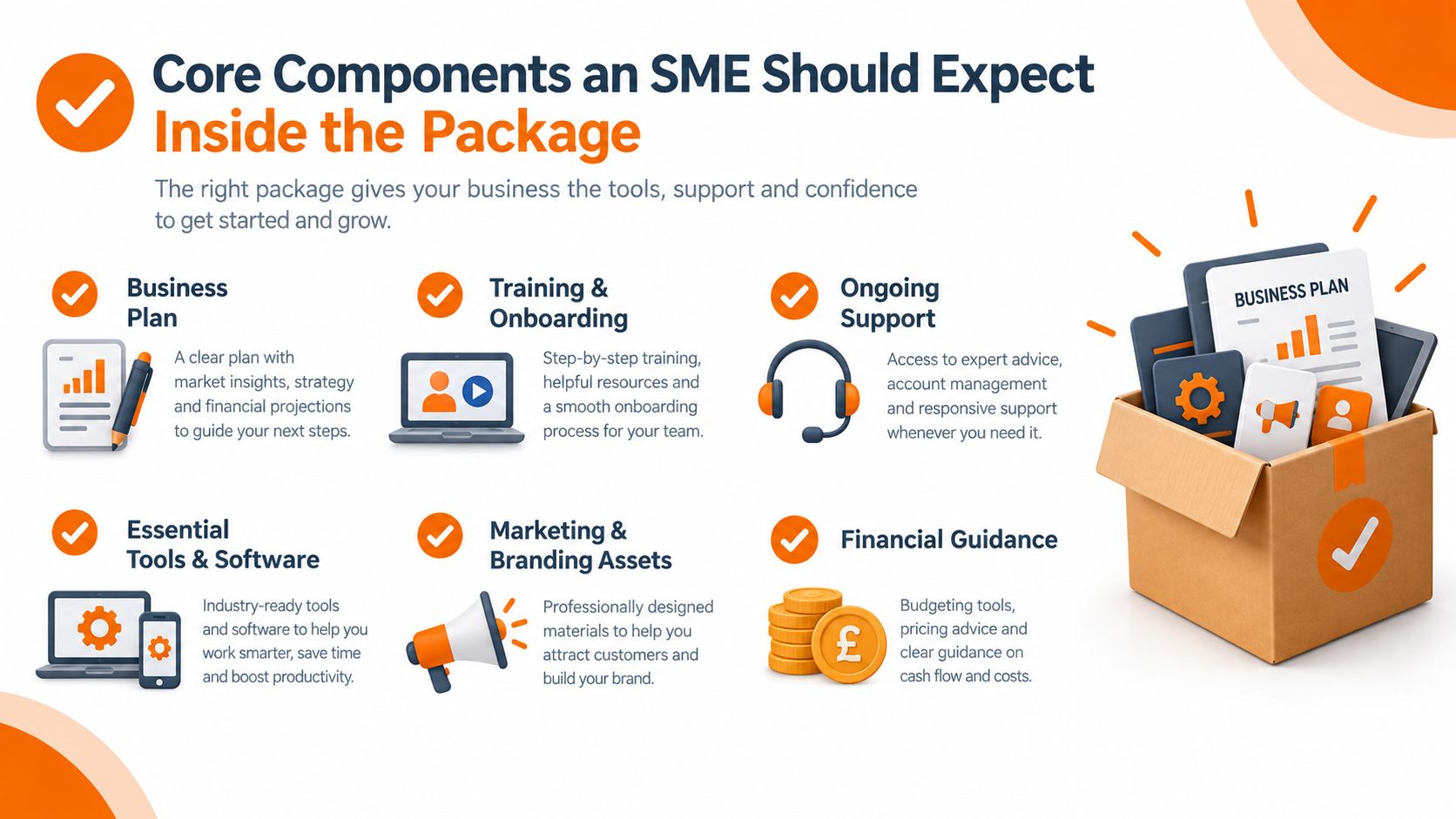
The non-negotiables
Start here. If a proposal misses any of these, push back.
Managed EDR
Endpoint Detection and Response should watch business devices for suspicious behaviour and support containment when needed. If you want a plain-English explanation of where EDR fits, this guide on what endpoint detection and response is is a useful baseline.Identity protection
Most SMEs now have more risk in identities than on-prem servers. You need control over sign-ins, admin roles, MFA enforcement, and suspicious access patterns. If attackers take the account, they often take the business process that sits behind it.Microsoft 365 backup with restore testing
Backup that hasn't been tested is paperwork. Mailboxes, OneDrive, SharePoint, and Teams data need proper recovery planning.User awareness training
Staff don't need lectures. They need short, repeated, relevant training and realistic phishing simulations.
The controls that should sit alongside them
These are often sold as add-ons. In practice, they're part of doing the job properly.
Access and filtering
DNS and web filtering help stop users reaching known bad destinations. Password management reduces the mess of reused credentials and shared spreadsheets full of logins. App-based or phishing-resistant MFA is the right direction for any SME that handles sensitive information.
Managed patching
Unpatched devices and applications create easy opportunities for attackers. Patching needs ownership, scheduling, exception handling, and reporting. “We push updates” is not the same as managed patching.
Incident runbooks
When a user reports a weird login prompt or finance spots a suspicious supplier request, the provider should already know the escalation path, decision-makers, and containment options.
If a quote proudly lists EDR but says nothing about backup restore testing, it's incomplete.
What can be staged later
Not everything has to land in one month.
A smaller business might phase in advanced identity controls, stricter privileged access separation, or wider supplier assurance once the fundamentals are settled. That's fine. What isn't fine is treating the basics as optional while spending money on tools no one actively manages.
One practical example of a provider that bundles the right sort of building blocks includes managed EDR, ITDR, DNS filtering, MFA support, password management, and user awareness training. That combination is a better sign than a long list of loosely related products.
UK Compliance Pathways and What Each One Demands
A lot of SMEs first look seriously at cyber security management services because a customer, insurer, or procurement team forces the conversation.
That's not a bad thing. Compliance can be a useful discipline, but only if you treat it as evidence of operational control, not a badge to wave around.
The four routes most SMEs actually deal with
For a grounded overview of wider obligations, this guide on what SMEs must know about compliance is a decent companion read. For UK businesses, the practical conversation usually comes down to Cyber Essentials, Cyber Essentials Plus, ISO 27001, and UK GDPR accountability. If you need a straightforward explanation of the entry point, this page on what Cyber Essentials certification involves is worth reading before you speak to any provider.
| Scheme | Best Fit | Evidence Required from MSP | Typical Cycle |
|---|---|---|---|
| Cyber Essentials | SMEs that need a recognised baseline for clients, tenders, or insurer conversations | Secure configuration evidence, access control support, patching discipline, MFA-related support where applicable, documented scope | Annual certification cycle |
| Cyber Essentials Plus | SMEs that need independent technical verification, often in regulated or procurement-heavy environments | Same controls as above, but with stronger proof that configurations are in place and working in practice | Annual certification cycle with hands-on validation |
| ISO 27001 | Firms with formal governance requirements, larger supplier due diligence demands, or broader risk-management maturity | Policy support, control evidence, asset and access records, incident and backup evidence, documented review process | Ongoing management system with regular review and audit activity |
| UK GDPR accountability | Any organisation handling personal data | Evidence of access control, supplier oversight, incident handling, backup governance, and demonstrable accountability | Continuous obligation |
What matters more than the logo
Cyber Essentials is usually the right start for SMEs that need a clean baseline quickly. Cyber Essentials Plus matters when a client or sector expects stronger proof. ISO 27001 suits businesses prepared to run a formal management system rather than a checklist exercise. UK GDPR sits across all of it because personal data handling doesn't disappear just because you passed a certification.
What your MSP should provide is not “help with compliance”. That phrase is useless. They should provide configuration evidence, reports, named responsibilities, and records you can put in front of an assessor or client questionnaire without scrambling.
The mistake to avoid
Don't buy a compliance project from one supplier and an operational security service from another unless they work tightly together. If the people producing your evidence aren't the people managing your controls, gaps appear fast.
The Accountability Question Most Buyer Guides Skip
This is the part that matters most, and it's where too many SME buyers stay vague because the sales call felt comfortable.
You can outsource operations. You cannot outsource responsibility for your business. If an incident hits, your directors, partners, or owners still carry the consequences.
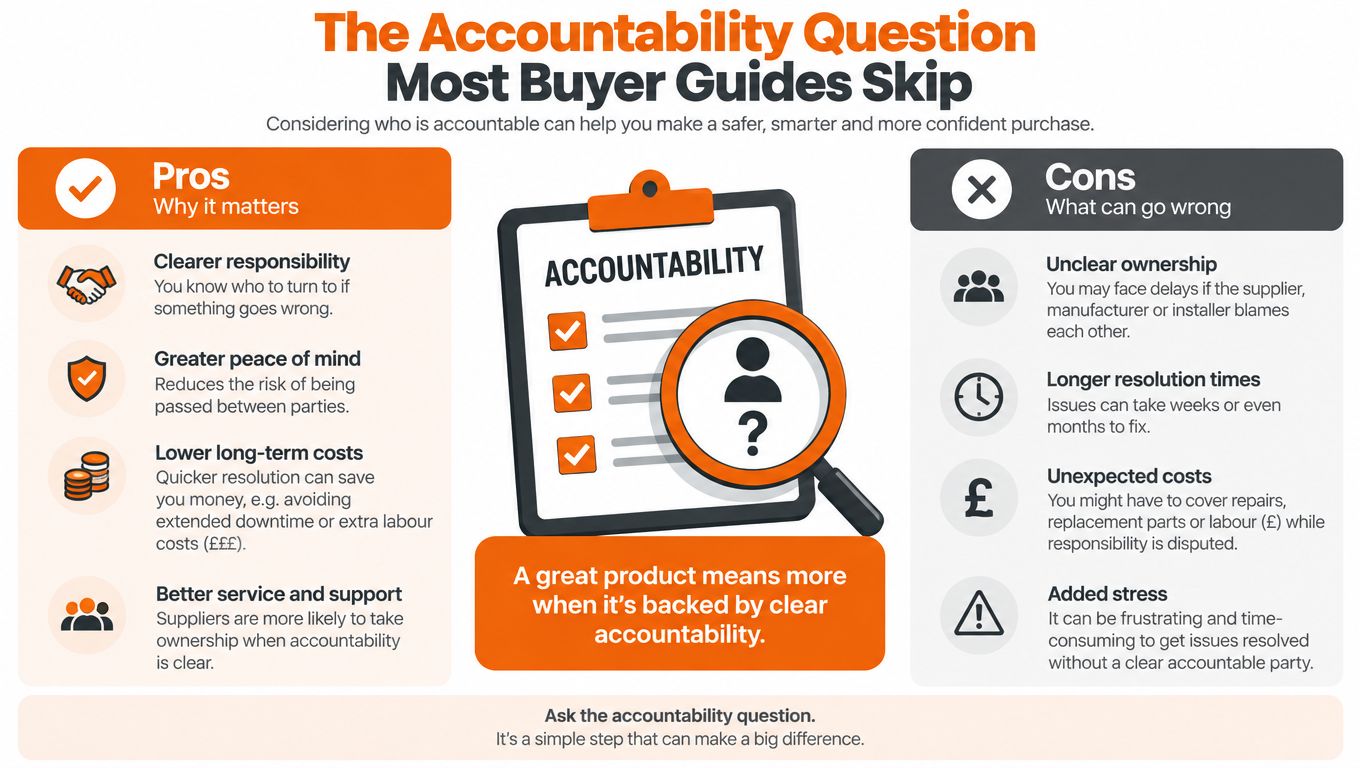
Put these questions in writing
Ask every provider these before signing anything.
After-hours monitoring
Who watches alerts outside office hours, and what happens when a serious alert lands?Containment authority
Can the provider isolate a device or disable an account immediately, or do they need permission every time?Backup ownership
Who owns Microsoft 365 backup policy, retention checks, restore testing, and restore approval?Incident notification
How quickly must the provider notify you of a confirmed incident, and by what route?Evidence
What logs, reports, screenshots, tickets, or test records prove the controls were in place and functioning?Exit
What happens to tooling, documentation, accounts, backup access, and administrative permissions at contract end?
A simple responsibility matrix
You don't need a massive governance pack. You do need a basic RACI-style view.
| Activity | SME | Provider |
|---|---|---|
| Approve security policy | Accountable | Consulted |
| Monitor alerts | Informed | Responsible |
| Investigate suspicious activity | Informed | Responsible |
| Approve business-critical shutdown decisions | Accountable | Consulted |
| Run backup restore tests | Accountable for review | Responsible for execution if contracted |
| Maintain named escalation contacts | Responsible | Responsible |
| Manage offboarding and transition | Accountable | Responsible for handover tasks |
Later, when you formalise your incident response planning, this matrix becomes even more important because it removes hesitation under pressure.
Here's a useful explainer on why these questions matter in practice.
A provider that won't commit to measurable response and reporting obligations is telling you something. Listen.
The outcomes worth measuring
Don't obsess over tool counts. Measure service behaviour.
Ask for:
- Defined alert triage expectations
- Named escalation paths
- Restore-test frequency
- Unresolved alert thresholds
- Evidence packs for Cyber Essentials or audits
- Clear contract language on authority and exceptions
That's what separates a real managed service from a pile of subscriptions with a helpdesk wrapper.
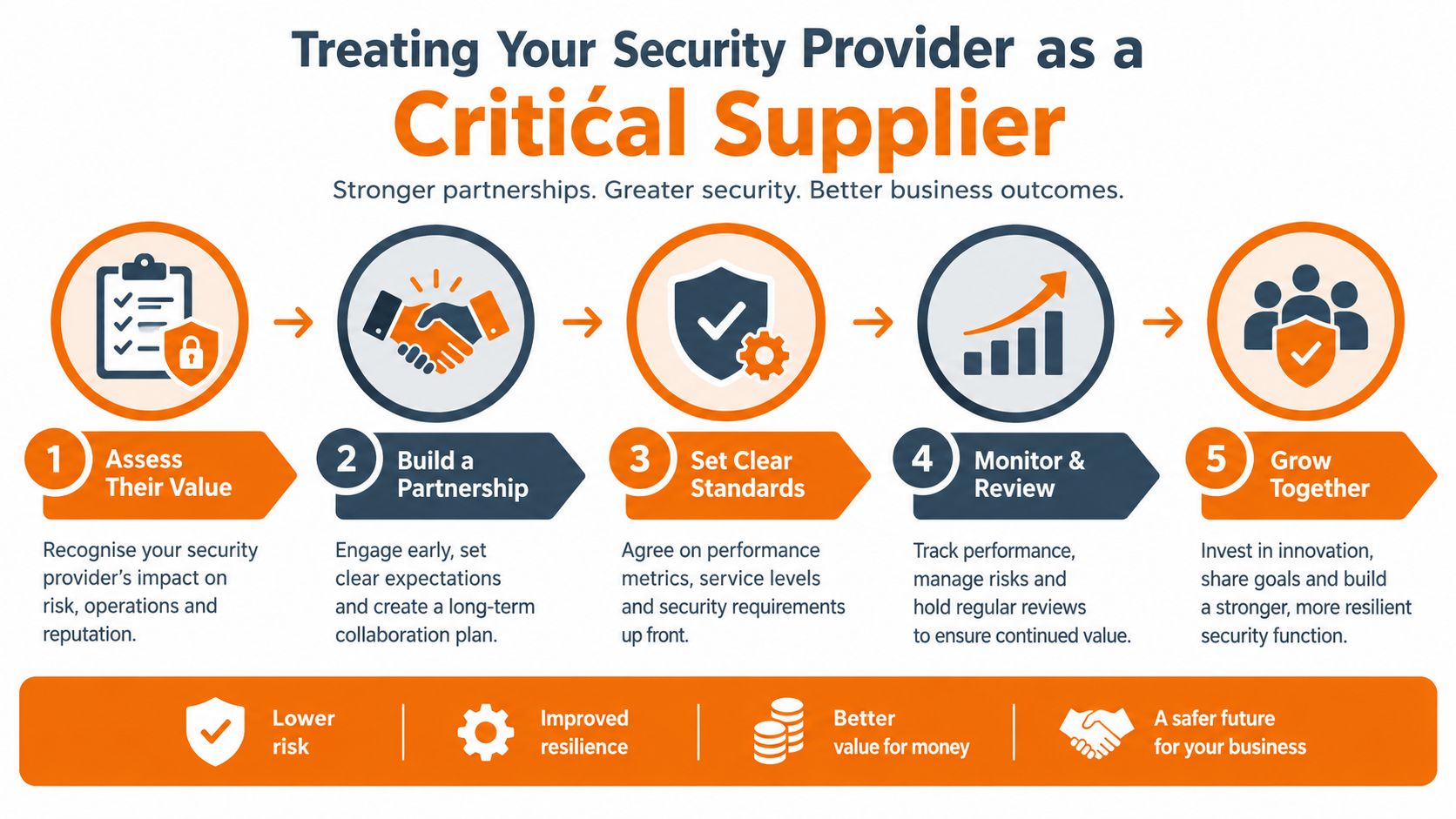
Treating Your Security Provider as a Critical Supplier
Most buyer guides focus on what the provider does to your systems. They don't spend enough time on the risk created by the provider itself.
That's a mistake. Your security provider can have privileged access, remote tooling, backup visibility, and influence over identity controls. In plain terms, they become part of your attack surface.
Why supplier scrutiny matters
Government-commissioned research on the economic impact of cyber attacks estimated the average cost of a significant cyber attack on a UK business at almost £195,000, with sector averages of about £330,000 in manufacturing and £309,000 in financial services according to the UK government's summary of research on the economic impact of cyber attacks. If your provider sits close to production systems, client data, or finance workflows, supplier assurance isn't bureaucracy. It's risk control.
What to demand from the provider
Treat them like you would any critical outsourced function.
Separate administrative accounts
Their engineers shouldn't use shared high-privilege identities across client environments.Strong MFA and controlled access
Push for phishing-resistant MFA where feasible, and ask how privileged access is restricted and approved.Logging outside their sole control
You need confidence that key activity records can still be reviewed if the relationship sours or the provider has its own incident.Backup isolation
Ask whether backups are immutable, offline, logically isolated, or otherwise protected from the same compromise path.Incident-notification deadlines
Put a contractual timer on when they must tell you about provider-side or customer-side incidents affecting your environment.Subcontractor disclosure
If third parties touch your systems, you should know who they are and what access they have.
The procurement script to use
Ask these questions directly in the next meeting:
Show me how your engineers access our environment, how that access is approved, and how it is removed.
Show me evidence that our backups can be restored and explain who owns testing.
Show me your transition process if we leave, including handover of documentation, access records, and recovery data.
How this maps to UK expectations
UK GDPR accountability expects organisations to stay in control of processors and suppliers. Regulated sectors expect resilience, not vague assurances. Your contract should reflect that reality through access controls, reporting obligations, incident notification, and exit provisions.
Managed services are still the right move for many SMEs. The point isn't to avoid providers. The point is to stop treating them like low-risk utilities.
Two North West Scenarios That Bring the Service to Life
Abstract service lists are forgettable. Real situations aren't.
An engineering firm with a payment problem
A North West engineering business with a busy accounts team receives what looks like a routine supplier request on the same morning a major client payment is due. The message isn't sloppy. It references a live job, uses familiar names, and pushes for urgency because “accounts are being updated”.
A decent managed service catches this in layers. User awareness training makes the finance user pause. Identity controls reduce the chance that a compromised mailbox is used to continue the conversation. Managed detection gives IT somewhere to escalate the message immediately. The provider reviews the account activity, confirms whether any suspicious sign-ins or mailbox changes exist, and helps the business lock the process down before money moves.
The key point isn't that one tool saved the day. The point is that the provider, the user, and the process all had clear roles.
A legal practice preparing for Cyber Essentials Plus
Now take a multi-partner legal firm getting ready for Cyber Essentials Plus. On paper, they already “have backups”. In reality, nobody has recently tested whether Microsoft 365 mailboxes, files, and collaboration data can be restored in a way the practice could live with after ransomware.
That gap matters. The provider runs a proper review, finds the weakness, and fixes the operating model. Backup scope is clarified. Restore testing is scheduled. Admin access is tightened. Evidence is documented so the practice isn't relying on verbal reassurance during assessment.
Security maturity shows up in the records. If a provider says a control exists, they should be able to prove it.
Both examples use the same foundations: identity control, managed detection, backup governance, escalation discipline, and evidence. The difference is how those pieces support the business outcome. In engineering, it's stopping fraud and disruption. In legal, it's resilience and assessable control.
Choosing a Provider and How Blowfish Technology Fits
By this point, the shortlist should be clearer. You're not choosing the prettiest stack. You're choosing the provider with the clearest operating model.
The selection checklist that actually matters
Use this when comparing providers.
Ask who does what
Don't accept generic phrases like “fully managed”. Ask for written responsibility split, after-hours handling, and escalation routes.Inspect backup reality
Ask who owns Microsoft 365 backup, how restores are tested, and what evidence you'll see.Check identity depth
If the provider talks endlessly about endpoints but lightly about identities, they're behind the risk.Demand compliance evidence
If you need Cyber Essentials, Cyber Essentials Plus, or stronger governance, ask what artefacts they provide for assessment and audit.Review supplier controls
Ask about privileged access, subcontractors, notification obligations, and exit planning.
Where Blowfish Technology is a practical fit
For SMEs in the North West that need a joined-up service rather than isolated products, Blowfish Technology maps well to the requirements above. Its stack covers managed EDR, ITDR, DNS filtering, password management, two-factor authentication, user awareness training, Microsoft 365 support, managed backup and disaster recovery, and Cyber Essentials support, alongside broader IT and connectivity services. If you want a more local example of how that approach is positioned, this page explains how Blowfish Technology protects local businesses from cybercrime.
The operational details matter too. Transparent pricing, engineer-led support, and measurable service levels are much more useful than vague claims about “peace of mind”. If you're comparing providers this quarter, ask every bidder for the same evidence and see who answers cleanly.
The recommendation
Start with an accountability review, not a product demo. Get the responsibility split, backup ownership, incident authority, compliance evidence, and supplier-risk controls on paper. Then decide whether the technical stack matches the promises.
That order saves time and avoids expensive misunderstandings later.
If your current setup feels like a pile of licences with nobody clearly accountable, it's time to fix it. Blowfish Technology helps SMEs put proper cyber security management services in place, including managed detection, Microsoft 365 protection, backup oversight, Cyber Essentials support, and the operational clarity most contracts miss. Visit Blowfish Technology and ask for a security accountability review or Cyber Essentials readiness check this quarter.
