
A multi-site UK business can have offices, warehouses, remote staff and cloud applications all competing for reliable access, while security obligations and connectivity costs continue to grow. A legal practice may need consistent access to case management systems. A manufacturer may depend on cloud production tools and live operational data. An engineering firm may transfer large design files from sites where broadband quality varies considerably.
That's where the SD-WAN benefits become a business decision rather than a feature checklist. SD-WAN can combine broadband, fibre, mobile connectivity and, where necessary, legacy private circuits with intelligent routing, central control and application-aware policies. The value appears when those capabilities improve costs, resilience, user experience and operational control together. It also helps to understand how the approach relates to broader software defined networking concepts.
The strongest SD-WAN business case comes from measurable improvement across connectivity, resilience and operational effort, not from buying another network appliance.
The roundup below treats each benefit as a practical decision. You'll find implementation checks, realistic trade-offs and examples for UK SMEs and regulated organisations. Some businesses can self-manage SD-WAN successfully. Others will get more value from a managed service that includes monitoring, carrier coordination, security integration and documented service levels. Blowfish Technology is one relevant managed-service option for organisations that want connectivity to sit alongside broader IT and security support.
Table of Contents
- 1. Reduced WAN Costs Through Intelligent Traffic Management
- 2. Enhanced Application Performance and User Experience
- 3. Seamless Cloud Connectivity and Hybrid Networking
- 4. Improved Network Security and Threat Prevention
- 5. Business Continuity and Disaster Recovery Resilience
- 6. Centralised Management and Simplified Operations
- 7. Scalability for Multi-Site and Distributed Operations
- 8. Bandwidth Optimisation and Network Efficiency
- 9. Compliance and Regulatory Support for Data Protection
- 10. Remote Work and Mobile Workforce Support
- Top 10 SD-WAN Benefits Comparison
- Turn SD-WAN Benefits Into a Managed Connectivity Plan
1. Reduced WAN Costs Through Intelligent Traffic Management
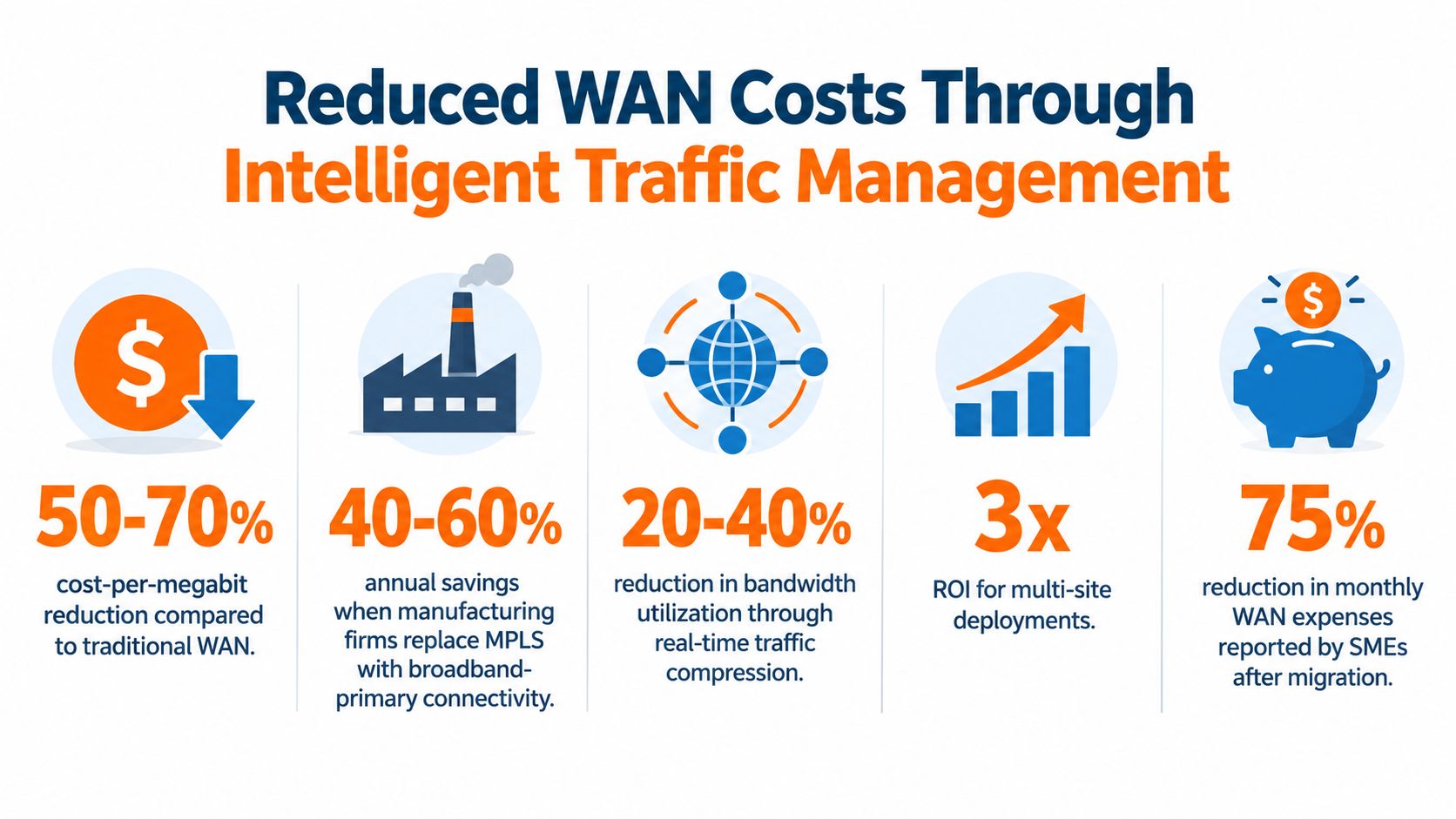
SD-WAN can reduce dependence on expensive private circuits by using multiple connectivity types and selecting a suitable path for each application. That doesn't mean replacing every MPLS circuit with the cheapest broadband package. It means matching transport to business requirements, then using policy and live network conditions to decide how traffic should move.
UK economics make this especially relevant. A 2026 UK industry source says SD-WAN can provide enterprise-grade performance at 40% to 60% lower cost than legacy MPLS, while redundant broadband connections may save 84% compared with equivalent MPLS networks, based on research cited by Amvia's SD-WAN guide. The same source reports that businesses reduce IT staff time spent managing WANs by over 32%, while new office locations can be onboarded 59% faster after implementation.
Where the saving comes from
A manufacturing business might use fibre as its primary path, mobile connectivity for contingency and a private circuit only where production systems genuinely require it. A legal practice could consolidate branch connectivity through a centrally managed design rather than maintaining separate, heavily customised arrangements at every office.
Before migration, analyse actual WAN usage. Identify which applications need predictable latency, which traffic can use broadband and where backup capacity is insufficient. Review carrier contracts at the same time, but don't assume a lower circuit bill equals a lower total cost. Licensing, appliances, support, security services and migration work all belong in the comparison.
Use dashboards to track circuit charges, support effort, failover events and application performance after deployment. A phased migration is usually safer than an abrupt MPLS replacement. Businesses considering the trade-offs should also compare SD-WAN with MPLS before finalising the design.
2. Enhanced Application Performance and User Experience
Users don't experience a WAN as a diagram. They experience it when Microsoft 365 takes too long to respond, a cloud case-management screen stalls or a CAD file transfer fails repeatedly. SD-WAN improves that experience by steering traffic according to application requirements and current path conditions, rather than treating every packet identically.
A financial practice with several offices may prioritise Microsoft 365, voice and payment-related applications over general browsing. An engineering consultancy may assign design-system traffic a different policy from software updates. A manufacturing site may keep operational visibility traffic on a path with suitable latency while sending less sensitive data through another connection.
Performance needs a baseline
Start by profiling applications before changing routes. Record response behaviour, packet loss, jitter and user complaints across sites and times of day. Without a baseline, the business may install SD-WAN and then struggle to prove whether the experience improved.
Quality-of-service policies also need discipline. Prioritising everything creates no priority at all. Define which applications matter to revenue, safety, customer service or compliance, and decide what happens when the preferred path becomes congested.
Practical rule: prioritise business outcomes first, applications second and individual users third.
Real-time steering can improve consistency, but it can't make an under-sized access circuit perform like a high-capacity one. A policy may also move traffic to a path that costs more or has different security characteristics. Test failover with the applications people use, not just with a connectivity probe. Review the rules after seasonal peaks, office moves and major SaaS changes.

3. Seamless Cloud Connectivity and Hybrid Networking
Cloud adoption changes the shape of the WAN. In a traditional design, branch traffic may travel back to a central data centre before reaching Microsoft 365, Azure, AWS or another SaaS platform. That backhauling can add delay and concentrate risk at a central point.
SD-WAN can provide controlled local internet breakout, so suitable cloud traffic takes a more direct route. The business still needs security inspection, identity controls and logging, but it doesn't have to force every cloud session through an architecture designed for an earlier data-centre model.
Match connectivity to the cloud workload
A small business moving to Microsoft 365 may need reliable direct access from every office, not a complex private-cloud design. An engineering firm running workloads in AWS may need carefully selected routes for design applications and storage. A financial practice planning disaster recovery in Azure should consider how users will reach the recovery environment if the primary site or circuit becomes unavailable.
The right design depends on the application. Direct internet breakout may suit SaaS, while critical private-cloud workloads may benefit from a provider-integrated connection such as Azure ExpressRoute or AWS Direct Connect. These options add cost and design work, so use them where predictable performance, data handling or governance justifies the investment.
Review each cloud provider's SD-WAN integration before selecting a platform. Test DNS resolution, identity flows, inspection points and logging, not only raw latency. A cloud strategy should also account for backup, recovery and user access. Businesses reviewing that wider change can assess the benefits of cloud infrastructure for business alongside the network design.
Cloud integration is not automatically better just because traffic avoids the data centre. Poorly governed breakout can bypass inspection, complicate incident response or create inconsistent policies between offices. The benefit comes from combining direct access with deliberate security and operational controls.
4. Improved Network Security and Threat Prevention
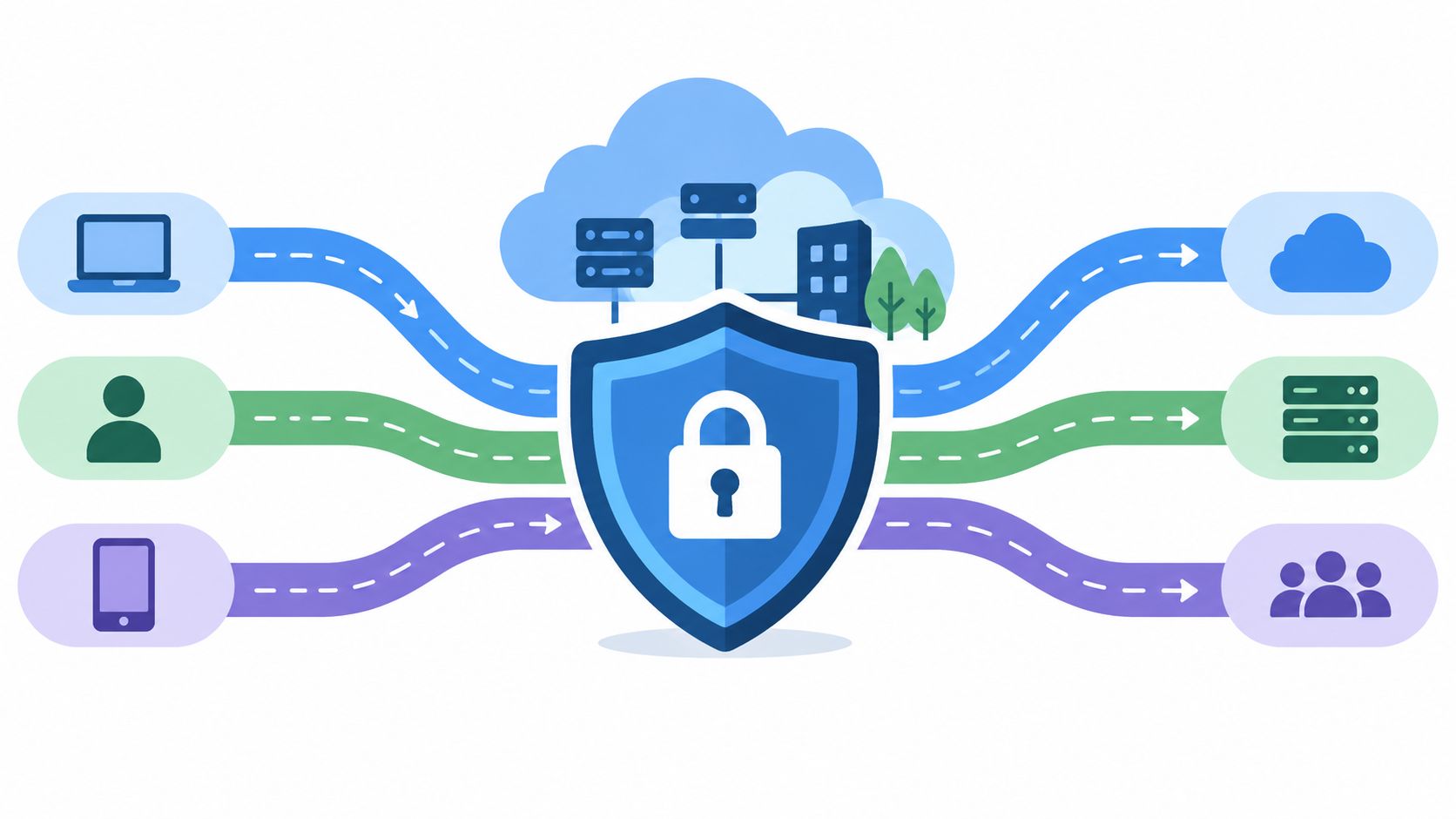
SD-WAN can make security policy more consistent across branches, cloud connections and different access links. It may support encrypted overlays, segmentation, filtering and central policy administration. Those controls are useful for a legal practice with sensitive client data, a manufacturer with operational technology and an SME that can't maintain separate security configurations at every site.
The important qualification is that SD-WAN isn't security by itself. UK enterprises are increasingly treating it as part of a wider SASE and edge strategy rather than a complete protection layer, according to industry reporting on the UK move towards AI-enabled networking and SASE. That distinction matters when a business evaluates identity, endpoint detection, backup, secure access and incident response.
Consistency is the operational gain
A centrally defined policy can make it easier to apply DNS filtering, isolate sensitive traffic and control which sites can reach particular services. Central logging can also help a security team correlate events across locations. For regulated firms, the ability to show who changed a policy and when may be as valuable as the routing function itself.
Integrate SD-WAN with existing endpoint and identity controls rather than treating the edge as a replacement for them. Review whether inspection occurs before or after traffic breaks out to the internet. Confirm how the platform handles administrator access, certificate management, software updates and emergency policy changes.
Security decision: ask how SD-WAN integrates with identity, filtering, endpoint protection and backup. Don't ask only whether the product is secure.
A managed service can be sensible where the business needs continuous monitoring or lacks the capacity to investigate events outside office hours. A provider such as Blowfish Technology can also connect network policy with broader managed IT security services, but the organisation remains responsible for defining its risk and compliance requirements.
5. Business Continuity and Disaster Recovery Resilience
For many UK businesses, resilience is the most commercially important SD-WAN benefit. Ofcom's Connected Nations 2024 report says 1% of UK premises still cannot access decent broadband. It also recorded 1,523 significant fixed and mobile resilience incidents in the year to August 2024, compared with 1,209 in the previous year.
Separate outage research cited in the same verified UK context says 22.4 million UK users were disconnected at least once in the prior twelve months, and 15 million experienced outages lasting three hours or more. Those figures make dual-path design more than a technical preference. A failed link can interrupt payment processing, production visibility, client work or access to cloud systems.
Design for genuine path diversity
SD-WAN can fail traffic over from fibre or broadband to another connection, including 4G or 5G. The design only works as intended if the paths are genuinely independent. Two services delivered through the same duct, carrier or local exchange may fail together.
A manufacturing plant may keep production monitoring available during a primary-link failure. A legal office may preserve access to case systems while engineers resolve a local outage. A financial firm may need documented continuity evidence rather than an informal claim that traffic can fail over.
Define recovery objectives before choosing circuits. Check whether backup capacity can support critical services, even if it can't support normal peak usage. Test failover with documented results, then investigate every unexpected event. Include DNS, authentication, voice, cloud access and security inspection in those tests.
SD-WAN protects connectivity, not every dependency. A solid continuity plan still needs tested backups, recovery procedures and clear ownership. Businesses reviewing that wider requirement can compare cloud backup solutions as part of the same resilience exercise.
6. Centralised Management and Simplified Operations
A distributed WAN becomes difficult when every branch has its own router, policy and troubleshooting history. SD-WAN provides a central control plane for routing, application rules and many security settings. That can give a small IT team a clearer view of what is happening and reduce the need for manual configuration at each location.
A regional legal practice can use consistent policies across offices instead of relying on local fixes. A manufacturer can update a routing rule centrally rather than coordinating changes site by site. An engineering firm can give an internal administrator controlled access to reporting without granting unrestricted configuration rights.

Central control still needs governance
Automation reduces repetitive work, but a bad policy can spread quickly. Document application priorities, segmentation rules, change approval and rollback procedures before deployment. Use role-based access and retain an independent management route for emergencies.
Dashboards should expose more than green status icons. Teams need circuit health, application experience, failover history, configuration changes and capacity trends. A managed provider can add value by watching those signals, opening carrier faults and escalating issues before users report them.
The operating model matters as much as the platform. Decide who owns policy design, who approves changes and who responds to alerts. Train internal staff even when a provider manages the service, because local teams still need to understand the impact of network decisions.
The following video provides additional visual context on centralised SD-WAN management.
A business with limited networking capacity may prefer managed SD-WAN, particularly when it operates several sites or handles regulated data. Self-management can work where the organisation already has strong network engineering, security monitoring and out-of-hours cover.
7. Scalability for Multi-Site and Distributed Operations
Opening a branch, temporary office or production location shouldn't require a completely new network design. SD-WAN can apply a standard configuration to a new edge device, connect it to approved transports and enforce the same application and security policies used elsewhere.
That helps a growing manufacturer bring a new facility online without recreating routing decisions from scratch. An engineering consultancy can support regional offices while keeping central visibility. A legal practice can add a satellite location without giving every branch its own network administration model. During a disruption, a financial or professional-services firm may also need a temporary site with controlled access to essential systems.
Standardise the repeatable parts
Zero-touch provisioning can reduce manual setup, but it doesn't remove the need for preparation. Define device templates, naming, addressing, security zones, monitoring and approval workflows before expansion begins. Keep spare hardware or a documented replacement process for sites where delays would affect operations.
Capacity planning should include the controller, licences, support model and security inspection, not just the number of branches. A small office may need a simple broadband and mobile design, while a production site may require diverse carriers and local survivability.
Growth works best when the next site is a controlled variation of the previous site, not a new exception.
Rapid deployment can also create inconsistency if local requirements aren't recorded. A regulated organisation may need different retention, access or segmentation policies for a particular location. Build those exceptions into governance rather than allowing engineers to make undocumented changes under time pressure.
The benefit is therefore not speed alone. It is repeatable deployment with a known security posture, documented ownership and predictable support. That combination helps SMEs expand without immediately building a large internal networking function.
8. Bandwidth Optimisation and Network Efficiency
SD-WAN can improve the effective use of available bandwidth by identifying traffic, selecting suitable paths and, where supported, applying techniques such as compression, caching or deduplication. This can help a remote engineering office work more effectively over broadband or allow a business to delay an upgrade while it investigates what the traffic is doing.
The result depends heavily on the workload. Text-heavy and repetitive data may benefit from optimisation. Already-compressed video, audio and many modern file formats may see little improvement, while compression can add processing overhead. A business shouldn't buy capacity-saving features without checking whether its traffic can use them.
Measure before optimising
Capture application traffic patterns and peak periods. Identify backup jobs, software updates, video calls, file synchronisation and other traffic that may compete with business-critical systems. Then test compression and deduplication selectively, rather than enabling every option globally.
A manufacturer might separate operational data from large non-urgent transfers. A financial firm could schedule backup traffic so it doesn't compete with customer-facing services. A multi-site organisation may use caching for content that branches repeatedly access, but avoid retaining data locally where governance or confidentiality makes that inappropriate.
Use compression ratios, circuit utilisation, packet loss and application response as validation measures. If the ratio is poor or the processor becomes a bottleneck, the policy may be counterproductive. Capacity testing should include normal operation and failover, because a secondary path may carry a very different mix of traffic.
Bandwidth optimisation isn't a substitute for adequate capacity. It is a way to make informed decisions about where more capacity is necessary and where better traffic management will solve the problem.
9. Compliance and Regulatory Support for Data Protection
SD-WAN can support compliance by making encryption, access control, segmentation, policy enforcement and audit logging more consistent across sites. Those capabilities are useful to legal, financial, healthcare-adjacent and regulated manufacturing organisations, but they don't create compliance automatically.
A legal practice may need to control how client data reaches cloud services and retain evidence of administrative changes. A financial business may separate payment-related traffic from general office activity. A regulated manufacturer may need documented network controls that support an information-security certification process.
Turn technical controls into evidence
Start with the obligation, not the product feature. Identify where data may travel, which users and systems can access it, what logs must be retained and who can approve changes. Then confirm that the SD-WAN platform and service provider can produce the required evidence in a usable format.
Data localisation policies may matter for particular workloads. So may encryption in transit, administrator authentication, vulnerability management and incident escalation. Ask how logs are protected, how long they're retained and whether the organisation can export them for an auditor or investigation.
A central policy model can reduce configuration drift between branches, but it can also make one incorrect rule affect the whole estate. Use change control, staged deployment and rollback procedures. Separate administrative roles where appropriate, and review policies after acquisitions, office moves and changes to cloud services.
SD-WAN should sit within the organisation's wider control framework. Endpoint security, identity governance, backup, staff training and supplier assurance remain necessary. A managed service may help a smaller regulated firm maintain documentation and monitoring, but the firm still needs to approve its risk decisions and understand its responsibilities.
10. Remote Work and Mobile Workforce Support
Remote and mobile employees need access that is secure, reliable and appropriate to the device and application. SD-WAN can extend policy beyond fixed branches through remote-access clients and integrated secure connectivity. That gives an engineering consultant at a project site, a solicitor working from home or a mobile supervisor on a factory floor a more consistent route to business systems.
The design should distinguish between a managed office edge and an unmanaged home network. A remote user may have variable broadband, competing household traffic and a device that needs additional endpoint controls. The network policy must therefore work with device compliance, identity verification and endpoint protection.
Build remote access around the user journey
Test access from different locations before rollout. Check sign-in, multifactor authentication, DNS, printing, voice, file access and cloud applications. A tunnel that connects successfully may still provide a poor experience for the applications employees use all day.
Use application-aware prioritisation carefully. Prioritising a business-critical system can help, but it can't control the entire home connection. Monitor connection quality and give users a clear support route when their local access is the cause.
Remote access also needs an exit plan. Remove access promptly when roles change, require compliant devices and review inactive accounts. Train users to recognise phishing, protect credentials and report unusual behaviour.
Businesses that want to combine connectivity with endpoint and policy support can review a secure remote working setup as part of the design. A managed approach is useful when the organisation needs consistent onboarding, monitoring and troubleshooting for a distributed workforce, rather than a VPN client deployed without operational ownership.
Top 10 SD-WAN Benefits Comparison
| Item | Implementation Complexity 🔄 | Resource Requirements ⚡ | Expected Outcomes ⭐ | Ideal Use Cases 📊 | Key Advantages 💡 |
|---|---|---|---|---|---|
| Reduced WAN Costs Through Intelligent Traffic Management | Medium, appliance deployment, migration planning, carrier renegotiation | Moderate, SD‑WAN appliances, broadband circuits, analytics | Significant cost reduction (50–70% cost-per-megabit); maintained or improved performance | SMEs and multi-site organisations replacing MPLS to cut connectivity spend | Immediate monthly savings; hybrid connectivity; scalable ROI |
| Enhanced Application Performance and User Experience | Medium, QoS policies, app discovery/profiling | Moderate, DPI-capable appliances, monitoring/analytics | Faster app response (≈20–40%); lower latency/jitter; improved UX | Cloud-first firms, SaaS-heavy users, latency-sensitive apps | Application-aware steering; sub-second failover; consistent UX |
| Seamless Cloud Connectivity and Hybrid Networking | Medium–High, cloud API integration and governance setup | Moderate, cloud connectors, edge routing, integration effort | Direct optimized cloud access; reduced latency; simplified migrations | Organisations migrating to cloud or using multi-cloud architectures | Direct-to-cloud routing; hybrid/multi-cloud support; edge security |
| Improved Network Security and Threat Prevention | High, security policy design, SIEM and integration work | High, NGFW-capable appliances, logging, SOC/MSP support | Unified security posture; better threat detection and prevention | Regulated industries and security-conscious SMEs | Centralized policies, edge inspection, reduced attack surface |
| Business Continuity and Disaster Recovery Resilience | Medium, failover policy configuration and testing | Moderate, multiple diverse links (broadband, 4G/5G), monitoring | Reduced downtime; automatic sub-second failover; session continuity | Mission-critical operations, sites with high availability needs | Multi-path redundancy; automatic recovery; preserves transactions |
| Centralized Management and Simplified Operations | Low–Medium, platform onboarding and staff training | Low–Moderate, cloud management console, role-based access | Lower operational overhead; faster policy deployment; fewer errors | Multi-site organisations seeking single-pane control | Automated provisioning; unified dashboards; easier troubleshooting |
| Scalability for Multi-Site and Distributed Operations | Low–Medium, architecture designed for growth and templates | Moderate, zero-touch provisioning, spare appliances, standardized configs | Rapid site onboarding (days vs weeks); consistent policy enforcement | Growing businesses, temporary sites, rapid expansions | Zero-touch deployment; fast time-to-productivity; consistent quality |
| Bandwidth Optimization and Network Efficiency | Medium, tuning compression/deduplication; CPU planning | Moderate, edge processing power, caching, analytics | 20–40% effective bandwidth reduction; improved responsiveness | Bandwidth-constrained sites; organisations deferring upgrades | Compression, deduplication, caching; cost-effective performance gains |
| Compliance and Regulatory Support for Data Protection | High, careful policy configuration, logging and retention planning | High, encryption, audit tooling, compliance expertise | Demonstrable compliance (GDPR/PCI/HIPAA); simplified audits | Legal, financial, healthcare, regulated manufacturing | End-to-end encryption, data localization, detailed audit logs |
| Remote Work and Mobile Workforce Support | Low–Medium, VPN client rollout and endpoint integration | Moderate, client software, endpoint security agents, testing | Secure, consistent remote access and performance for mobile users | Hybrid workforces, field engineers, mobile employees | Seamless VPN and zero-trust access; integrated endpoint security |
Turn SD-WAN Benefits Into a Managed Connectivity Plan
The best SD-WAN decision rarely rests on one benefit. Lower connectivity costs matter, but the business also needs better application performance, direct cloud access, consistent security, resilient failover, central management and enough flexibility for future sites. A design that saves on circuits but leaves staff unable to work during an outage isn't a successful transformation.
Start with the current WAN estate. Document circuit costs, contract dates, providers, access technologies, performance complaints and support effort. Map the applications that matter to revenue, customer service, production, safety and compliance. Separate genuinely critical traffic from traffic that is merely convenient to prioritise.
Then test the proposed architecture against real operating conditions:
- Cost control: Compare circuits, SD-WAN licensing, appliances, support, security services, migration and internal administration. Use total cost of ownership rather than comparing monthly access charges alone.
- Application priorities: Record baseline performance for Microsoft 365, voice, case-management platforms, ERP, CAD, backup and other core systems. Define what should happen when a preferred path degrades.
- Site and carrier diversity: Check whether primary and backup services use separate carriers, routes and local infrastructure. Include mobile failover where a site needs an additional option.
- Security and compliance: Confirm encryption, segmentation, filtering, identity integration, logging, retention, administrator controls and incident escalation. Treat SD-WAN as one layer in a broader security architecture.
- Failover testing: Document recovery objectives, test applications rather than only links, and record the result of each exercise. A failover policy that has never been tested is an assumption.
- Reporting: Require useful information about circuit health, application experience, policy changes, incidents, capacity and service performance.
- Migration: Plan a staged transition, retain rollback options and coordinate carriers, site contacts, security teams and application owners.
Self-managed SD-WAN may suit an organisation with experienced network engineers, established security monitoring and sufficient cover for incidents. Managed SD-WAN is more sensible when internal networking capacity is limited, the business operates multiple locations, data is regulated or users need proactive support. It can also be the better choice when the network must connect with managed security, Microsoft 365, backup, disaster recovery and wider IT operations.
Blowfish Technology is a relevant option for UK SMEs and regulated organisations looking for managed connectivity alongside managed IT, security, cloud, Microsoft 365, backup and disaster recovery services. Its service model can support SD-WAN designs that combine business broadband, fibre and mobile failover, while application-aware routing and central monitoring provide a practical operating framework.
Before committing, ask for a documented design and migration plan. Require clear service levels, a monitoring approach, responsibilities for carrier faults, failover-test procedures and a transparent cost comparison. The right provider should explain not only what the platform can do, but how the service will be operated when a circuit fails, a policy changes or a security incident affects the network.
Blowfish Technology provides managed SD-WAN and connectivity services for UK SMEs and regulated organisations, alongside managed IT, security, Microsoft 365, backup and disaster recovery support. Visit Blowfish Technology to request an SD-WAN assessment and ask for a documented design, migration plan, monitoring approach, service levels and cost comparison.
