
Your team is already using AI. Maybe not through a formal programme, but through Microsoft Copilot trials, ChatGPT in the browser, document summarisation tools, meeting note assistants, CRM add-ons, and vendor platforms that switched AI features on by default. That's the actual starting point for most UK SMEs.
If you run a firm in legal, financial, engineering, or another regulated sector, the tension is obvious. You want the efficiency. You also need control. Staff want faster drafting, quicker analysis, and less admin. You need to know whether client data is being exposed, whether decisions can be explained, and who carries the risk when an AI tool gets something wrong.
That's where AI governance frameworks stop being abstract. They become operational. You're not writing an academic ethics statement. You're deciding what tools are allowed, what data can go into them, which use cases need human review, and how your existing IT and security controls should support all of that. If you want a realistic view of how fast AI has become normal business behaviour, this snapshot on how businesses are already using generative AI is a useful prompt to treat governance as urgent, not optional.
Table of Contents
- The AI Question Facing Every UK Business
- What Is an AI Governance Framework Really
- UK vs EU AI Regulations What SMEs Need to Know
- The Core Components of Your AI Governance Framework
- A Practical Implementation Roadmap for Your Business
- Integrating AI Governance with Your Existing IT and Security
- Frequently Asked Questions on AI Governance
The AI Question Facing Every UK Business
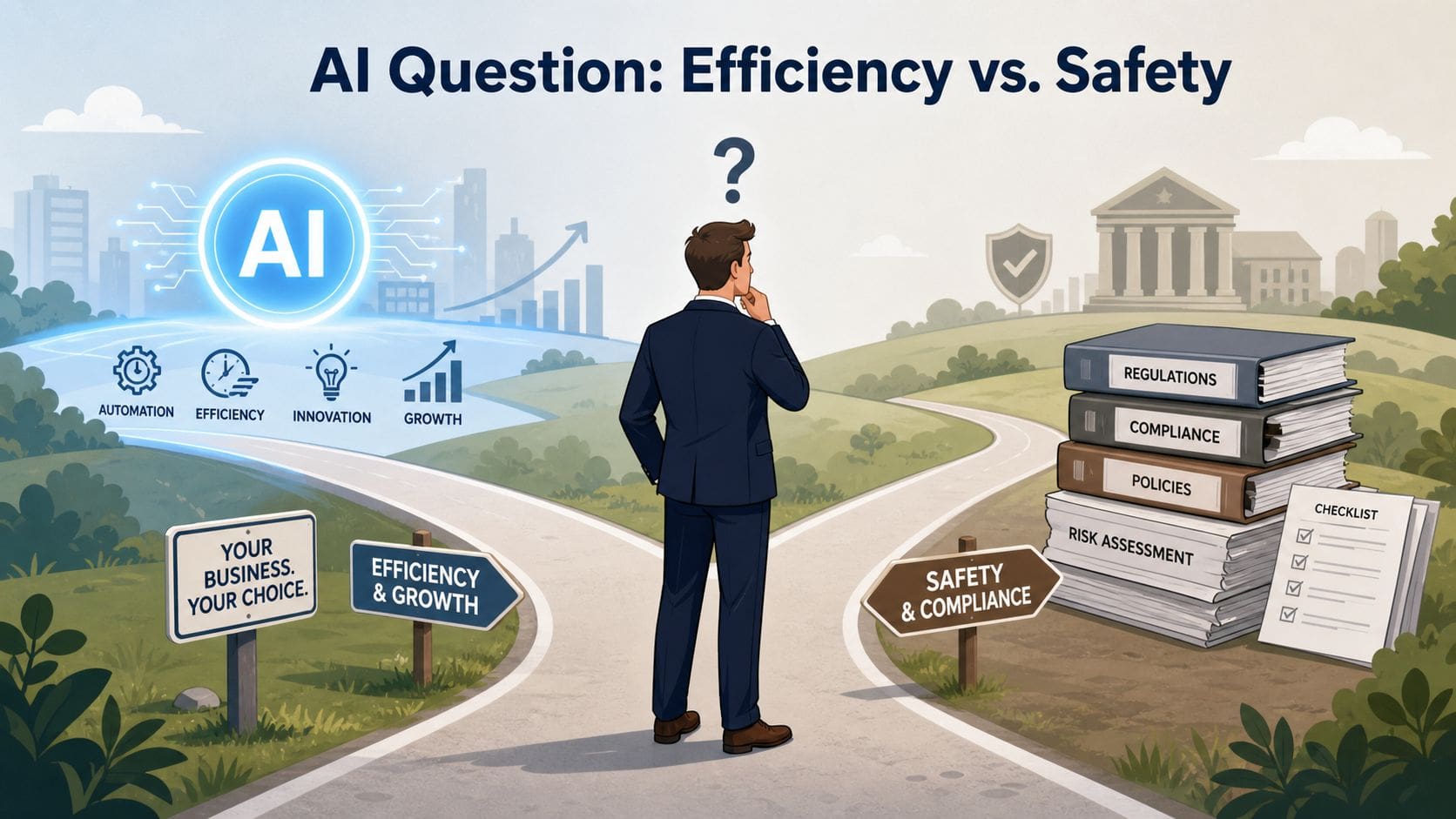
A typical SME director now gets three kinds of pressure at once. Staff ask for AI tools because they save time. Vendors promise competitive advantage. Regulators still expect the same level of accountability you had before AI entered the workflow.
Take a common example. A financial practice uses AI to summarise client communications, draft reports, and help staff search internal knowledge. None of that sounds dramatic. Then someone asks a basic question: can employees paste sensitive personal data into a public tool? Nobody's sure. A month later, the same business is relying on AI output in a regulated client process, but there's still no owner, no approval route, and no record of what tool is doing what.
That's the problem. Most AI risk in SMEs doesn't start with a rogue data science lab. It starts with convenience.
The real business dilemma
You don't need to choose between innovation and caution. You need a framework that makes sensible use possible. Good AI governance frameworks give you a simple operating model:
- What's allowed: Approved tools, approved use cases, approved data types.
- Who decides: A named business owner, IT lead, compliance contact, and escalation path.
- What needs extra control: Anything touching personal data, regulated decisions, or customer-facing outputs.
- What gets blocked: Unapproved tools, unsanctioned data sharing, and automated decisions without review.
Practical rule: If an AI tool can influence client outcomes, HR decisions, financial judgement, or safety, it needs governance before it needs scale.
Why SMEs should treat this as an enabler
A governance framework doesn't slow the business down. It stops the wrong kind of speed. It gives managers confidence to approve useful AI instead of banning everything out of frustration. It also helps staff understand the line between smart use and careless use.
For regulated firms, that matters more than ever. The question isn't whether your business will use AI. It's whether you'll use it deliberately, or spend the next year cleaning up after unmanaged adoption.
What Is an AI Governance Framework Really
Most owners hear “governance” and think paperwork. That's the wrong lens. An AI governance framework is closer to a company handbook for using a powerful tool safely.
If you already have health and safety rules, financial controls, access permissions, data retention policies, or change management, you already understand the model. AI governance frameworks do the same job for AI systems. They set boundaries, assign responsibility, and make sure nobody uses a high-impact tool without checks.
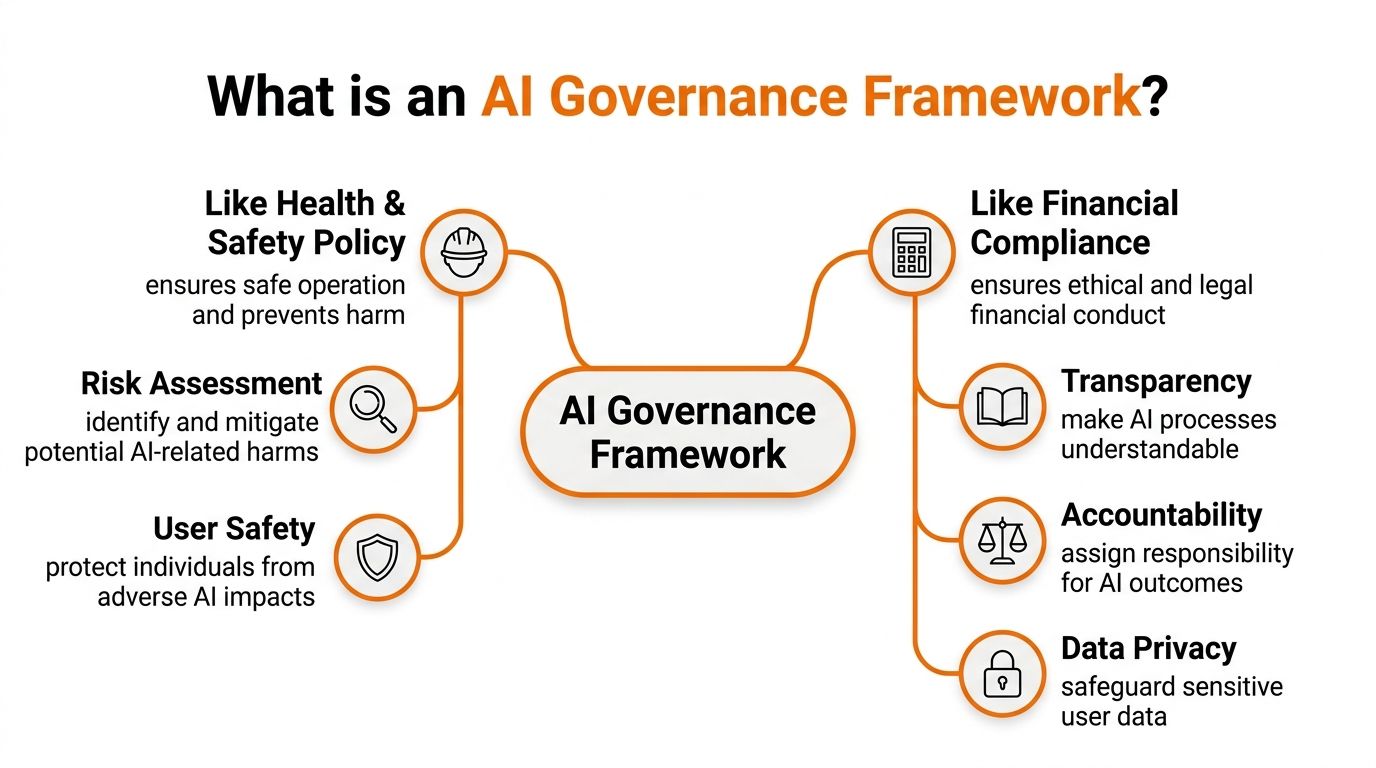
Think of it like health and safety for digital decision-making
You don't let someone install industrial equipment on the shop floor and hope for the best. You ask who owns it, who's trained to use it, what could go wrong, and what controls are in place.
AI needs the same discipline.
In practice, that means asking questions such as:
- Purpose: Why are we using this tool?
- Data: What information goes into it?
- Risk: Could it produce harm, bias, leakage, or bad decisions?
- Oversight: Who checks output before anyone acts on it?
- Record keeping: Can we explain what happened if a client, regulator, or auditor asks?
What a workable framework includes
An SME framework doesn't need a committee with fancy titles. It needs clear decisions and repeatable controls.
| Area | What it means in plain English |
|---|---|
| Ownership | One senior person is accountable for each important AI use case |
| Approval | Staff know which tools they can use and which need sign-off |
| Data rules | Sensitive or regulated data isn't fed into tools without authorisation |
| Monitoring | Someone checks whether outputs remain reliable and appropriate |
| Escalation | There's a process when the tool gets something wrong |
Good governance isn't “trust the AI”. It's “trust the process around the AI”.
Why this matters even if you buy, not build
Most SMEs aren't training models. They're buying software with AI features embedded. That doesn't remove your responsibility. It changes where your attention should go.
You need to govern:
- vendor selection
- data handling
- user permissions
- output checking
- contract terms
- incident response
That's why I advise clients to stop talking about AI as if it sits outside normal operations. If a tool affects service delivery, data handling, compliance, or customer communications, it belongs inside your existing control environment. Treat it like any other business system with risk attached.
UK vs EU AI Regulations What SMEs Need to Know
A compliance lead in a UK financial firm approves an AI feature in a SaaS platform. Two months later, a client asks how decisions were made, the board wants assurance on risk, and the software vendor starts talking about EU AI Act obligations. That is the point where vague AI ethics stops being useful. You need a clear view of which rules apply, who owns the risk, and which controls belong in your existing IT and security stack.
The UK approach gives you flexibility and more responsibility
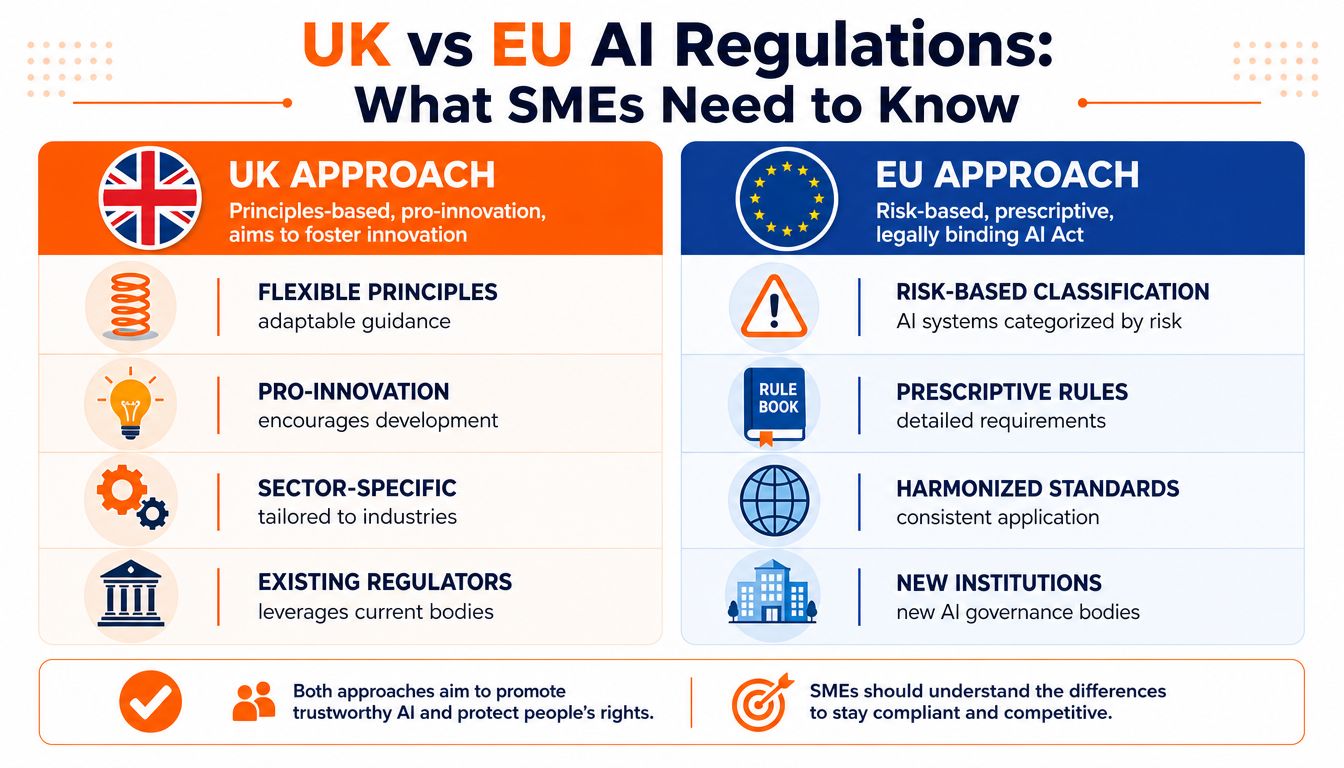
The UK did not introduce a single AI law for all sectors. Instead, the 2023 AI White Paper set out five principles and left enforcement with existing regulators, as explained in this overview of the UK AI governance model.
For UK SMEs in regulated sectors, that means AI governance sits inside the rules you already deal with. ICO expectations still apply to personal data. FCA expectations still apply to operational resilience and consumer outcomes. The SRA, MHRA, Ofcom, and public procurement requirements still matter where relevant. Your job is to show how AI use fits into those obligations, not to wait for a new act to tell you what common sense and existing regulation already require.
That creates more room for judgment. It also creates more room to get it wrong.
The EU approach is stricter and can still affect UK firms
The EU AI Act is more prescriptive. It classifies certain uses by risk level and attaches defined duties to some providers and deployers.
You should care if you sell into the EU, support EU-based clients, process data tied to EU operations, or rely on software vendors adapting their products for EU compliance. In practice, many UK SMEs will feel the effect through contracts, procurement questionnaires, platform terms, and customer due diligence before a regulator ever contacts them.
Here is the practical difference.
| Question | UK position | EU position |
|---|---|---|
| Regulatory style | Principles-led guidance applied by existing regulators | Formal legal duties tied to risk categories |
| Enforcement route | ICO, FCA, SRA, MHRA, Ofcom, CMA, and other sector bodies | AI Act obligations with supervisory enforcement |
| SME impact | You need documented judgment and internal controls | You need system classification, evidence, and supplier alignment |
| Main challenge | Turning broad principles into day-to-day operating rules | Proving your tools and processes meet specific requirements |
Public-sector pressure is pushing this in the same direction. This discussion of government concern over AI and cyber threats is worth your time because the same scrutiny is now showing up in regulated private-sector supply chains.
What to do now if you are a UK SME in a regulated sector
Treat this as an IT, security, and compliance exercise. That is the practical route.
Start with a simple review of every AI-enabled tool already in use. Include Microsoft Copilot features, CRM assistants, call transcription, document drafting, automated triage, chatbots, and any shadow AI staff have adopted without approval. Then sort each use case into one of three buckets: low operational risk, regulated decision support, or high-impact use affecting clients, staff, eligibility, advice, or sensitive data.
Then put these controls in place:
- Name an owner for each material AI use case. One person should approve it, review it, and stop it if needed.
- Check your legal and regulatory exposure. Match each use case to the rules that already govern your business, especially data protection, sector regulation, record keeping, and complaint handling.
- Review supplier terms carefully. Confirm where data goes, whether prompts are retained, how the model is updated, and what audit information the vendor will provide.
- Set user rules inside existing IT controls. Use access controls, DLP, logging, approved app lists, and change management rather than separate AI-only processes where your current systems already do the job.
- Require human review for higher-risk outputs. Staff should not rely on AI output for regulated advice, eligibility decisions, or client communications without a defined check.
- Keep an audit trail. Record why the tool was approved, what data it can use, what the limits are, and how incidents are escalated.
If your business publishes AI-assisted material, your marketing and compliance teams should also align content controls with best practices for ethical AI. That matters for accuracy, disclosure, and brand risk.
The key point is simple. UK rules give you flexibility, but regulated firms still need evidence, controls, and accountability. If you already have IT governance, cyber security, supplier management, and compliance oversight in place, build AI governance into those systems and get your IT partner to help operationalise it. That is faster, cheaper, and far more defensible than treating AI as a separate compliance project.
The Core Components of Your AI Governance Framework
Most SMEs don't need a massive governance programme. They need a framework with enough structure to control risk and enough simplicity for people to follow it.
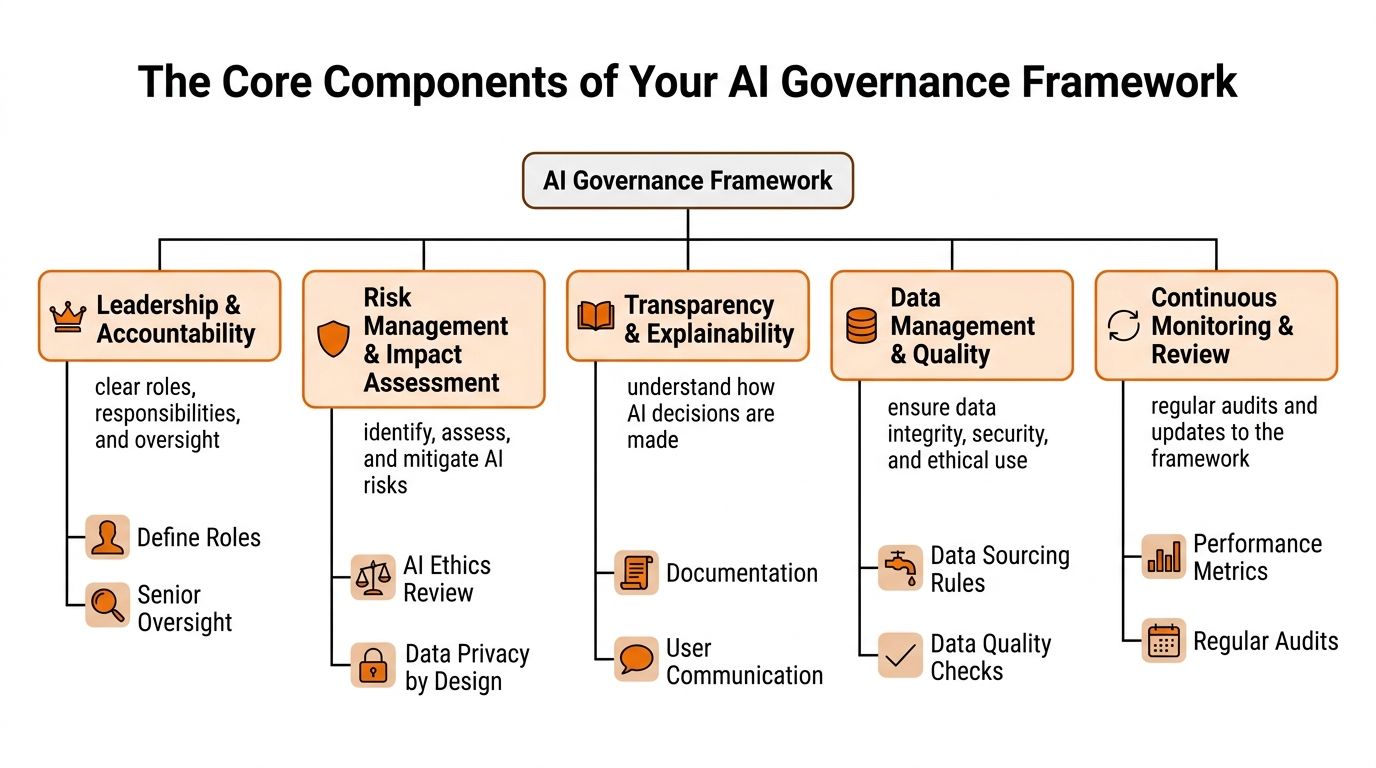
The UK model is risk-based. Low-risk uses such as spam filters need little governance overhead, while high-risk systems affecting rights or safety need tighter controls. Financial services face especially stringent requirements, and the core principles include lawful purpose, technical reliability, fairness, transparency, and contestability, as outlined in this UK AI ethics and governance framework summary.
Start with leadership and accountability
If nobody owns an AI system, nobody controls it.
Assign a senior responsible owner for each meaningful AI use case. That doesn't need to be a full-time AI officer. In an SME, it may be the operations director, compliance lead, IT manager, or departmental head. The key is that one named person signs off on use, understands the risk, and can stop the tool being used if problems emerge.
For a legal firm, that might mean the practice manager owns document drafting AI. For an engineering company, the operations lead may own AI used for maintenance recommendations. For a financial practice, the compliance lead may oversee client-facing analytical outputs.
Build an AI inventory before you write grand policies
You can't govern what you haven't identified.
Create a basic register that includes:
- Tool name and vendor: ChatGPT Enterprise, Copilot, CRM assistant, transcription platform, specialist legal AI, internal bots.
- Business use: Drafting, summarisation, search, analytics, automation, customer service.
- Data involved: Public, internal, confidential, special category, regulated client information.
- Decision impact: Advisory only, human-reviewed, or operationally relied on.
- Owner: The person accountable.
That single register will expose shadow AI faster than any workshop.
Separate low-risk use from high-risk use
Not every AI tool deserves the same approval path. Keep it proportionate.
| Risk level | Example | Governance response |
|---|---|---|
| Low | Summarising internal meeting notes | Basic approval, usage guidance, periodic review |
| Medium | Drafting client communications | Approved tool list, output review, data restrictions |
| High | Supporting lending, hiring, compliance, safety, or legal judgment | Formal assessment, senior sign-off, human review, documented controls |
If the output can affect someone's rights, money, employment, safety, or legal position, treat it as high risk until proven otherwise.
Control the data, not just the tool
The biggest mistake I see is firms approving an AI platform and forgetting that the main risk sits in what staff put into it.
Your framework should define:
- what data can never be entered into public AI tools
- when anonymisation is required
- whether prompts and outputs must be retained
- who can connect AI tools to Microsoft 365, CRM, ERP, or document management systems
- when vendor due diligence is mandatory
For content-heavy teams, this guide to best practices for ethical AI is useful because it turns abstract concerns into practical editorial and operational safeguards.
Demand transparency that normal people can understand
You don't need to reverse-engineer the model. You do need documentation that explains what the system does, where it's used, and what its limits are.
A good internal record answers these questions:
- What is the tool supposed to do?
- What data does it use or access?
- What can go wrong?
- What human checks are required?
- When should use stop and escalate?
That record should sit alongside your wider IT policies and procedures, not in a forgotten innovation folder.
A Practical Implementation Roadmap for Your Business
A compliance lead signs off an AI pilot for document summaries. Three months later, staff are pasting client files into it, nobody can say who approved that use, and an auditor asks for the control record. That is how governance failures start in UK SMEs. Not with a grand strategy mistake, but with a small tool that spreads faster than your controls.
You need a rollout plan that matches how regulated businesses already introduce new systems. Set scope. Name owners. apply controls. Train users. Review what changed. If your MSP or IT partner already helps you manage Microsoft 365, access control, security policy, and audit evidence, use that structure for AI as well.
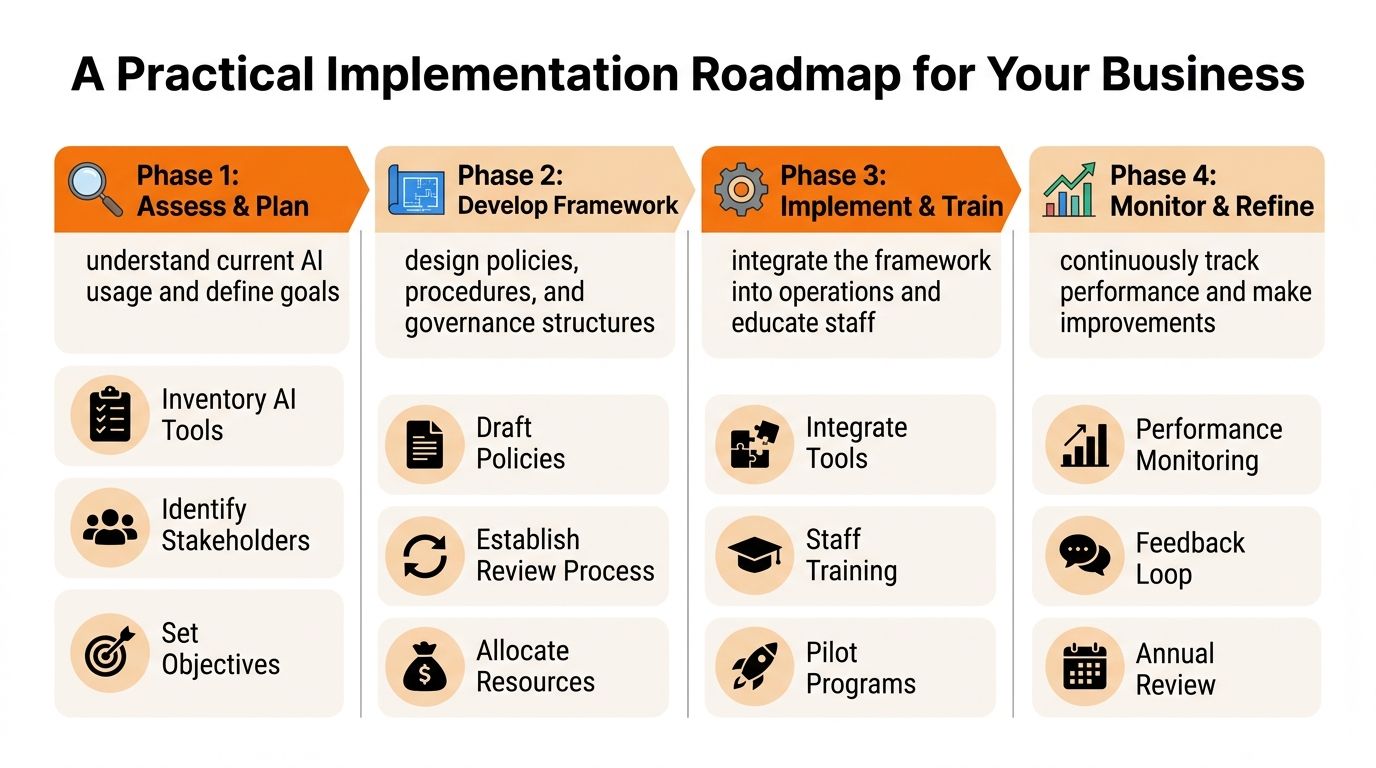
Phase 1 assess what's already happening
Start with a short fact-finding exercise across the business. Do this before you write policy, buy a new tool, or announce an AI programme.
Ask each department head and team manager:
- What AI tools or AI features are staff already using
- What task are they using them for
- What business data, client data, or internal documents go into them
- Who checks the output before it is used
- What happens if the output is wrong
This step matters because hidden use is common. Staff use browser tools, built-in copilots, AI features inside SaaS platforms, and personal accounts. In regulated sectors, a harmless drafting tool can quickly become a decision support tool without anyone formally approving that change.
Record each use case in a simple register. Tool name, purpose, data used, team, owner, risk level, and current controls are enough for a first pass.
Phase 2 classify risk and assign ownership
Once you have the register, sort each use case by business impact and regulatory exposure. Keep the model simple enough that managers can apply it consistently.
| Question | If yes |
|---|---|
| Does it use personal, financial, health, legal, or confidential client data? | Raise the risk rating |
| Does it influence a regulated decision, advice, or customer outcome? | Require formal review |
| Is it customer-facing or externally visible? | Add approval and monitoring |
| Could staff accept the output without checking it properly? | Require human review and written guidance |
Then assign one named owner to each meaningful AI process. That owner is accountable for approvals, review dates, control evidence, and escalation. Shared ownership sounds polite and fails in practice.
Use your existing IT and security risk process where possible. That keeps AI inside the same governance system you already use for software changes, supplier reviews, and incidents. If you need a plain-English primer on the technical side, this guide to AI security risks in business systems is a good reference point for scoping practical exposure.
Phase 3 write the policy and train people
Your first policy should be short, specific, and usable. If it reads like a whitepaper, staff will ignore it and auditors will still ask for the missing evidence.
Cover these points:
- approved and prohibited use cases
- approved tools and procurement rules
- data handling restrictions
- required human checks before use
- incident reporting and escalation
- minimum documentation standards
- review dates and triggers for reassessment
Then train people on the actual rules. Show them which tools are approved, what data they must never paste into public systems, how to check output, and when to stop and escalate to compliance, IT, or a line manager.
High-risk AI use also needs a clear record. In UK regulated businesses, you should be able to show what the tool does, where it is used, who owns it, what data it touches, what checks are required, and how problems are reported. Vendor marketing material is not evidence. Your internal record is.
A short explainer like the video below can help non-technical stakeholders grasp the operational side before you roll policies out.
Phase 4 monitor, review, and tighten
AI use changes quickly. The approved use case in month one is rarely the actual use case in month six.
Set a recurring review with a practical checklist:
- Check usage drift: Is the tool now being used for tasks beyond the original approval?
- Review output quality: Are staff finding errors, bias, or fabricated content?
- Recheck access: Do permissions still match job roles and current responsibilities?
- Test incident response: Can you respond if data is exposed, output causes harm, or a decision is challenged?
- Review supplier changes: Has the vendor changed features, data handling, or model behaviour?
If you are moving from simple assistants to tools that can take actions, trigger workflows, or interact with other systems, governance needs to tighten. Read mastering AI agent control before you approve that next step. Agents create access, delegation, and monitoring problems that basic chatbot rules do not cover.
The right standard for SMEs is not perfection. It is control you can prove. If your team can show what is in use, who owns it, what data it handles, what checks apply, and when it was last reviewed, you are in a far stronger position with regulators, clients, insurers, and your own board.
Integrating AI Governance with Your Existing IT and Security
AI governance should plug into controls you already own. If it sits in a separate document with no technical enforcement, staff will bypass it.
Start with identity and access. If a user shouldn't access sensitive client files, they also shouldn't be able to connect an AI tool to those files. Your Microsoft 365 permissions, conditional access rules, MFA, device compliance policies, and joiner-mover-leaver process already provide the backbone. Extend them to AI-enabled tools instead of inventing a parallel regime.
Use your existing security stack to support enforcement
Managed EDR won't tell you whether an AI summary is fair, but it can help you spot unapproved applications, risky browser behaviour, and suspicious data movement. DNS filtering can reduce access to unsanctioned AI sites. Email security can help prevent prompt-injection-style phishing and malicious links hidden inside AI-generated messages. Backup matters too. If staff start relying on AI-assisted editing in Microsoft 365, you still need recoverability when bad output or accidental overwrites spread quickly.
A practical guide on mastering AI agent control is worth reading if you're moving beyond simple copilots into task-running agents, because those systems introduce access, delegation, and monitoring issues that standard app governance won't fully cover.
Treat data classification as the control point
Most governance failures happen because nobody linked AI use to data classification.
If you already label information in Microsoft 365, use that structure. Define what happens when data is public, internal, confidential, or highly sensitive. Then map those labels to AI rules. Public marketing copy may be fine in an approved tool. Client contracts, HR files, case notes, and regulated financial material usually need much tighter restrictions.
That's also where broader AI security risks in business systems become operational, not theoretical. Prompt leakage, over-permissioned integrations, and unchecked plug-ins are security problems first and AI problems second.
Don't separate governance from service management
If your MSP or internal IT team already runs change control, supplier reviews, security awareness training, incident response, and policy enforcement, AI belongs there. Add AI checks to procurement. Add AI scenarios to user training. Add AI-related events to incident playbooks.
That's how AI governance frameworks become sustainable. Not as a standalone initiative, but as an extension of disciplined IT operations.
Frequently Asked Questions on AI Governance
Do we need a framework if we only use public AI tools
Yes. Public tools create governance issues faster, not slower. Staff can upload sensitive information, rely on weak output, or use unapproved tools without procurement ever knowing. A lightweight framework is still necessary. In fact, it's often most urgent there.
Isn't this just part of our data protection policy
Not quite. Data protection is one piece. AI governance also covers accountability, risk classification, human oversight, vendor control, explainability, and operational monitoring. Your data protection policy helps, but it doesn't answer who approves AI use or what to do when an AI-generated output affects a regulated decision.
How much does implementation cost
Cost depends on complexity, existing controls, and how many systems you need to govern. For most SMEs, the first step is less about buying new software and more about using existing IT, security, and compliance processes properly. Start with inventory, ownership, policy, and training. Add specialist tooling only where the risk justifies it.
Is this a one-off project
No. It starts as a project and becomes an operational discipline. Tools change, vendors add features, staff find workarounds, and use cases creep into higher-risk areas. Review has to be ongoing.
What if a vendor says their AI is compliant
Treat that as a starting point, not proof. You still need to assess how your business uses the tool, what data goes into it, and whether staff rely on it appropriately. Vendor claims don't remove your responsibility.
What's the quickest win for a busy SME
Do three things this month:
- Create an AI inventory: Find every tool already in use.
- Name owners: Put one person in charge of each important use case.
- Publish basic rules: Approved tools, banned data, mandatory human review.
For a useful companion read on limiting wider information risk, this guide to data breach prevention helps reinforce the discipline around data handling that AI governance depends on.
If your business needs a practical AI governance framework that fits your existing IT, compliance, and security controls, speak to Blowfish Technology. They help UK SMEs turn complex technology risk into clear operational standards, with the managed IT support, Microsoft 365 expertise, cybersecurity controls, and policy guidance needed to make AI adoption safer and easier to manage.

The Blowfish Technology team. Managed IT, cloud services, software development and connectivity for North West businesses since 1999.