
A suspicious login appears on a staff account late at night. At the same time, a large file transfer begins from a server that normally handles routine business documents. The firewall is still running, antivirus reports no obvious malware, and nobody notices the warning until the next morning.
This is the gap an intrusion detection system, or IDS, is designed to address. It watches for signs that network traffic, devices, or users are behaving in a way that deserves investigation. It doesn't replace a firewall, endpoint protection, backups, or incident response. It adds an early-warning layer, giving your team a chance to investigate suspicious activity before it becomes a serious business interruption.
Table of Contents
- Introduction Why Early Detection Matters for SMEs
- What an Intrusion Detection System Is and How It Works
- Types of IDS and Detection Methods Explained
- How IDS Compares with IPS and Other Security Tools
- Deploying IDS in SME Environments That Actually Works
- Common Pitfalls Compliance Considerations and Lessons from History
- Choosing the Right Path and Next Steps for Your Business
Introduction Why Early Detection Matters for SMEs
Small and medium-sized businesses often have the same exposure points as larger organisations, but fewer people watching them. A remote worker might sign in from an unfamiliar location, a supplier connection might behave differently from usual, or an employee account might access systems outside its normal role. None of these events automatically proves an attack. Together, however, they can form a pattern that a detection system should highlight.

The important distinction is that an IDS normally detects and alerts, rather than stopping traffic itself. Think of it as a burglar alarm. A lock makes entry harder, while an alarm tells someone that suspicious activity may be taking place. That alert only creates value when a person, service provider, or security platform reviews it and decides what to do.
A late response gives an intruder more time to explore systems, obtain credentials, move between devices, or access sensitive information. Early detection doesn't guarantee that an organisation will avoid every consequence, but it improves visibility at the point where investigation and containment are still possible.
Practical rule: Treat IDS as part of a chain, not as a standalone product. Detection, investigation, containment, recovery, and learning all need to connect.
The UK's national cyber-defence history reflects this progression. In June 2003, GCHQ specialists investigated the first cyber-attack response against the UK Government after a government employee noticed suspicious activity on a workstation. The National Cyber Security Centre account of that incident describes it as a forerunner to the capability that became the NCSC in 2016. For an SME, the lesson is straightforward: spotting unusual behaviour early has long been a foundation of serious cyber defence.
Businesses reviewing their wider exposure can also use this cybersecurity guidance for SMEs to consider how detection fits alongside identity controls, endpoint security, staff awareness, and recovery planning.
What an Intrusion Detection System Is and How It Works
The simplest answer to what is intrusion detection system technology is this: it monitors activity, compares what it sees with known or expected behaviour, and raises an alert when the activity looks suspicious.
An office analogy helps. A door lock is a preventative control. It tries to stop unauthorised entry. An alarm is a detection control. It notices a possible breach and notifies someone. An IDS is closer to the alarm, although modern systems can inspect far more than a single door.
An IDS watches for indicators of compromise and suspicious patterns, then gives an analyst or monitoring service evidence to investigate.
The basic operating cycle
Most deployments follow a practical sequence:
- Collect signals. A network sensor may inspect traffic at an internet boundary or inside a critical segment. A host sensor may collect operating-system, application, process, or file activity from an individual device.
- Compare activity. The system checks what it sees against signatures, protocol rules, policy violations, or a behavioural baseline.
- Create an alert. A potential match becomes a security event. The event may include the source, destination, service, time, rule involved, and supporting log information.
- Review the context. An analyst or managed service checks whether the alert represents a real threat, an approved business action, or an expected technical event.
- Respond. The organisation may isolate a device, disable an account, block a connection through another control, investigate logs, or escalate into its incident response process.
The NCSC describes IDS as a passive control at a trust boundary. It can monitor traffic for known attack signatures, protocol violations, and behavioural anomalies, then alert operators. The same NCSC guidance on detection approaches stresses that rules and signatures need maintenance and tuning for the environment where the tool operates.
That last point matters. A system that doesn't understand normal business traffic may generate alerts for routine backups, software updates, vulnerability scans, or authorised administration. A system with weak coverage may miss activity that doesn't match its rules. Good IDS operation therefore combines telemetry, current detection content, environmental knowledge, and human triage.
If your organisation is also formalising information governance, resources covering digital compliance strategies can help connect security monitoring with wider data-handling responsibilities.

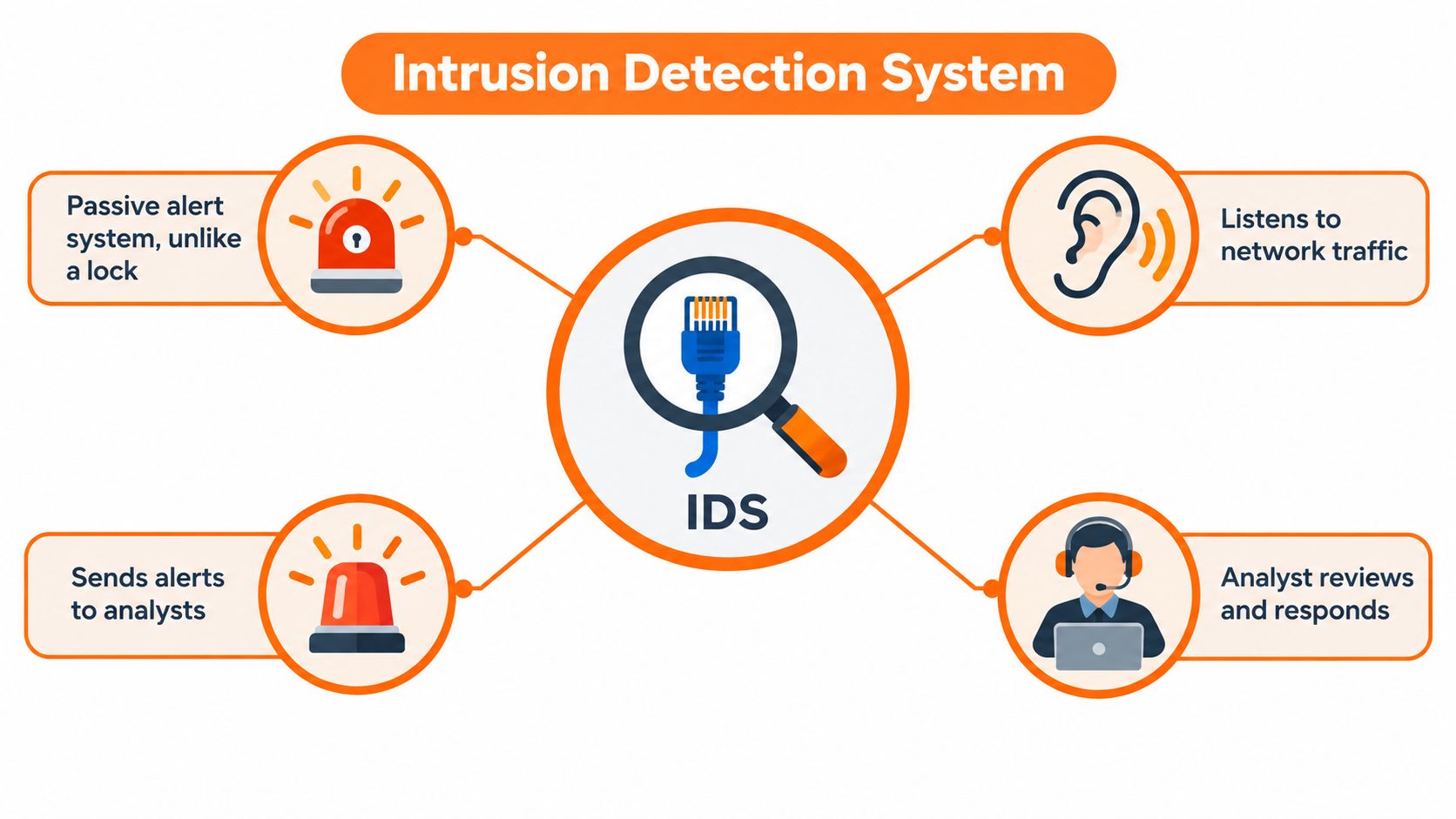
A short visual explanation can make the difference between an alert and a response clearer:
Types of IDS and Detection Methods Explained
IDS choices have two separate dimensions. The first is where the system observes activity. The second is how it decides that activity is suspicious. Keeping those dimensions separate prevents a common mistake, choosing a detection method without considering what the sensor can see.
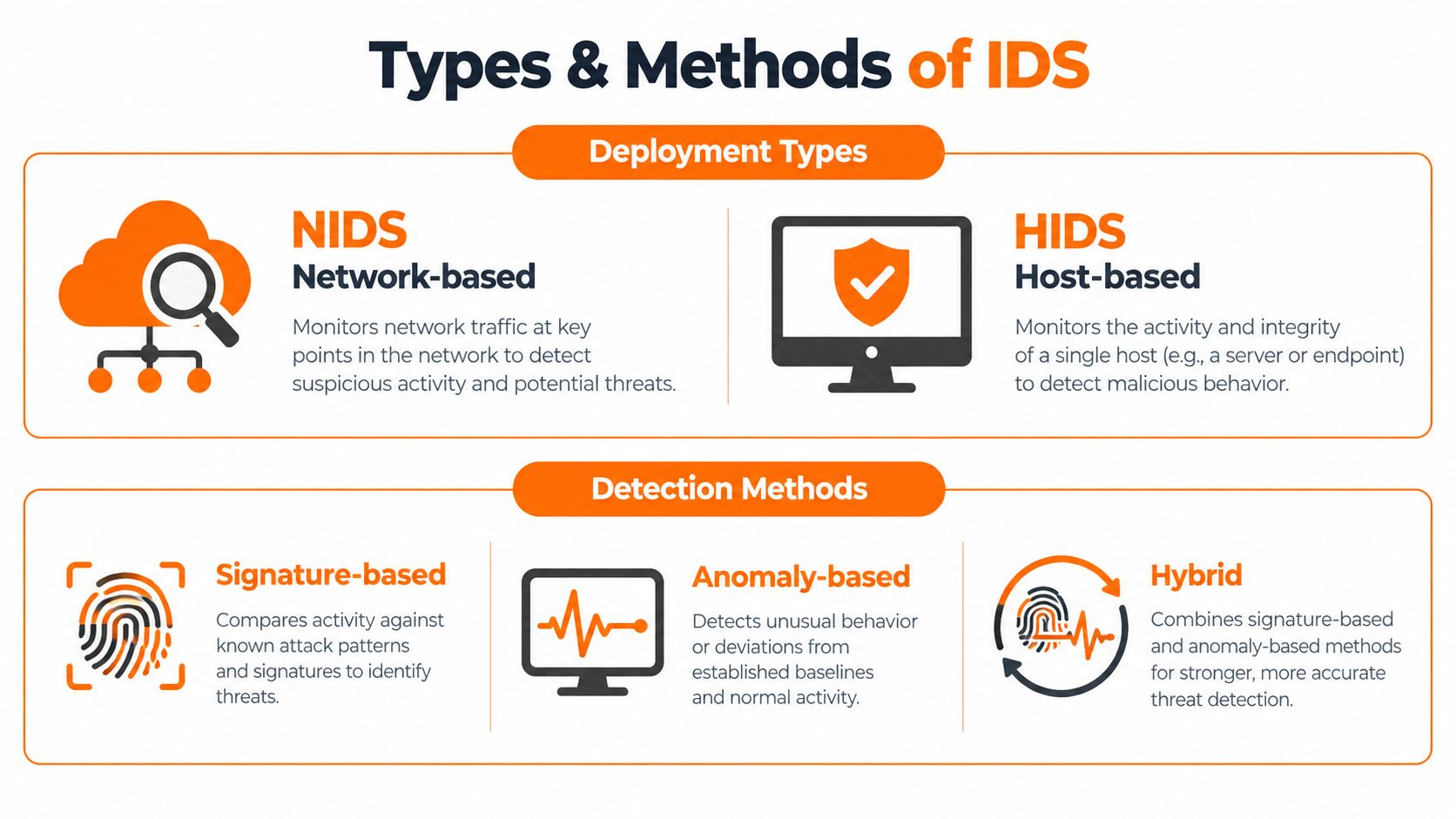
Network-based and host-based monitoring
A network intrusion detection system, or NIDS, observes traffic moving across a network. SMEs commonly consider it at the internet boundary, between sites, around important servers, or on internal segments where lateral movement would create serious risk.
A host intrusion detection system, or HIDS, runs on an individual endpoint or server. It can examine local logs, processes, file changes, application activity, and other host-level signals. HIDS provides depth on a device that network monitoring may not see, particularly when traffic is encrypted or an attacker is using legitimate credentials.
Neither type provides complete visibility by itself. NIDS gives broader network context, while HIDS supplies detailed evidence about what happened on a particular machine.
Signature, anomaly, and hybrid detection
Signature-based detection looks for known patterns. It can be effective when a rule matches a recognised attack, protocol violation, or indicator of compromise. Its limitation is clear: new techniques or small variations may not match existing content.
Anomaly-based detection establishes a picture of expected behaviour and flags meaningful deviations. It can identify activity that doesn't resemble known signatures, but normal business behaviour changes over time. Without a useful baseline, anomaly detection can produce too many alerts or miss subtle activity.
Hybrid detection combines both approaches. It uses known-threat intelligence for recognisable attacks and behavioural analysis for activity that falls outside the expected pattern. This generally provides broader coverage, but it also creates more tuning and triage work.
NIDS vs HIDS and Detection Methods at a Glance
| Category | What It Monitors | Strengths | Limitations |
|---|---|---|---|
| NIDS | Network traffic at boundaries and internal segments | Broad visibility across connections and services | May have limited insight into encrypted traffic or host activity |
| HIDS | Host logs, processes, applications, and file activity | Detailed evidence from critical devices | Requires deployment, maintenance, and capacity on each selected host |
| Signature-based | Known attack patterns and rule matches | Clear matches for recognised threats | Can miss new or modified techniques |
| Anomaly-based | Deviations from an established baseline | Can highlight unfamiliar behaviour | Legitimate changes can create false positives |
| Hybrid | Signatures and behavioural indicators together | Balances known-threat coverage with discovery | Needs careful tuning and stronger operational oversight |
A sensible design often combines the types selectively. Put network sensors where they can see important traffic, then use host-level monitoring on critical servers, identity systems, or high-value workstations. The right combination depends on the business's architecture, data sensitivity, connectivity, and ability to investigate alerts.
How IDS Compares with IPS and Other Security Tools
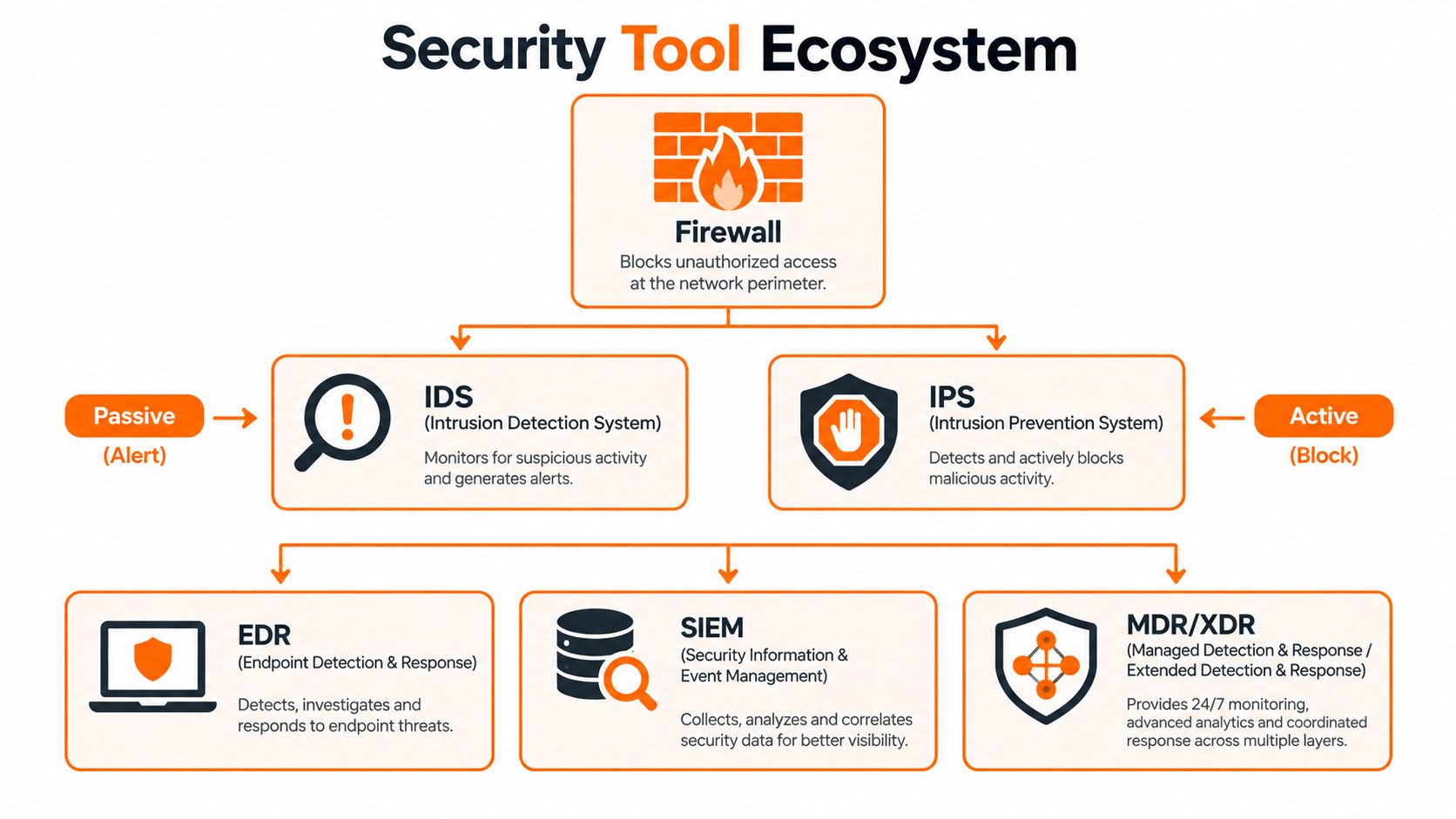
IDS and IPS are related, but they make different operational choices. An intrusion detection system observes and reports. An intrusion prevention system, or IPS, usually sits inline and can take an active action, such as blocking traffic, when a rule identifies a threat.
That doesn't make IPS a universally better IDS. Automatic blocking can stop some attacks quickly, but an incorrect decision can interrupt a legitimate service. Passive detection gives a security team more opportunity to examine context before changing traffic or access.
The tools have different jobs
| Tool | Primary role | Typical question it answers |
|---|---|---|
| Firewall | Control permitted connections | Should this connection be allowed? |
| IDS | Detect suspicious activity | Does this traffic or behaviour look hostile? |
| IPS | Detect and enforce | Should this connection be blocked or interrupted? |
| EDR | Monitor and respond at endpoints | What happened on this device, and can it be contained? |
| SIEM | Collect and correlate events | Do separate alerts form a meaningful incident? |
| MDR/XDR | Provide broader monitoring and response | Who will investigate and act when alerts arrive? |
A firewall applies access rules, but it doesn't provide the same depth of behavioural detection. EDR focuses on endpoints, including process activity and device response. A SIEM brings logs and alerts together so an analyst can correlate a suspicious network connection with an unusual login or server event. MDR and XDR add monitoring, investigation, and response capabilities across a wider set of signals.
For managers comparing endpoint monitoring with network detection, this explanation of endpoint detection and response provides useful context. EDR and IDS can complement each other because they observe different parts of the same event.
The UK threat environment also makes simple signature-only thinking increasingly risky. In its 2025 annual review, the NCSC reported 1,727 incident tips triaged into 429 incidents requiring intervention, including 18 highly significant incidents. The review also recorded a 50% year-on-year increase in highly significant cases, as reported in the NCSC's reports and advisories. The NCSC warned that AI is expected to make cyber-intrusion operations more effective and efficient through 2027, which reinforces the need for layered detection and regularly maintained rules.
Deploying IDS in SME Environments That Actually Works
An IDS works best when it sees the traffic and systems that matter most to the business. Installing a sensor at the internet edge is a sensible starting point, but it shouldn't be the entire design. An attacker who gains access through a compromised account or device may operate inside the network, where perimeter-only monitoring has limited visibility.
Start with the right observation points
The NCSC recommends applying NIDS to internal business-critical network zones, not just external boundaries. NHS network-monitoring guidance also highlights routers and gateways between the network and the internet, third-party networks, and connected medical devices, with logs collected and analysed continuously. Those principles translate well to regulated SMEs.
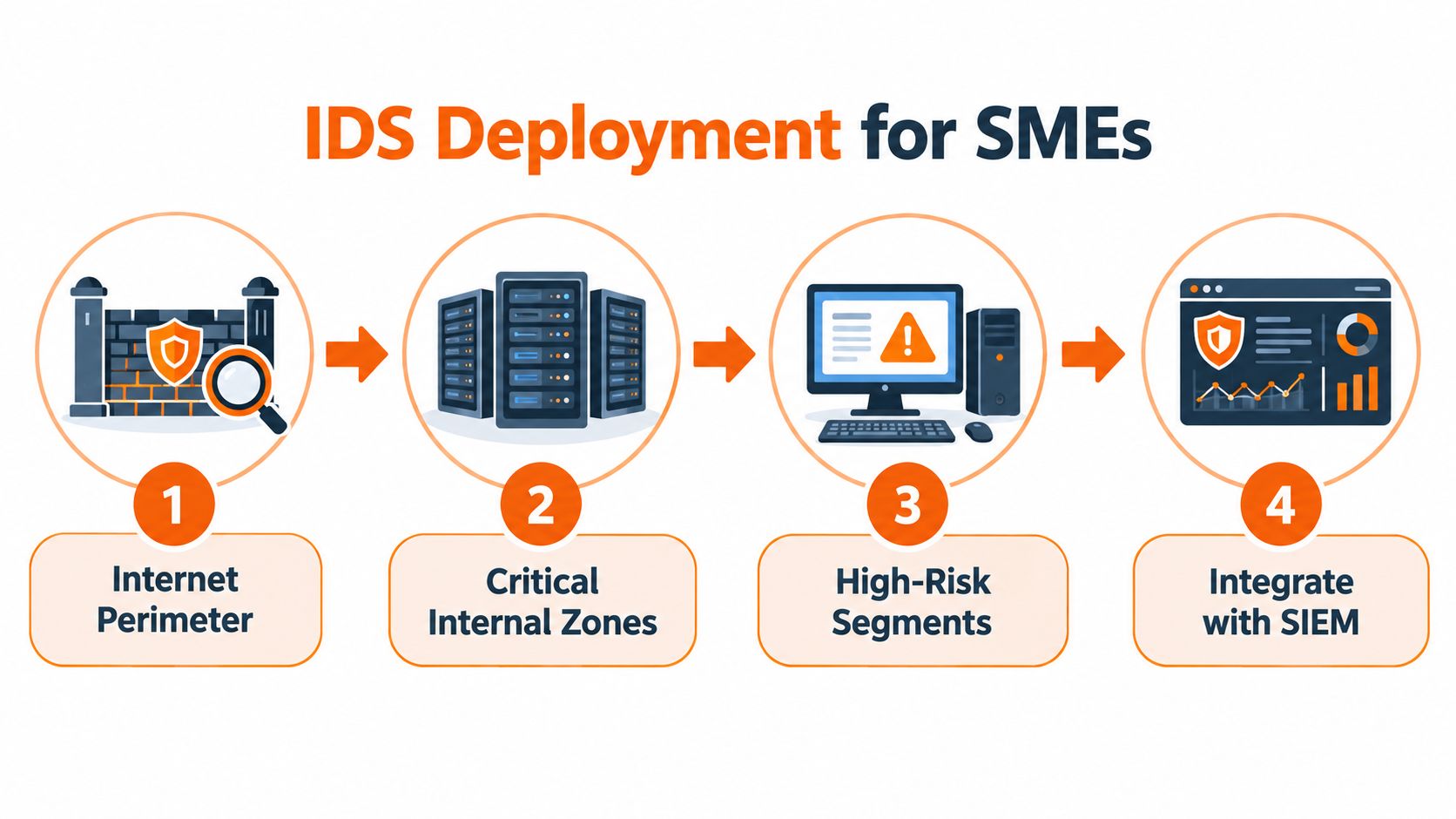
A practical placement exercise should identify:
- Internet boundaries: Monitor traffic entering through routers, gateways, remote-access services, and hosted connections.
- Critical internal zones: Prioritise servers supporting finance, legal files, production systems, identity, backups, and line-of-business applications.
- High-risk segments: Consider areas containing privileged administration systems, engineering workstations, operational technology, guest devices, or third-party access.
- Cloud and site connections: Review how traffic moves between offices, cloud services, remote users, and suppliers. A sensor can't protect traffic it can't observe.
Make the alert workflow manageable
Begin by documenting normal activity. Record legitimate vulnerability scanning, backup jobs, administrator access, software deployment, and expected data transfers. Then tune rules so those known events don't obscure higher-risk signals.
Every alert also needs ownership. Decide who receives it, who assesses severity, what evidence they collect, and which actions require approval. Sending every notification to an already busy administrator creates the same operational problem seen in other monitoring systems. Guidance on managing notification overload in WordPress offers a useful general lesson: notifications need prioritisation, grouping, and clear ownership.
Connect IDS events to central log collection or a SIEM where possible. Correlation can show that a network alert occurred alongside an unusual account login, endpoint process, or file access event. The cyber security monitoring services available to SMEs can be considered when the business needs continuous review but doesn't have a dedicated security operations team.
Common Pitfalls Compliance Considerations and Lessons from History
Many IDS deployments fail without notice. The software stays installed, alerts keep arriving, and nobody has enough context or time to decide which events matter. Poor tuning turns useful signals into background noise, while weak sensor placement leaves internal movement unseen.
UK research shows why detection coverage requires ongoing engineering. A 2022 Middlesex University survey found that the IDS examined covered only 25% of the authors' proposed threat taxonomy. The survey also identified datasets containing deprecated threats and lacking realistic real-network attack representation, limiting machine-learning IDS accuracy. The Middlesex University research record supports a practical conclusion: an IDS is never a finished installation.
Common causes of disappointment
- Static rules: Threats change, so signatures and detection logic need regular review.
- Weak baselines: A system cannot judge unusual activity well without a useful picture of normal business behaviour.
- Perimeter-only coverage: Internal lateral movement may remain unseen after an attacker enters the network.
- Unassigned alerts: A notification without a named investigator is not a response process.
- Unproven recovery: Detection has limited value if the organisation has not planned how to contain affected accounts, devices, and services.
Compliance can strengthen the business case for legal, finance, engineering, manufacturing, and healthcare organisations. Cyber Essentials, customer security questionnaires, contractual controls, and CAF-aligned expectations may require evidence that the business understands its protective monitoring and incident response responsibilities. IDS is not a certificate by itself. Proper deployment can support documented detection and investigation, provided the organisation records how alerts are handled.
History also shows why visibility and response must develop together. The UK's early state-sponsored attack response and later public-sector security capability marked a shift from ad hoc reaction towards formal security operations. SMEs do not need government architecture, but they do need a clear relationship between monitoring, investigation, and action.
Testing can expose gaps that IDS rules miss. Material about ThreatExploit AI CMMC pentesting offers a comparison point for how security testing can support compliance evidence. An IDS does not replace testing, and testing does not provide continuous detection. Used together, they show whether controls work and whether suspicious activity can be identified between assessments.
A documented incident response planning process gives alerts a defined destination. It should identify decision-makers, evidence to preserve, containment steps, and approval limits. For a UK SME without a SOC, that clarity often determines whether an alert becomes a managed incident or an overlooked notification.
Choosing the Right Path and Next Steps for Your Business
The right IDS arrangement depends less on the product name than on whether someone can operate it reliably. An SME with experienced security staff, central logging, clear escalation procedures, and time for regular tuning may manage selected sensors internally. A business without those capabilities may gain more from a managed detection service that watches alerts, investigates context, and supports response.
Use these questions to choose a realistic path:
- Coverage: Can the proposed design see internet boundaries, critical internal zones, and high-risk segments?
- Tuning: Who will maintain rules, update detection content, and review false positives?
- Response: Who acts outside office hours, and what can they isolate or disable?
- Evidence: Can the business demonstrate monitoring, investigation, and follow-up to customers or auditors?
- Integration: Will IDS events connect with EDR, identity monitoring, backups, and incident response records?
- Capacity: Does the team have the time and skill to investigate alerts rather than just collect them?
A sensible starting point is a focused pilot around a high-value service or internal zone. Measure usefulness qualitatively by asking whether alerts arrive with enough context, whether staff can triage them, and whether the process leads to practical action. If those tasks consistently compete with normal IT work, managed monitoring may be the safer operational choice.
Blowfish Technology offers managed EDR with security-analyst monitoring, managed ITDR for Microsoft 365 identity protection, and broader managed security support for UK SMEs. Visit Blowfish Technology to discuss where IDS, endpoint detection, identity monitoring, and incident response can fit into a practical security plan.
